


Reassortant Eurasian Avian-Like Influenza A(H1N1) Virus from a Severely Ill Child, Hunan Province, China, 2015
Supporting Files
Public Domain

-
Nov 2016
-
File Language:
English
Details
-
Alternative Title:Emerg Infect Dis
-
Personal Author:Zhu, Wenfei ; Zhang, Hong ; Xiang, Xingyu ; Zhong, Lili ; Yang, Lei ; Guo, Junfeng ; Xie, Yiran ; Li, Fangcai ; Deng, Zhihong ; Feng, Hong ; Huang, Yiwei ; Hu, Shixiong ; Xu, Xin ; Zou, Xiaohui ; Li, Xiaodan ; Bai, Tian ; Chen, Yongkun ; Li, Zi ; Li, Junhua ; Shu, Yuelong
-
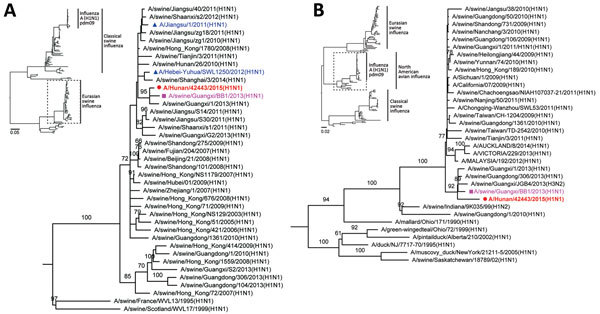
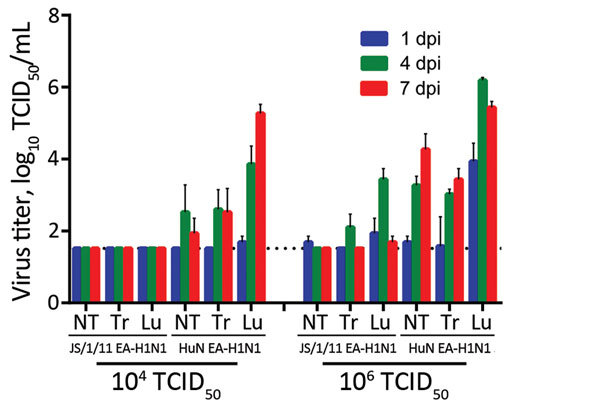
Description:In 2015, a novel influenza A(H1N1) virus was isolated from a boy in China who had severe pneumonia. The virus was a genetic reassortant of Eurasian avian-like influenza A(H1N1) (EA-H1N1) virus. The hemagglutinin, neuraminidase, and matrix genes of the reassortant virus were highly similar to genes in EA-H1N1 swine influenza viruses, the polybasic 1 and 2, polymerase acidic, and nucleoprotein genes originated from influenza A(H1N1)pdm09 virus, and the nonstructural protein gene derived from classical swine influenza A(H1N1) (CS H1N1) virus. In a mouse model, the reassortant virus, termed influenza A/Hunan/42443/2015(H1N1) virus, showed higher infectivity and virulence than another human EA-H1N1 isolate, influenza A/Jiangsu/1/2011(H1N1) virus. In the respiratory tract of mice, virus replication by influenza A/Hunan/42443/2015(H1N1) virus was substantially higher than that by influenza A/Jiangsu/1/2011(H1N1) virus. Human-to-human transmission of influenza A/Hunan/42443/2015(H1N1) virus has not been detected; however, given the circulation of novel EA-H1N1 viruses in pigs, enhanced surveillance should be instituted among swine and humans.
-
Subjects:
-
Source:Emerg Infect Dis. 22(11):1930-1936.
-
Pubmed ID:27767007
-
Pubmed Central ID:PMC5088044
-
Document Type:
-
Genre:
-
Place as Subject:
-
Location:
-
Volume:22
-
Issue:11
-
Collection(s):
-
Main Document Checksum:urn:sha256:232ffae7117ffbb2bdc8603017ebcd910b4e1e8a46790135690f5b28ccbaab7f
-
Download URL:
-
File Type:
 [PDF
- 2.38 MB
]
[PDF
- 2.38 MB
]
Supporting Files


File Language:
English
ON THIS PAGE






CDC STACKS serves as an archival repository of CDC-published products including
scientific findings,
journal articles, guidelines, recommendations, or other public health information authored or
co-authored by CDC or funded partners.
As a repository, CDC STACKS retains documents in their original published format to ensure public access to scientific information.
As a repository, CDC STACKS retains documents in their original published format to ensure public access to scientific information.
You May Also Like
COLLECTION
Emerging Infectious Diseases