


Marburg Virus Infection Detected in a Common African Bat
Supporting Files
Public Domain

-
08/22/2007
-
File Language:
English
Details
-
Alternative Title:PLoS One
-
Personal Author:
-
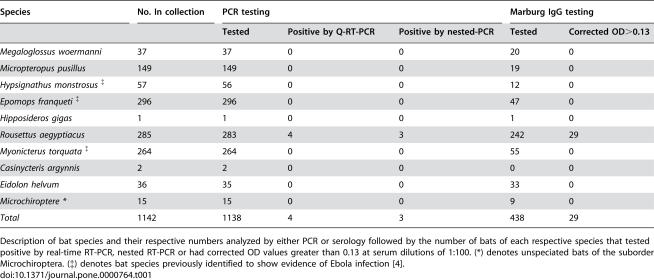
Description:Marburg and Ebola viruses can cause large hemorrhagic fever (HF) outbreaks with high case fatality (80-90%) in human and great apes. Identification of the natural reservoir of these viruses is one of the most important topics in this field and a fundamental key to understanding their natural history. Despite the discovery of this virus family almost 40 years ago, the search for the natural reservoir of these lethal pathogens remains an enigma despite numerous ecological studies. Here, we report the discovery of Marburg virus in a common species of fruit bat (Rousettus aegyptiacus) in Gabon as shown by finding virus-specific RNA and IgG antibody in individual bats. These Marburg virus positive bats represent the first naturally infected non-primate animals identified. Furthermore, this is the first report of Marburg virus being present in this area of Africa, thus extending the known range of the virus. These data imply that more areas are at risk for MHF outbreaks than previously realized and correspond well with a recently published report in which three species of fruit bats were demonstrated to be likely reservoirs for Ebola virus.
-
Subjects:
-
Source:PLoS One. 2007; 2(8)
-
Pubmed ID:17712412
-
Pubmed Central ID:PMC1942080
-
Document Type:
-
Place as Subject:
-
Volume:2
-
Issue:8
-
Collection(s):
-
Main Document Checksum:urn:sha-512:b27669f6f7a68f5dfa8e7186818d6f3ec787f88188c30dbb6e72815bdbb9a864fb93f1cd93c6950ff459df441b037a9d3712a45c8835a81c9151079e130c621c
-
Download URL:
-
File Type:
 [PDF
- 406.21 KB
]
[PDF
- 406.21 KB
]
Supporting Files


File Language:
English
ON THIS PAGE







CDC STACKS serves as an archival repository of CDC-published products including
scientific findings,
journal articles, guidelines, recommendations, or other public health information authored or
co-authored by CDC or funded partners.
As a repository, CDC STACKS retains documents in their original published format to ensure public access to scientific information.
As a repository, CDC STACKS retains documents in their original published format to ensure public access to scientific information.
You May Also Like
COLLECTION
CDC Public Access