



Daily Stressor Reactivity during Adolescence: The Buffering Role of Parental Warmth
Supporting Files

-
9 2016 ; 9-2016
-
Available in CDC Stacks on September 01, 2017, 12:00 AM
File Language:
English
Details
-
Alternative Title:Health Psychol
-
Personal Author:
-
Description:Objective
This study examined youth stressor reactivity in the form of links between daily stressors and adolescents’ negative affect, physical health symptoms, and cortisol patterns. We also tested whether youth gender and parental warmth moderated these linkages.
Method
Participants were the children of employees in the Information Technology division of a large company (N = 132, mean age = 13.39 years, 55% female). Youth completed daily diary telephone interviews on 8 consecutive evenings and provided saliva samples at 4 time points over 4 days to assess daily stressors and youth physiological and affective functioning. Parental warmth was assessed during in-home interviews. Multi-level modeling was used to account for interdependencies in the data.
Results
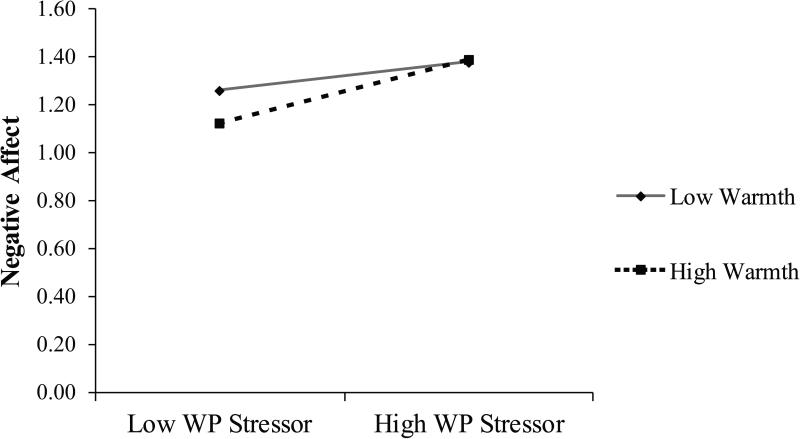
Youth who experienced more daily stressors, on average, reported more negative affect and physical health symptoms, on average. Further, on days youth reported more stressors than usual (compared to their own across-day average), they also exhibited more physical health symptoms, reduced evening cortisol decline (e.g., flatter slopes), higher bedtime cortisol, and more negative affect. Girls had stronger within-person linkages between daily stressors and daily negative affect than boys. Parental warmth moderated these within-person linkages: Youth who experienced more parental warmth had lower negative affect and steeper cortisol decline than usual on less stressful days. Yet, youth who experienced less parental warmth had higher negative affect and their cortisol levels declined less, even on days with lower-than-usual stress.
Conclusions
Daily stressors are associated with youth's affective and physiological functioning, but parental warmth can support youth's stress recovery. -
Subjects:
-
Keywords:
-
Source:Health Psychol. 35(9):1027-1035
-
Pubmed ID:27175577
-
Pubmed Central ID:PMC4993628
-
Document Type:
-
Funding:U01 HD051217/HD/NICHD NIH HHSUnited States/ ; U01 OH008788/OH/NIOSH CDC HHSUnited States/ ; U01 AG027669/AG/NIA NIH HHSUnited States/ ; U01 HD051256/HD/NICHD NIH HHSUnited States/ ; R03 AG046393/AG/NIA NIH HHSUnited States/ ; R01 HL107240/HL/NHLBI NIH HHSUnited States/ ; U01 HD059773/HD/NICHD NIH HHSUnited States/ ; U01 HD051276/HD/NICHD NIH HHSUnited States/ ; U01 HD051218/HD/NICHD NIH HHSUnited States/
-
Volume:35
-
Issue:9
-
Download URL:
-
File Type:
 [PDF - 533.16 KB]
 -
Collection(s):
-
Main Document Checksum:urn:sha256:ea0efd9fd9326bef558aae6081f1b118f1ac039fa314cea30864824cb05e48df
Supporting Files


File Language:
English
 Was this page helpful?
 Found an issue?


CDC STACKS serves as an archival repository of CDC-published products including
scientific findings, journal articles, guidelines, recommendations, or other public health information authored or
co-authored by CDC or funded partners.
As a repository, CDC STACKS retains documents in their original published format to ensure public access to scientific information.
As a repository, CDC STACKS retains documents in their original published format to ensure public access to scientific information.
You May Also Like
COLLECTION
CDC Public Access