


Clinical breast exam screening by trained laywomen in Malawi integrated with other health services
Supporting Files

-
7 2016
-
File Language:
English
Details
-
Alternative Title:J Surg Res
-
Personal Author:
-
Description:Background
Breast cancer awareness and early detection are limited in sub-Saharan Africa. Resource limitations make screening mammography or clinical breast exam (CBE) by physicians or nurses impractical in many settings. We aimed to assess feasibility and performance of CBE by laywomen in urban health clinics in Malawi.
Methods
Four laywomen were trained to deliver breast cancer educational talksand conduct CBE. After training, screening was implemented in diverse urbanhealth clinics. Eligible women were ≥30 years, with no prior breast cancer or breast surgery, and clinic attendance for reasons other than abreast concern. Wo men with abnormal CBE were referred to a study surgeon. All palpable masses confirmed by surgeon exam were pathologically sampled. Patients with abnormal screening CBE but normal surgeon exam underwentbreast ultrasound con firmation. Additionally, 50 randomly selected women with normal screening CBE underwent breast ultrasound, and 45 different women with normal CBE were randomly assigned to surgeon exam.
Results
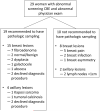
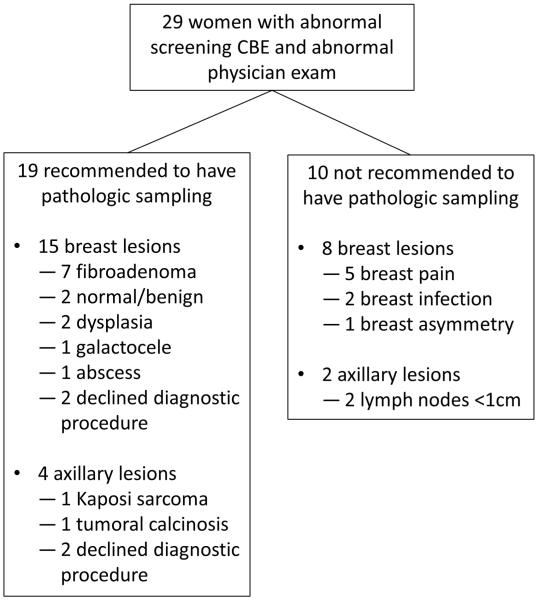
Among 1,220 eligible women, 1,000 (82%) agreed to CBE. Lack of time (69%) was the commonest reason for refusal. Educational talk attendance was associated with higher CBE participation (83% vs 77%, p=0.012). Among 1,000 women screened, 7% had abnormal CBE. Of 45 women with normal CBE randomized to physician exam, 43 had normal exams and two had axillary lymphadenopathy not detected by CBE. Sixty of 67 women (90%) with abnormal CBE attended the referral visit. Of these, 29 (48%) had concordant abnormal physician exam. Thirty-one women (52%) had discordant normal physician exam, all of whom also had normal breast ultrasounds. Compared to physician exam, sensitivity for CBE by laywomen was 94% (CI 79-99%), specificity 58% (CI 46-70%), positive predictive value 48% (CI 35-62%), and negative predictive value 96% (CI 85-100%). Of 13 women who underwent recommended pathologic sampling of a breast lesion, two had cytologic dysplasia and all others benign results.
Conclusions and relevance
CBE uptake in Lilongwe clinics was high. CBE by laywomen compared favorably with physician exam, and follow-up was good. Our intervention can serve as a model for wider implementation. Performance in rural areas, effects on cancer stage and mortality, and cost-effectiveness require evaluation.
-
Subjects:
-
Keywords:
-
Source:J Surg Res. 204(1):61-67
-
Pubmed ID:27451869
-
Pubmed Central ID:PMC4963624
-
Document Type:
-
Funding:K01 TW009488/TW/FIC NIH HHSUnited States/ ; P30 CA016086/CA/NCI NIH HHSUnited States/ ; P50 CA058223/CA/NCI NIH HHSUnited States/ ; K07 CA154850/CA/NCI NIH HHSUnited States/ ; U2G PS001965/PS/NCHHSTP CDC HHSUnited States/ ; R21 CA180815/CA/NCI NIH HHSUnited States/ ; U54 CA190152/CA/NCI NIH HHSUnited States/ ; R25 TW009340/TW/FIC NIH HHSUnited States/
-
Volume:204
-
Issue:1
-
Collection(s):
-
Main Document Checksum:urn:sha256:a62f8abd76bee13ef44adb51af8541a9b0c16a4f44639f3dfd6c7fab43b8e352
-
Download URL:
-
File Type:
 [PDF
- 426.57 KB
]
[PDF
- 426.57 KB
]
Supporting Files


File Language:
English
ON THIS PAGE


CDC STACKS serves as an archival repository of CDC-published products including
scientific findings,
journal articles, guidelines, recommendations, or other public health information authored or
co-authored by CDC or funded partners.
As a repository, CDC STACKS retains documents in their original published format to ensure public access to scientific information.
As a repository, CDC STACKS retains documents in their original published format to ensure public access to scientific information.
You May Also Like
COLLECTION
CDC Public Access