



Digital imaging analysis to assess scar phenotype
Supporting Files

-
Mar-Apr 2014
-
Available in CDC Stacks on April 28, 2015, 12:00 AM
File Language:
English
Details
-
Alternative Title:Wound Repair Regen
-
Personal Author:
-
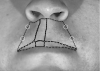
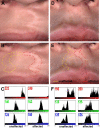
Description:In order to understand the link between the genetic background of patients and wound clinical outcomes, it is critical to have a reliable method to assess the phenotypic characteristics of healed wounds. In this study, we present a novel imaging method that provides reproducible, sensitive, and unbiased assessments of postsurgical scarring. We used this approach to investigate the possibility that genetic variants in orofacial clefting genes are associated with suboptimal healing. Red-green-blue digital images of postsurgical scars of 68 patients, following unilateral cleft lip repair, were captured using the 3dMD imaging system. Morphometric and colorimetric data of repaired regions of the philtrum and upper lip were acquired using ImageJ software, and the unaffected contralateral regions were used as patient-specific controls. Repeatability of the method was high with intraclass correlation coefficient score > 0.8. This method detected a very significant difference in all three colors, and for all patients, between the scarred and the contralateral unaffected philtrum (p ranging from 1.20(-05) to 1.95(-14) ). Physicians' clinical outcome ratings from the same images showed high interobserver variability (overall Pearson coefficient = 0.49) as well as low correlation with digital image analysis results. Finally, we identified genetic variants in TGFB3 and ARHGAP29 associated with suboptimal healing outcome.
-
Subjects:
- Adolescent
- Adult
- Child
- Child, Preschool
- Cicatrix
- Cleft Lip
- Color
- Esthetics
- Female
- GTPase-Activating Proteins
- Humans
- Lip
- Male
- Observer Variation
- Patient Satisfaction
- Phenotype
- Photography
- Plastic Surgery Procedures
- Reproducibility of Results
- Skin Pigmentation
- Transforming Growth Factor beta3
- Wound Healing
-
Keywords:
-
Source:Wound Repair Regen. 22(2):228-238
-
Pubmed ID:24635173
-
Pubmed Central ID:PMC4411947
-
Document Type:
-
Funding:T32 DE014678/DE/NIDCR NIH HHSUnited States/ ; R37 DE008559/DE/NIDCR NIH HHSUnited States/ ; T90 DE023520/DE/NIDCR NIH HHSUnited States/ ; DE08559/DE/NIDCR NIH HHSUnited States/ ; T32 DEO14678-09/PHS HHSUnited States/ ; R03 AR055313/AR/NIAMS NIH HHSUnited States/ ; R01 DE008559/DE/NIDCR NIH HHSUnited States/ ; AR055313/AR/NIAMS NIH HHSUnited States/ ; R01 DD000295/DD/NCBDD CDC HHSUnited States/
-
Volume:22
-
Issue:2
-
Download URL:
-
File Type:
 [PDF - 850.16 KB]
 -
Collection(s):
-
Main Document Checksum:urn:sha256:943298534e65e912b130425deaed382cf01c76d48b0830b3df9e81daed4d8f01
Supporting Files


File Language:
English
 Was this page helpful?
 Found an issue?



CDC STACKS serves as an archival repository of CDC-published products including
scientific findings, journal articles, guidelines, recommendations, or other public health information authored or
co-authored by CDC or funded partners.
As a repository, CDC STACKS retains documents in their original published format to ensure public access to scientific information.
As a repository, CDC STACKS retains documents in their original published format to ensure public access to scientific information.
You May Also Like
COLLECTION
CDC Public Access