



Sparse modeling of spatial environmental variables associated with asthma
Supporting Files

-
2 2015
-
File Language:
English
Details
-
Alternative Title:J Biomed Inform
-
Personal Author:
-
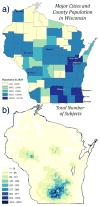
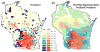
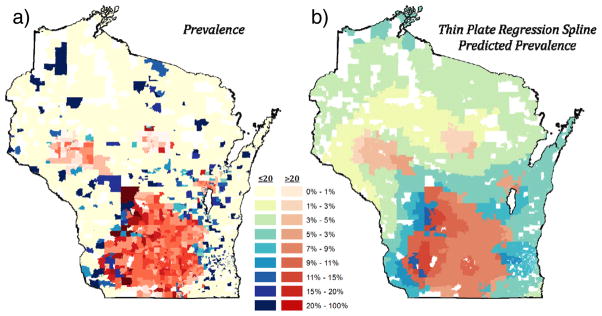
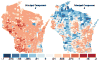
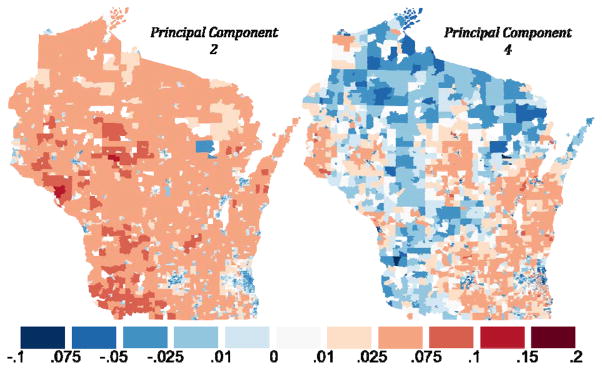
Description:Geographically distributed environmental factors influence the burden of diseases such as asthma. Our objective was to identify sparse environmental variables associated with asthma diagnosis gathered from a large electronic health record (EHR) dataset while controlling for spatial variation. An EHR dataset from the University of Wisconsin's Family Medicine, Internal Medicine and Pediatrics Departments was obtained for 199,220 patients aged 5-50years over a three-year period. Each patient's home address was geocoded to one of 3456 geographic census block groups. Over one thousand block group variables were obtained from a commercial database. We developed a Sparse Spatial Environmental Analysis (SASEA). Using this method, the environmental variables were first dimensionally reduced with sparse principal component analysis. Logistic thin plate regression spline modeling was then used to identify block group variables associated with asthma from sparse principal components. The addresses of patients from the EHR dataset were distributed throughout the majority of Wisconsin's geography. Logistic thin plate regression spline modeling captured spatial variation of asthma. Four sparse principal components identified via model selection consisted of food at home, dog ownership, household size, and disposable income variables. In rural areas, dog ownership and renter occupied housing units from significant sparse principal components were associated with asthma. Our main contribution is the incorporation of sparsity in spatial modeling. SASEA sequentially added sparse principal components to Logistic thin plate regression spline modeling. This method allowed association of geographically distributed environmental factors with asthma using EHR and environmental datasets. SASEA can be applied to other diseases with environmental risk factors.
-
Subjects:
-
Keywords:
-
Source:J Biomed Inform. 2014; 53:320-329
-
Pubmed ID:25533437
-
Pubmed Central ID:PMC4355087
-
Document Type:
-
Funding:UL1 TR000427/TR/NCATS NIH HHSUnited States/ ; U58 CD001316/CD/ODCDC CDC HHSUnited States/ ; T32 GM008692/GM/NIGMS NIH HHSUnited States/ ; TL1 TR000429/TR/NCATS NIH HHSUnited States/ ; F30HL112491/HL/NHLBI NIH HHSUnited States/ ; UL1 RR025011/RR/NCRR NIH HHSUnited States/ ; U38 EH000951/EH/NCEH CDC HHSUnited States/ ; F30 HL112491/HL/NHLBI NIH HHSUnited States/ ; 1UL1RR025011/RR/NCRR NIH HHSUnited States/ ; 9U54TR000021/TR/NCATS NIH HHSUnited States/
-
Volume:53
-
Collection(s):
-
Main Document Checksum:urn:sha256:5059acaf88df8a415098da9434046ed6d513728c0e4a335d4e14bf5ec965ab32
-
Download URL:
-
File Type:
 [PDF
- 737.20 KB
]
[PDF
- 737.20 KB
]
Supporting Files


File Language:
English
 Was this page helpful?
 Found an issue?


CDC STACKS serves as an archival repository of CDC-published products including
scientific findings,
journal articles, guidelines, recommendations, or other public health information authored or
co-authored by CDC or funded partners.
As a repository, CDC STACKS retains documents in their original published format to ensure public access to scientific information.
As a repository, CDC STACKS retains documents in their original published format to ensure public access to scientific information.
You May Also Like
COLLECTION
CDC Public Access