


Females in the Juvenile Justice System: Who Are They and How Do They Fare?
Supporting Files

-
Feb 01 2014
File Language:
English
Details
-
Alternative Title:Crime Delinq
-
Personal Author:
-
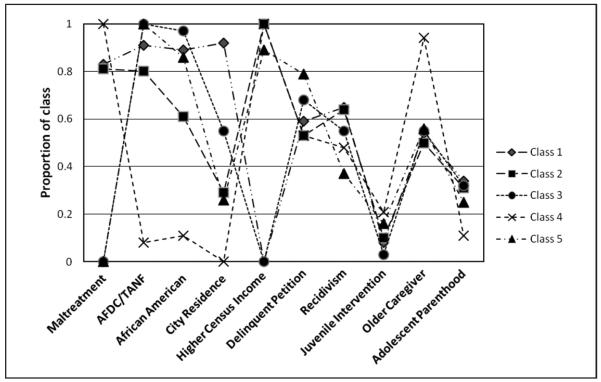
Description:Increasing numbers of female youth involved in the juvenile justice system highlight the need to examine this population. This study enumerates distinct profiles of risk and protection among juvenile court-involved females, examining young adult outcomes associated with these profiles. Administrative data on 700 participants were drawn from multiple service sectors in a Midwest metropolitan region. Latent class and Pearson chi-square analyses were used. Five unique classes were identified; these classes were associated with young adult outcomes. One class of impoverished African American females was most likely to experience problematic young adult outcomes but least likely to have received juvenile justice services. Findings highlight the heterogeneity in the female juvenile court population and discrepancies between service needs and service receipt.
-
Subjects:
-
Source:Crime Delinq. 2011; 60(1):106-125
-
Pubmed ID:24683203
-
Pubmed Central ID:PMC3965180
-
Document Type:
-
Funding:
-
Volume:60
-
Issue:1
-
Collection(s):
-
Main Document Checksum:urn:sha256:381138eccbb5578a694341ab1f77a157754f333b58c66dc003905f28be4825c3
-
Download URL:
-
File Type:
 [PDF
- 243.59 KB
]
[PDF
- 243.59 KB
]
Supporting Files


File Language:
English
ON THIS PAGE



CDC STACKS serves as an archival repository of CDC-published products including
scientific findings,
journal articles, guidelines, recommendations, or other public health information authored or
co-authored by CDC or funded partners.
As a repository, CDC STACKS retains documents in their original published format to ensure public access to scientific information.
As a repository, CDC STACKS retains documents in their original published format to ensure public access to scientific information.
You May Also Like
COLLECTION
CDC Public Access