



A multimodal imaging analysis of subcortical gray matter in fragile X premutation carriers
Supporting Files

-
May 06 2013
Details
-
Alternative Title:Mov Disord
-
Personal Author:
-
Description:Background
Approximately 40% of males with the fragile X premutation develop fragile X-associated tremor/ataxia syndrome after age 50. Although the thalamus and basal ganglia play a crucial role in movement disorders, their involvement in fragile X premutation carriers has not been systematically investigated.
Methods
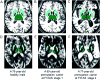
The current study characterized structural abnormalities associated with fragile X premutation carriers (with and without fragile X-associated tremor/ataxia syndrome) in the thalamus, caudate nucleus, putamen, and globus pallidus using T1-weighted and diffusion tensor imaging.
Results
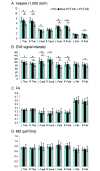
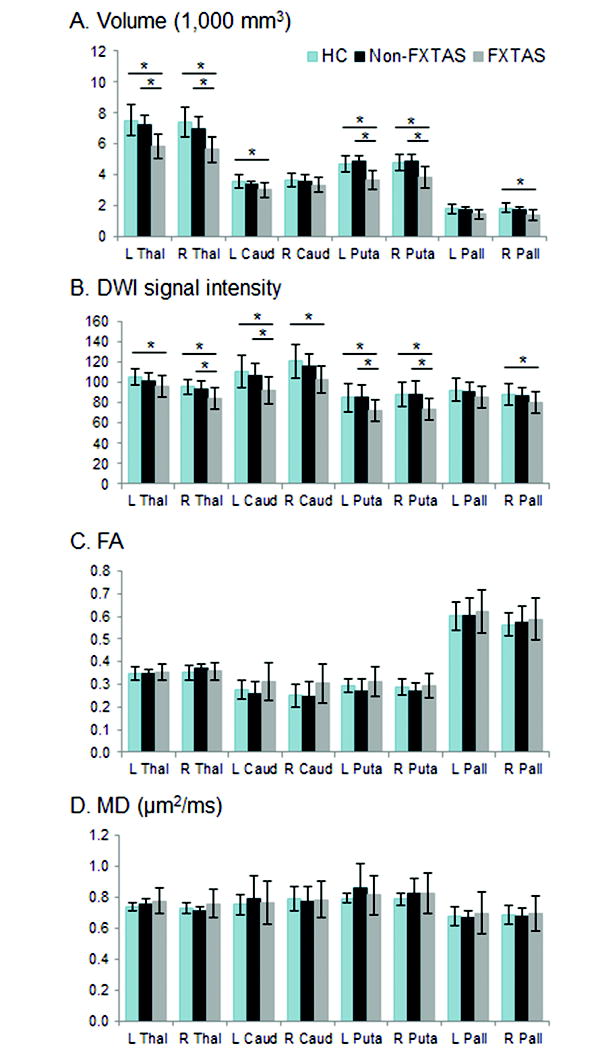
Male premutation carriers with fragile X-associated tremor/ataxia syndrome showed significant volume atrophy and diffusion-weighted signal loss in all 4 structures compared to the control group. They also exhibited volume atrophy and diffusion-weighted signal loss in the thalamus and striatum compared to the premutation carriers without fragile X-associated tremor/ataxia syndrome. Importantly, many of the measurements exhibited robust correlations with symptom severity, with volume and DWI measurements displaying negative correlations and fractional anisotropy measurements displaying positive correlations.
Conclusions
The current study demonstrated involvement of all 4 subcortical gray matter structures in fragile X-associated tremor/ataxia syndrome, with significant volume atrophy, and possibly iron deposition indicated by the diffusion-weighted signal loss. The significant correlation between the subcortical measurements and symptom severity suggests the benefits of tracking structural changes in the subcortical gray matter in future longitudinal studies for early detection and disease monitoring.
-
Subjects:
-
Source:Mov Disord. 28(9):1278-1284.
-
Pubmed ID:23649693
-
Pubmed Central ID:PMC3785985
-
Document Type:
-
Funding:R01 HD054764/HD/NICHD NIH HHS/United States ; TL1DA024854/DA/NIDA NIH HHS/United States ; P30 HD002274/HD/NICHD NIH HHS/United States ; R01 MH078041/MH/NIMH NIH HHS/United States ; MH078041/MH/NIMH NIH HHS/United States ; RL1 NS062412/NS/NINDS NIH HHS/United States ; UL1 DE0199583/DE/NIDCR NIH HHS/United States ; U50 DD000596/DD/NCBDD CDC HHS/United States ; RL1AG032115/AG/NIA NIH HHS/United States ; TL1 DA024854/DA/NIDA NIH HHS/United States ; UL1 RR024146/RR/NCRR NIH HHS/United States ; HD036071/HD/NICHD NIH HHS/United States ; RL1 AG032115/AG/NIA NIH HHS/United States ; NS062412/NS/NINDS NIH HHS/United States ; R01 HD036071/HD/NICHD NIH HHS/United States
-
Volume:28
-
Issue:9
-
Collection(s):
-
Main Document Checksum:urn:sha256:330cc87a95e6645b05ae017c2b0cf30a41e3cadf25c2475aa95c58969557af28
-
Download URL:
-
File Type:
 [PDF
- 1.14 MB
]
[PDF
- 1.14 MB
]
Supporting Files


 Was this page helpful?
 Found an issue?

CDC STACKS serves as an archival repository of CDC-published products including
scientific findings,
journal articles, guidelines, recommendations, or other public health information authored or
co-authored by CDC or funded partners.
As a repository, CDC STACKS retains documents in their original published format to ensure public access to scientific information.
As a repository, CDC STACKS retains documents in their original published format to ensure public access to scientific information.
You May Also Like
COLLECTION
CDC Public Access