


Effect of antioxidants on enzyme-catalysed biodegradation of carbon nanotubes†
Supporting Files

-
2013
-
File Language:
English
Details
-
Alternative Title:J Mater Chem B Mater Biol Med
-
Personal Author:
-
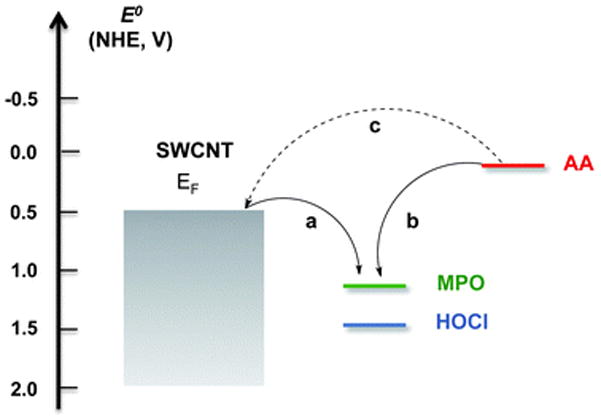
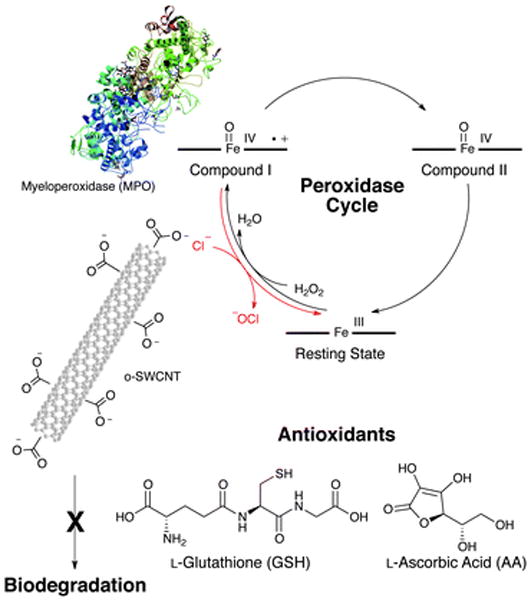
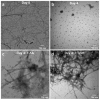
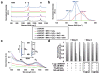
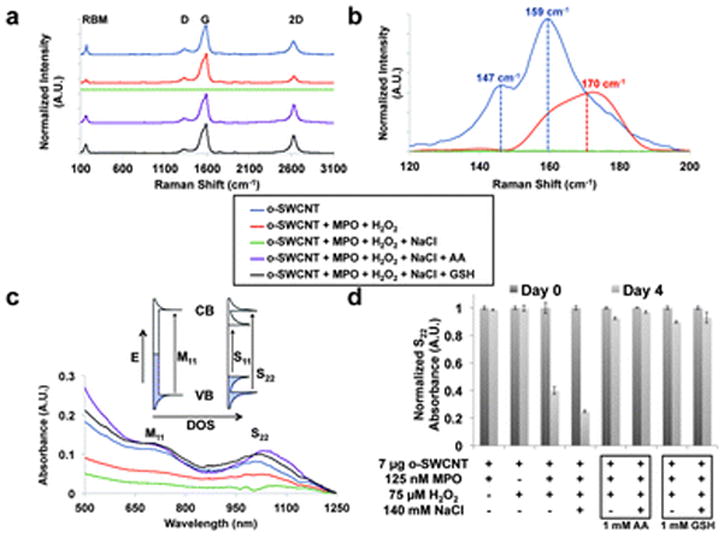
Description:The growing applications of carbon nanotubes (CNTs) inevitably increase the risk of exposure to this potentially toxic nanomaterial. In an attempt to address this issue, research has been implemented to study the biodegradation of CNTs. In particular, myeloperoxidase (MPO), an enzyme expressed by inflammatory cells of animals including humans, catalyse the degradation of oxidized carbon nanomaterials. While reactive intermediates generated by MPO efficiently degrade oxidized single-walled carbon nanotubes (o-SWCNTs); the exact mechanism of enzyme-catalysed biodegradation remains ambiguous. In this work, we tried to explain enzymatic oxidation in terms of redox potentials by employing competitive substrates for MPO such as chloride, which is oxidized by MPO to form a strong oxidant (hypochlorite), and antioxidants that have lower redox potentials than CNTs. Employing transmission electron microscopy, Raman spectroscopy, and vis-NIR absorption spectroscopy, we demonstrate that the addition of antioxidants, L-ascorbic acid and L-glutathione, with or without chloride significantly mitigates MPO-catalysed biodegradation of o-SWCNTs. This study focuses on a fundamental understanding of the mechanisms of enzymatic biodegradation of CNTs and the impact of antioxidants on these pathways.
-
Subjects:
-
Source:J Mater Chem B Mater Biol Med. 1(3):302-309
-
Pubmed ID:23626907
-
Pubmed Central ID:PMC3634595
-
Document Type:
-
Funding:
-
Volume:1
-
Issue:3
-
Collection(s):
-
Main Document Checksum:urn:sha256:3a3b0416dd9b4e383d9fa525a62e82faa2520ff18067057194cc531499c03f90
-
Download URL:
-
File Type:
 [PDF
- 737.34 KB
]
[PDF
- 737.34 KB
]
Supporting Files


File Language:
English
ON THIS PAGE


CDC STACKS serves as an archival repository of CDC-published products including
scientific findings,
journal articles, guidelines, recommendations, or other public health information authored or
co-authored by CDC or funded partners.
As a repository, CDC STACKS retains documents in their original published format to ensure public access to scientific information.
As a repository, CDC STACKS retains documents in their original published format to ensure public access to scientific information.
You May Also Like
COLLECTION
CDC Public Access