



Misclassification of Survey Responses and Black-White Disparity in Mammography Use, Behavioral Risk Factor Surveillance System, 1995-2006
Supporting Files
Public Domain

-
Apr 15 2011
File Language:
English
Details
-
Journal Article:Preventing Chronic Disease (PCD)
-
Personal Author:
-
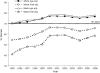
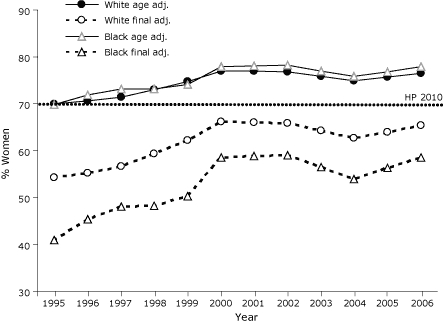
Description:Introduction ; The validity of self-reported data for mammography differ by race. We assessed the effect of racial differences in the validity of age-adjusted, self-reported mammography use estimates from the Behavioral Risk Factor Surveillance System (BRFSS) from 1995 through 2006 to determine whether misclassification (inaccurate survey question response) may have obscured actual racial disparities. ; Methods ; We adjusted BRFSS mammography use data for age by using 2000 census estimates and for misclassification by using the following formula: (estimated prevalence − 1 + specificity) / (sensitivity + specificity − 1). We used values reported in the literature for the formula (sensitivity = 0.97 for both black and white women, specificity = 0.49 and 0.62, respectively, for black and white women). ; Results ; After adjustment for misclassification, the percentage of women aged 40 years or older in 1995 who reported receiving a mammogram during the previous 2 years was 54% among white women and 41% among black women, compared with 70% among both white and black women after adjustment for age only. In 2006, the percentage after adjustment for misclassification was 65% among white women and 59% among black women compared with 77% among white women and 78% among black women after adjustment for age only. ; Conclusion ; Self-reported data overestimate mammography use — more so for black women than for white women. After adjustment for respondent misclassification, neither white women nor black women had attained the Healthy People 2010 objective (≥70%) by 2006, and a disparity between white and black women emerged.
-
Subjects:
-
Source:Prev Chronic Dis. 2011; 8(3).
-
ISSN:1545-1151
-
Document Type:
-
Corporate as Subject:
-
Volume:8
-
Issue:3
-
Download URL:
-
File Type:
 [PDF - 522.62 KB]
 -
Collection(s):
-
Main Document Checksum:urn:sha-512:3bcedfeafa9d26e1492b32c7dd9dc786ed10e2de0684715d825a757ed8a87cc54b9519328179cd82029b43f6593ca2366bb0b1919660c701861ed9c837be56c6
Supporting Files


File Language:
English
 Was this page helpful?
 Found an issue?

CDC STACKS serves as an archival repository of CDC-published products including
scientific findings, journal articles, guidelines, recommendations, or other public health information authored or
co-authored by CDC or funded partners.
As a repository, CDC STACKS retains documents in their original published format to ensure public access to scientific information.
As a repository, CDC STACKS retains documents in their original published format to ensure public access to scientific information.
You May Also Like
COLLECTION
Preventing Chronic Disease