



Microtia-Anotia: A Global Review of Prevalence Rates
Supporting Files

-
2011/09/01
-
Available in CDC Stacks on September 01, 2012, 12:00 AM
File Language:
English
Details
-
Alternative Title:Birth Defects Res A Clin Mol Teratol
-
Personal Author:
-
Description:Background
There are few published studies on microtia-anotia frequency.
Methods
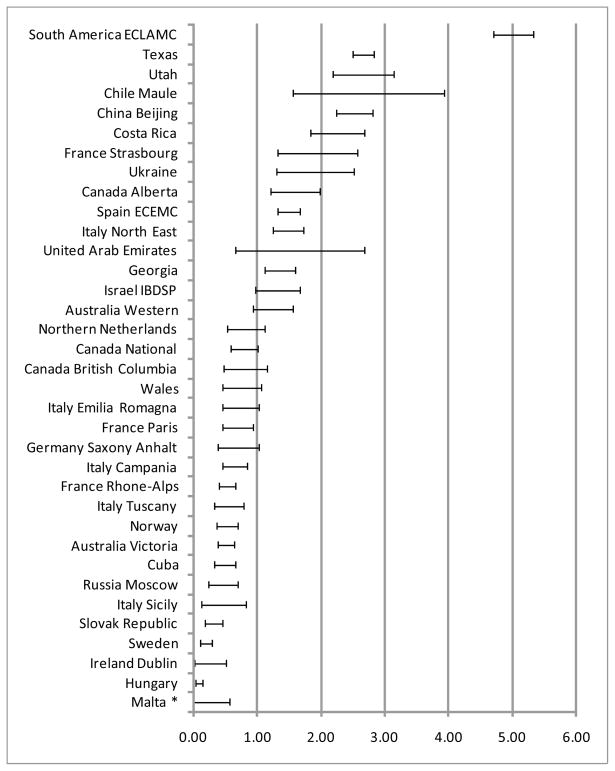
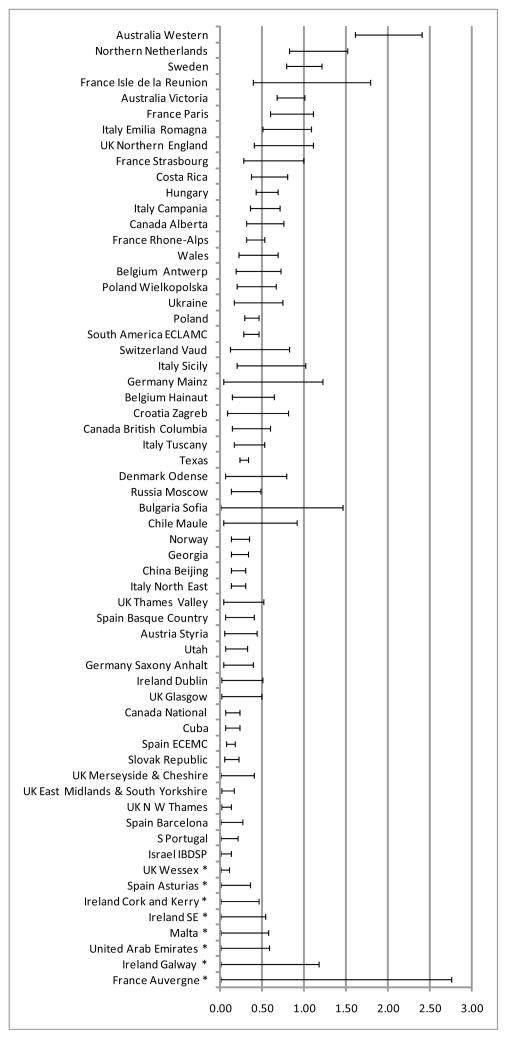
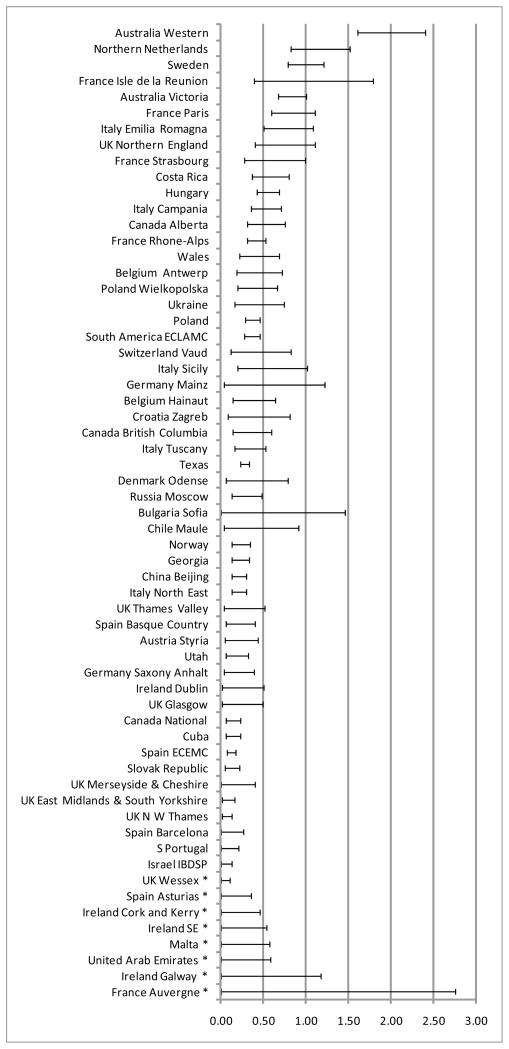
Using data from birth defects surveillance programs around the world, we conducted a systematic review on the frequency of microtia-anotia to further explore the differences in prevalence across countries. Ninety-two birth defects surveillance programs were evaluated with a total of 8,917 cases of microtia-anotia. We computed the prevalence per 10,000 births for each surveillance program for total cases of microtia-anotia (microtia types I to IV), microtia (types I to III), and anotia (type IV). Prevalence ratios were calculated by large geographical areas, race/ethnicity, and by surveillance methodologies.
Results
The overall prevalence were for microtia-anotia 2.06 (CI: 2.02-2.10), for microtia 1.55 (CI: 1.50-1.60), and for anotia 0.36 (CI: 0.34-0.38). Higher prevalence was observed in the Americas, Northern Europe and Asia, among Hispanics and Asians, and among active ascertainment and hospital-based surveillance programs.
Conclusions
We observed marked variation in the prevalence of microtia-anotia across surveillance programs and within countries. These results must be interpreted cautiously as this variability may be explained mainly by differences in surveillance methods. However, given the magnitude of some of the differences, other factors may also be involved. This study contributes to the knowledge on the prevalence of microtia-anotia by providing a critical analysis of the existing data. In addition, it supports the need for a coding system that allows complete phenotype characterization of microtia-anotia, including severity and laterality; as well as further studies on the variation of its frequency related to race and ethnicity. -
Subjects:
-
Source:Birth Defects Res A Clin Mol Teratol. 91(9):813-822
-
Pubmed ID:21656661
-
Pubmed Central ID:PMC3405852
-
Document Type:
-
Funding:
-
Genre:
-
Volume:91
-
Issue:9
-
Download URL:
-
File Type:
 [PDF - 768.68 KB]
 -
Collection(s):
-
Main Document Checksum:urn:sha-512:da971ca1e922a00ef77a34cb02def92edef58f101163e46a897b9f7c456ba5aff9b9b4e06e784833fe8307e00b0d0eb4d13503ee57692742875bbd44c1697eee
Supporting Files


File Language:
English
 Was this page helpful?
 Found an issue?


CDC STACKS serves as an archival repository of CDC-published products including
scientific findings, journal articles, guidelines, recommendations, or other public health information authored or
co-authored by CDC or funded partners.
As a repository, CDC STACKS retains documents in their original published format to ensure public access to scientific information.
As a repository, CDC STACKS retains documents in their original published format to ensure public access to scientific information.
You May Also Like
COLLECTION
CDC Public Access