


Underascertainment of Radiotherapy Receipt in SEER Registry Data
Supporting Files

-
Jun 29 2011
-
File Language:
English
Details
-
Alternative Title:Cancer
-
Personal Author:
-
Description:Purpose
SEER registry data has been used to suggest underuse and disparities in receipt of radiotherapy. Prior studies have cautioned that SEER may underascertain radiotherapy but lacked adequate representation to assess whether underascertainment varies by geography or patient sociodemographic characteristics. We sought to determine rates and correlates of underascertainment of radiotherapy in recent SEER data.
Methods
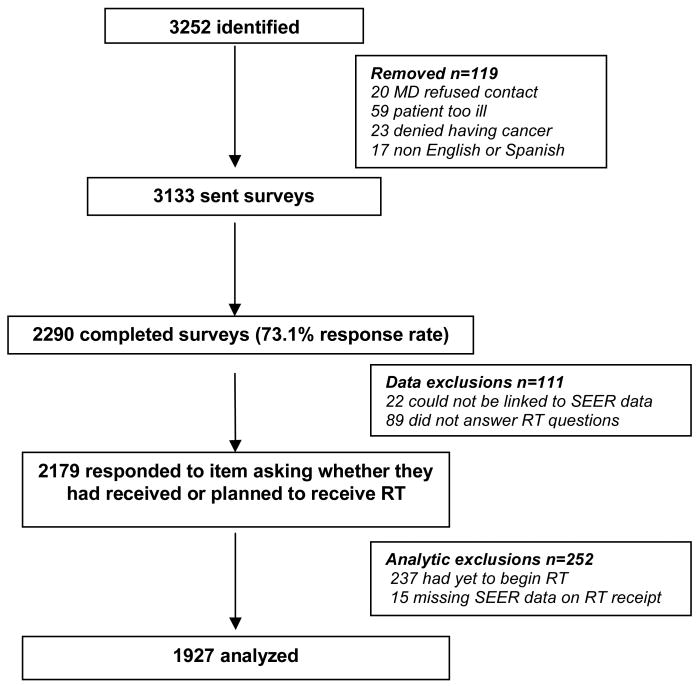
We evaluated data from 2290 survey respondents with nonmetastatic breast cancer, aged 20-79, diagnosed from 6/05-2/07 in Detroit and Los Angeles (LA) and reported to SEER registries (73% response rate). Survey responses regarding treatment and sociodemographic factors were merged to SEER data. We compared radiotherapy receipt as reported by patients versus SEER records. We then assessed correlates of radiotherapy underascertainment in SEER.
Results
Of 1292 patients who reported receiving radiotherapy, 273 were coded as not receiving radiotherapy in SEER (“underascertained”). Underascertainment was more common in LA than in Detroit (32.0% vs 11.25%, p<0.001). On multivariate analysis, radiotherapy underascertainment was significantly associated in each registry (LA, Detroit) with stage (p=0.008, p=0.026), income (p<0.001, p=0.050), mastectomy receipt (p<0.001, p<0.001), chemotherapy receipt (p<0.001, p=0.045), and diagnosis at a hospital that was not accredited by the American College of Surgeons (p<0.001, p<0.001). In LA, additional significant variables included younger age (p<0.001), non-private insurance (p<0.001), and delayed receipt of radiotherapy (p<0.001).
Conclusions
SEER registry data as currently collected may not be an appropriate source for documentation of rates of radiotherapy receipt or investigation of geographic variation in the radiation treatment of breast cancer.
-
Subjects:
-
Source:Cancer. 118(2):333-341.
-
Pubmed ID:21717446
-
Pubmed Central ID:PMC3224683
-
Document Type:
-
Funding:K05CA111340/CA/NCI NIH HHS/United States ; N01-PC-35145/PC/NCI NIH HHS/United States ; R01 CA088370/CA/NCI NIH HHS/United States ; CA109696-06/CA/NCI NIH HHS/United States ; K05 CA111340-05/CA/NCI NIH HHS/United States ; N01-PC-35139/PC/NCI NIH HHS/United States ; K05 CA111340/CA/NCI NIH HHS/United States ; R01 CA088370-06/CA/NCI NIH HHS/United States ; R01 CA109696-06/CA/NCI NIH HHS/United States ; U58 DP000807/DP/NCCDPHP CDC HHS/United States ; CA088370-06/CA/NCI NIH HHS/United States ; N01PC54404/CA/NCI NIH HHS/United States ; N01PC35145/CA/NCI NIH HHS/United States ; CA111340-05/CA/NCI NIH HHS/United States ; N01PC35139/CA/NCI NIH HHS/United States ; N01-PC-54404/PC/NCI NIH HHS/United States ; R01 CA109696/CA/NCI NIH HHS/United States
-
Volume:118
-
Issue:2
-
Collection(s):
-
Main Document Checksum:urn:sha256:704b34de4d157b79484513c2fa936e62c5cae18fead59895e41db35368178148
-
Download URL:
-
File Type:
 [PDF
- 314.01 KB
]
[PDF
- 314.01 KB
]
Supporting Files


File Language:
English
ON THIS PAGE

CDC STACKS serves as an archival repository of CDC-published products including
scientific findings,
journal articles, guidelines, recommendations, or other public health information authored or
co-authored by CDC or funded partners.
As a repository, CDC STACKS retains documents in their original published format to ensure public access to scientific information.
As a repository, CDC STACKS retains documents in their original published format to ensure public access to scientific information.
You May Also Like
COLLECTION
CDC Public Access