



Military Service, Deployments, and Exposures in Relation to Amyotrophic Lateral Sclerosis Etiology
Supporting Files

-
5 2016 ; 5-2016
-
Available in CDC Stacks on 2017-05-01T00:00:00Z
File Language:
English
Details
-
Alternative Title:Environ Int
-
Personal Author:Beard, John D. ; Engel, Lawrence S. ; Richardson, David B. ; Gammon, Marilie D. ; Baird, Coleen ; Umbach, David M. ; Allen, Kelli D. ; Stanwyck, Catherine L. ; Keller, Jean ; Sandler, Dale P. ; Schmidt, Silke ; Kamel, Freya
-
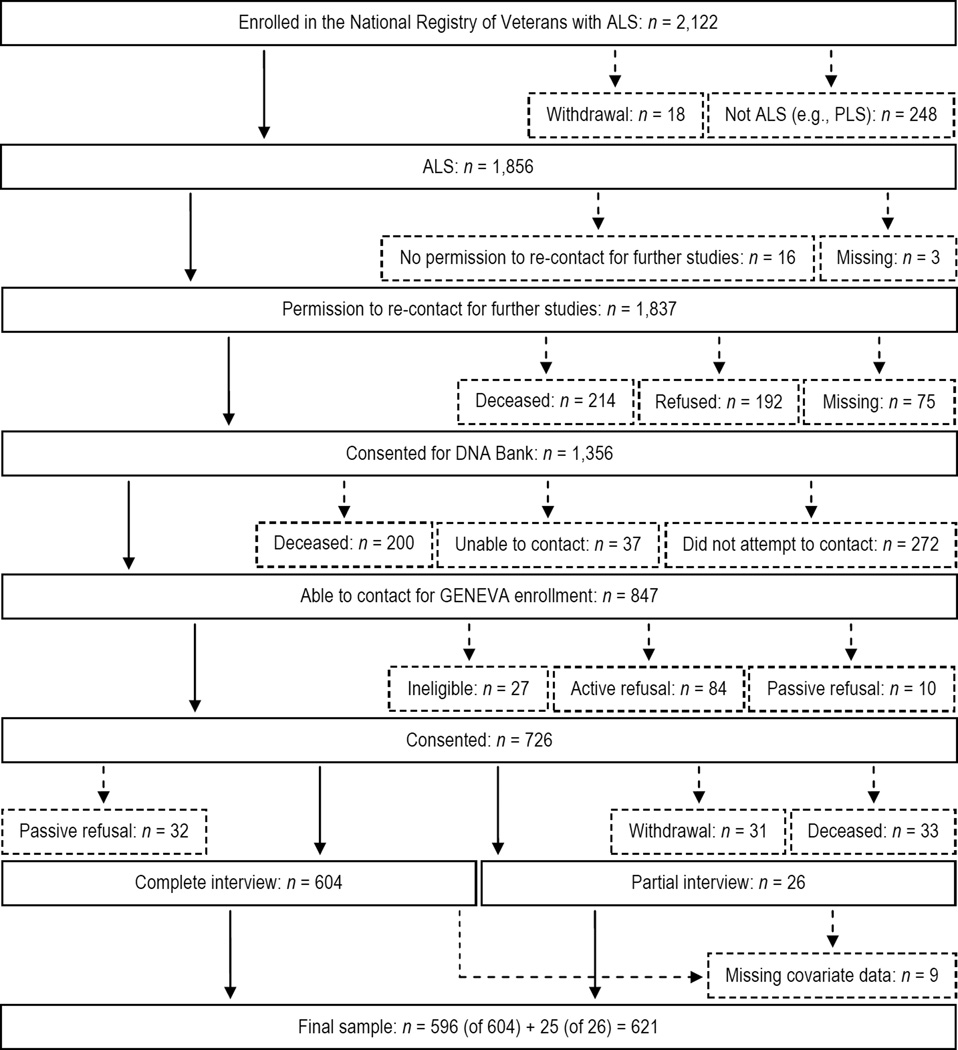
Description:Background ; Factors underlying a possible excess of amyotrophic lateral sclerosis (ALS) among military veterans remain unidentified. Limitations of previous studies on this topic include reliance on ALS mortality as a surrogate for ALS incidence, low statistical power, and sparse information on military-related factors. ; Objectives ; We evaluated associations between military-related factors and ALS using data from a case-control study of U.S. military veterans. ; Methods ; From 2005 to 2010, we identified medical record-confirmed ALS cases via the National Registry of Veterans with ALS and controls via the Veterans Benefits Administration’s Beneficiary Identification and Records Locator System database. In total, we enrolled 621 cases and 958 frequency-matched controls in the Genes and Environmental Exposures in Veterans with Amyotrophic Lateral Sclerosis study. We collected information on military service and deployments and 39 related exposures. We used unconditional logistic regression models to estimate odds ratios (ORs) and 95% confidence intervals (CIs). We used inverse probability weighting to adjust for potential bias from confounding, missing covariate data, and selection arising from a case group that disproportionately included long-term survivors and a control group that may or may not differ from U.S. military veterans at large. ; Results ; The odds of ALS did not differ for veterans of the Air Force, Army, Marines, and Navy. We found higher odds of ALS for veterans whose longest deployment was World War II or the Korean War and a positive trend with total years of all deployments (OR = 1.27; 95% CI: 1.06, 1.52). ALS was positively associated with exposure to herbicides for military purposes, nasopharyngeal radium, personal pesticides, exhaust from heaters or generators, high-intensity radar waves, contaminated food, explosions within one mile, herbicides in the field, mixing and application of burning agents, burning agents in the field, and Agent Orange in the field, with ORs between 1.50 and 7.75. ; Conclusions ; Although our results need confirmation, they are potentially important given the large number of U.S. military veterans, and they provide clues to potential factors underlying the apparent increase of ALS in veteran populations.
-
Keywords:
- amyotrophic lateral sclerosis
- case-control
- deployment
- etiology
- military
- 2,4,5-Trichlorophenoxyacetic Acid
- 2,4-Dichlorophenoxyacetic Acid
- Adult
- Aged
- Agent Orange
- Amyotrophic Lateral Sclerosis
- Case-Control Studies
- Environmental Exposure
- Female
- Humans
- Incidence
- Logistic Models
- Male
- Middle Aged
- Military Personnel
- Odds Ratio
- Pesticides
- Polychlorinated Dibenzodioxins
- Radium
- United States
- Veterans
-
Source:Environ Int. 91:104-115
-
Pubmed ID:26923711
-
Pubmed Central ID:PMC4876822
-
Document Type:
-
Funding:T32ES007018/ES/NIEHS NIH HHSUnited States/ ; T42OH00867302/OH/NIOSH CDC HHSUnited States/ ; R01 ES013244/ES/NIEHS NIH HHSUnited States/ ; T32 ES007018/ES/NIEHS NIH HHSUnited States/ ; R01 ES13244/ES/NIEHS NIH HHSUnited States/ ; Z01 ES049005-16/ImNIH/Intramural NIH HHSUnited States/ ; Z01 ES049005/ImNIH/Intramural NIH HHSUnited States/
-
Volume:91
-
Download URL:
-
File Type:
 [PDF - 1.32 MB]
 -
Collection(s):
-
Main Document Checksum:urn:sha256:6a2c3708c472362db439319ad922f7ef70f687926f475755781621b035f2e3e1
Supporting Files


File Language:
English
 Was this page helpful?
 Found an issue?



CDC STACKS serves as an archival repository of CDC-published products including
scientific findings, journal articles, guidelines, recommendations, or other public health information authored or
co-authored by CDC or funded partners.
As a repository, CDC STACKS retains documents in their original published format to ensure public access to scientific information.
As a repository, CDC STACKS retains documents in their original published format to ensure public access to scientific information.
You May Also Like
COLLECTION
CDC Public Access