



PrEP Awareness and Attitudes in a National Survey of Primary Care Clinicians in the United States, 2009–2015
Supporting Files
Public Domain

-
Jun 03 2016
File Language:
English
Details
-
Alternative Title:PLoS One
-
Personal Author:
-
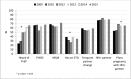
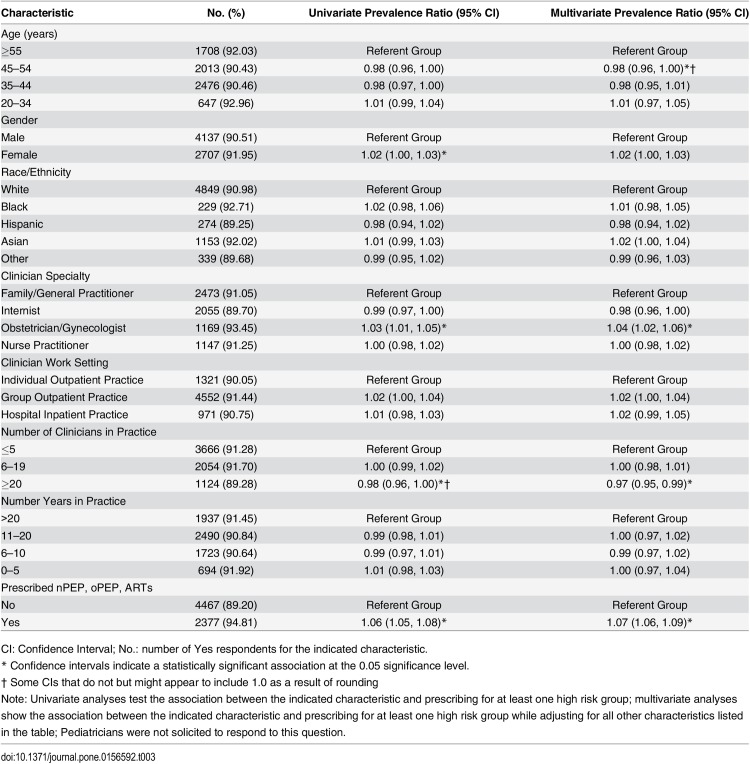
Description:Objectives ; As trials were assessing the safety and efficacy of daily oral antiretroviral preexposure prophylaxis (PrEP) for the prevention of HIV infection, there was a clear need to understand the evolution of knowledge of, and attitudes toward, PrEP among primary care clinicians. ; Methods ; Physicians and nurse practitioners were surveyed in 2009 (n = 1500), 2010 (n = 1504), 2012 (n = 1503), 2013 (n = 1507), 2014 (n = 1508) and 2015 (n = 1501) to assess their awareness of PrEP, willingness to prescribe PrEP, and whether they support use of public funds to pay for PrEP. Pharmacists (n = 251) were surveyed about PrEP in 2012 only. Descriptive statistics were computed for physician demographics and PrEP-related questions. Prevalence ratios for willingness to prescribe PrEP were computed using Poisson regression analysis. ; Results ; Awareness of PrEP was low among clinicians (2009: 24%, 2010: 29%) but increased after trials reported effectiveness (2012: 49%, 2013: 51%, 2014: 61%, 2015: 66%). Following a description of PrEP with an estimated effectiveness of 75%, across 6 of the study years 91% of clinicians indicated a willingness to prescribe PrEP to at least one group at high risk of HIV acquisition. A smaller majority of clinicians indicated support for public funding of PrEP in 2009: 59%, 2010: 53%, and 2013: 63%. ; Conclusions ; In surveys conducted before and after the release of PrEP trial results, primary care clinicians were largely unaware of PrEP. They indicated high levels of willingness to prescribe it for patients at high risk of HIV acquisition and expressed interest in education about how to deliver this new clinical HIV prevention method. It will be important to continue monitoring clinician knowledge, attitudes, and practices as the use of PrEP increases in the US.
-
Subjects:
-
Source:PLoS One. 11(6).
-
Pubmed ID:27258374
-
Pubmed Central ID:PMC4892482
-
Document Type:
-
Place as Subject:
-
Volume:11
-
Issue:6
-
Download URL:
-
File Type:
 [PDF - 320.61 KB]
 -
Collection(s):
-
Main Document Checksum:urn:sha256:9c7098f7c38e129740b22c18650e1bac817ea412d596be2f896fb6705f2475b6
Supporting Files


File Language:
English
 Was this page helpful?
 Found an issue?






CDC STACKS serves as an archival repository of CDC-published products including
scientific findings, journal articles, guidelines, recommendations, or other public health information authored or
co-authored by CDC or funded partners.
As a repository, CDC STACKS retains documents in their original published format to ensure public access to scientific information.
As a repository, CDC STACKS retains documents in their original published format to ensure public access to scientific information.
You May Also Like
COLLECTION
CDC Public Access