


The Burden of Cryptosporidium Diarrheal Disease among Children < 24 Months of Age in Moderate/High Mortality Regions of Sub-Saharan Africa and South Asia, Utilizing Data from the Global Enteric Multicenter Study (GEMS)
Supporting Files
Public Domain

-
May 24 2016
-
File Language:
English
Details
-
Alternative Title:PLoS Negl Trop Dis
-
Personal Author:Sow, Samba O. ; Muhsen, Khitam ; Nasrin, Dilruba ; Blackwelder, William C. ; Wu, Yukun ; Farag, Tamer H. ; Panchalingam, Sandra ; Sur, Dipika ; Zaidi, Anita K. M. ; Faruque, Abu S. G. ; Saha, Debasish ; Adegbola, Richard ; Alonso, Pedro L. ; Breiman, Robert F. ; Bassat, Quique ; Tamboura, Boubou ; Sanogo, Doh ; Onwuchekwa, Uma ; Manna, Byomkesh ; Ramamurthy, Thandavarayan ; Kanungo, Suman ; Ahmed, Shahnawaz ; Qureshi, Shahida ; Quadri, Farheen ; Hossain, Anowar ; Das, Sumon K. ; Antonio, Martin ; Hossain, M. Jahangir ; Mandomando, Inacio ; Nhampossa, Tacilta ; Acácio, Sozinho ; Omore, Richard ; Oundo, Joseph O. ; Ochieng, John B. ; Mintz, Eric D. ; O’Reilly, Ciara E. ; Berkeley, Lynette Y. ; Livio, Sofie ; Tennant, Sharon M. ; Sommerfelt, Halvor ; Nataro, James P. ; Ziv-Baran, Tomer ; Robins-Browne, Roy M. ; Mishcherkin, Vladimir ; Zhang, Jixian ; Liu, Jie ; Houpt, Eric R. ; Kotloff, Karen L. ; Levine, Myron M.
-
Description:Background
The importance of Cryptosporidium as a pediatric enteropathogen in developing countries is recognized.
Methods
Data from the Global Enteric Multicenter Study (GEMS), a 3-year, 7-site, case-control study of moderate-to-severe diarrhea (MSD) and GEMS-1A (1-year study of MSD and less-severe diarrhea [LSD]) were analyzed. Stools from 12,110 MSD and 3,174 LSD cases among children aged <60 months and from 21,527 randomly-selected controls matched by age, sex and community were immunoassay-tested for Cryptosporidium. Species of a subset of Cryptosporidium-positive specimens were identified by PCR; GP60 sequencing identified anthroponotic C. parvum. Combined annual Cryptosporidium-attributable diarrhea incidences among children aged <24 months for African and Asian GEMS sites were extrapolated to sub-Saharan Africa and South Asian regions to estimate region-wide MSD and LSD burdens. Attributable and excess mortality due to Cryptosporidium diarrhea were estimated.
Findings
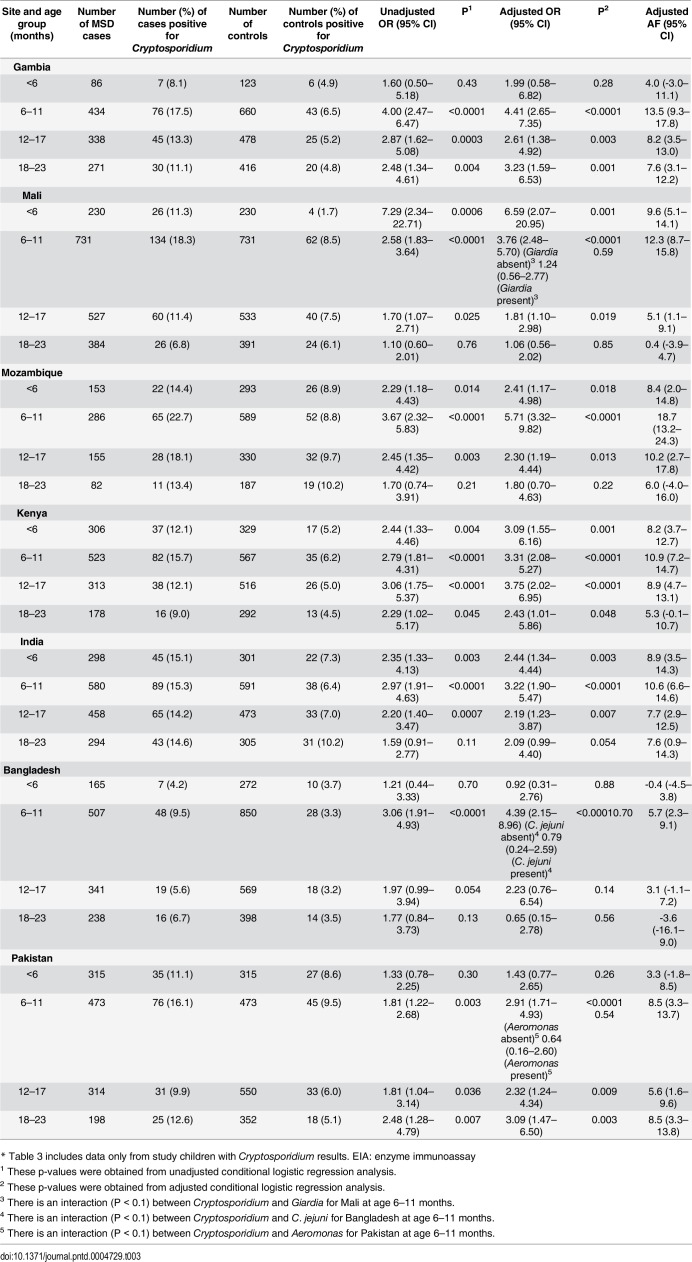
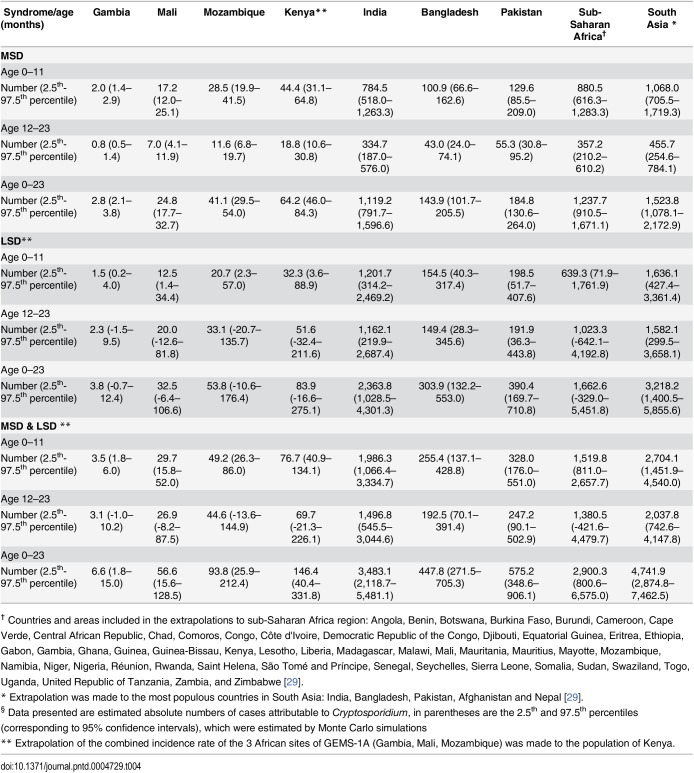
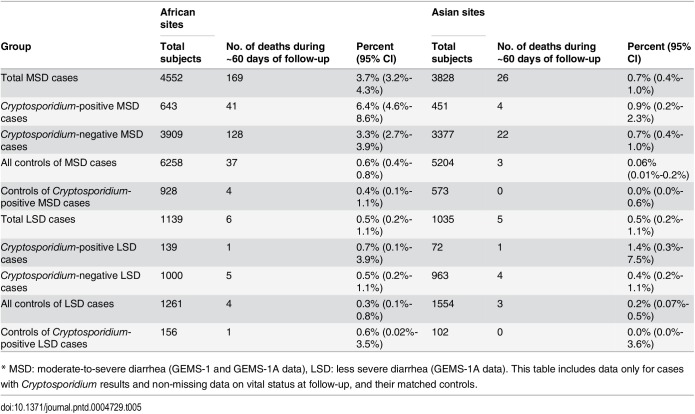
Cryptosporidium was significantly associated with MSD and LSD below age 24 months. Among Cryptosporidium-positive MSD cases, C. hominis was detected in 77.8% (95% CI, 73.0%-81.9%) and C. parvum in 9.9% (95% CI, 7.1%-13.6%); 92% of C. parvum tested were anthroponotic genotypes. Annual Cryptosporidium-attributable MSD incidence was 3.48 (95% CI, 2.27–4.67) and 3.18 (95% CI, 1.85–4.52) per 100 child-years in African and Asian infants, respectively, and 1.41 (95% CI, 0.73–2.08) and 1.36 (95% CI, 0.66–2.05) per 100 child-years in toddlers. Corresponding Cryptosporidium-attributable LSD incidences per 100 child-years were 2.52 (95% CI, 0.33–5.01) and 4.88 (95% CI, 0.82–8.92) in infants and 4.04 (95% CI, 0.56–7.51) and 4.71 (95% CI, 0.24–9.18) in toddlers. We estimate 2.9 and 4.7 million Cryptosporidium-attributable cases annually in children aged <24 months in the sub-Saharan Africa and India/Pakistan/Bangladesh/Nepal/Afghanistan regions, respectively, and ~202,000 Cryptosporidium-attributable deaths (regions combined). ~59,000 excess deaths occurred among Cryptosporidium-attributable diarrhea cases over expected if cases had been Cryptosporidium-negative.
Conclusions
The enormous African/Asian Cryptosporidium disease burden warrants investments to develop vaccines, diagnostics and therapies.
-
Subjects:
-
Source:PLoS Negl Trop Dis. 10(5).
-
Pubmed ID:27219054
-
Pubmed Central ID:PMC4878811
-
Document Type:
-
Place as Subject:
-
Volume:10
-
Issue:5
-
Collection(s):
-
Main Document Checksum:urn:sha256:85c0874d08a931d1531c2a9dab04b90e6cfd91e23bb6315e0e1db92c1eb75136
-
Download URL:
-
File Type:
 [PDF
- 963.41 KB
]
[PDF
- 963.41 KB
]
Supporting Files


File Language:
English
ON THIS PAGE






CDC STACKS serves as an archival repository of CDC-published products including
scientific findings,
journal articles, guidelines, recommendations, or other public health information authored or
co-authored by CDC or funded partners.
As a repository, CDC STACKS retains documents in their original published format to ensure public access to scientific information.
As a repository, CDC STACKS retains documents in their original published format to ensure public access to scientific information.
You May Also Like
COLLECTION
CDC Public Access