


The Concentration of Opioid Prescriptions by Providers and Patients in the Oregon Medicaid Program
Supporting Files

-
4 1 2016
-
File Language:
English
Details
-
Alternative Title:Psychiatr Serv
-
Personal Author:
-
Description:Objective
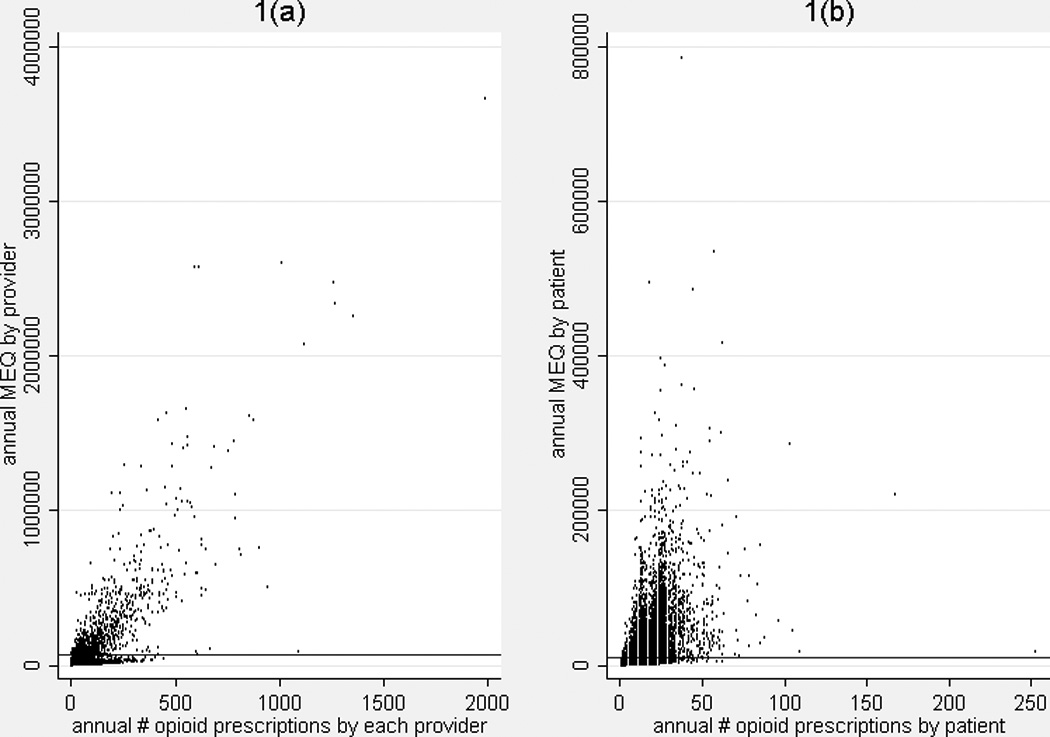
This study seeks to understand the distribution of opioid prescribing across providers and patients, and examines how this concentration predicts opioid misuse.
Methods
Using 2013 Oregon Medicaid claims and National Provider ID registry, this study identified patients who filled at least one opioid prescription and providers who prescribed opioids for those patients (N=61,477 Medicaid patients). This study examined the distribution of opioid prescriptions by provider and patient, the extent to which high-volume opioid use was associated with potential opioid misuse, and how this association changes when patients received opioids from providers in the top decile of morphine equivalents (MEQ) prescribed in 2013. This study used four indicators of opioid misuse: doctor and pharmacy shopping for opioid prescriptions, opioid prescription overlap, and opioid and benzodiazepine prescription overlap.
Results
Opioid use and prescriptions were heavily concentrated among the top 10% opioid users and prescribers. Those high-volume opioid users and prescribers accounted for 83.2% and 80.8% in MEQ of entire opioids prescribed. Patients’ increasing use of MEQ was associated with most measures of opioid misuse. Patients receiving opioids from high-volume prescribers had a higher probability of opioid prescription overlap and opioid and benzodiazepine prescription overlap, but the increase was significant only among patients who received high doses of opioids and the size of the increase was modest.
Conclusions
Whereas current policies emphasize reducing opioid prescriptions across all patients and providers, study results suggest potential for policies that focus on high-volume opioid users and prescribers.
-
Subjects:
-
Source:Psychiatr Serv. 67(4):397-404
-
Pubmed ID:26766755
-
Pubmed Central ID:PMC4912042
-
Document Type:
-
Funding:UG1 DA015815/DA/NIDA NIH HHSUnited States/ ; R33 DA035640/DA/NIDA NIH HHSUnited States/ ; U01 CE002500/CE/NCIPC CDC HHSUnited States/ ; R01 DA 030431/DA/NIDA NIH HHSUnited States/ ; P50 DA018165/DA/NIDA NIH HHSUnited States/ ; R01 DA030431/DA/NIDA NIH HHSUnited States/ ; R01MH1000001/MH/NIMH NIH HHSUnited States/ ; R01 MH100001/MH/NIMH NIH HHSUnited States/ ; R33DA035640,/DA/NIDA NIH HHSUnited States/ ; R01 DA029716/DA/NIDA NIH HHSUnited States/
-
Volume:67
-
Issue:4
-
Collection(s):
-
Main Document Checksum:urn:sha256:08bce3e5efaf3692abeb5567fe6e45b7803f97d7d99d70b0e9ae03dfbeb0a128
-
Download URL:
-
File Type:
 [PDF
- 204.04 KB
]
[PDF
- 204.04 KB
]
Supporting Files


File Language:
English
ON THIS PAGE


CDC STACKS serves as an archival repository of CDC-published products including
scientific findings,
journal articles, guidelines, recommendations, or other public health information authored or
co-authored by CDC or funded partners.
As a repository, CDC STACKS retains documents in their original published format to ensure public access to scientific information.
As a repository, CDC STACKS retains documents in their original published format to ensure public access to scientific information.
You May Also Like
COLLECTION
CDC Public Access