


Primer Extension Enrichment Reaction (PEER): a new subtraction method for identification of genetic differences between biological specimens
Supporting Files
Public Domain

-
Jun 21 2006
-
Details
-
Alternative Title:Nucleic Acids Res
-
Personal Author:
-
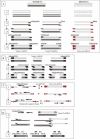
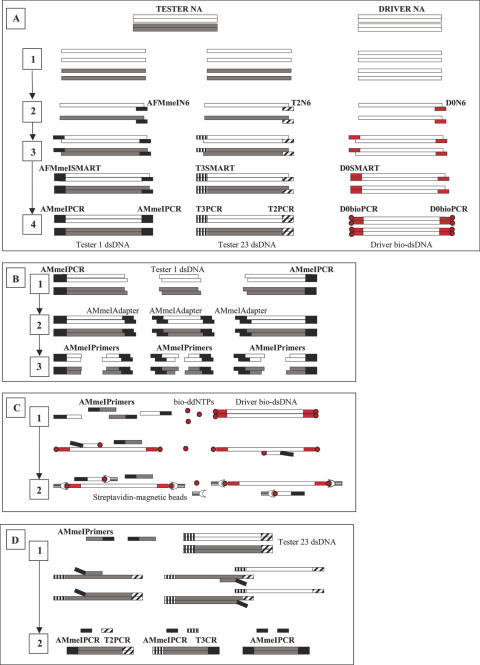
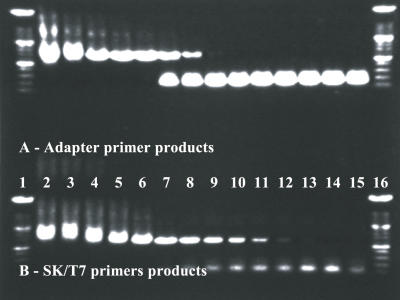
Description:We developed a conceptually new subtraction strategy for the detection and isolation of target DNA and/or RNA from complex nucleic acid mixtures, called Primer Extension Enrichment Reaction (PEER). PEER uses adapters and class IIS restriction enzymes to generate tagged oligonucleotides from dsDNA fragments derived from specimens containing an unknown target ('tester'). Subtraction is achieved by selectively disabling these oligonucleotides by extension reaction using ddNTPs and a double stranded DNA template generated from a pool of normal specimens ('driver'). Primers that do not acquire ddNTP are used to capture and amplify the unique target DNA from the original tester dsDNA. We successfully applied PEER to specimens containing known infectious agents (Hepatitis B Virus and Walrus Calicivirus) and demonstrated that it has higher efficiency than the best comparable technique. The strategy used for PEER is versatile and can be adapted for the identification of known and unknown pathogens and mutations, differential expression studies and other applications that allow the use of subtractive strategies.
-
Subjects:
-
Source:Nucleic Acids Res. 2006; 34(11):e76.
-
Document Type:
-
Volume:34
-
Issue:11
-
Collection(s):
-
Main Document Checksum:urn:sha-512:be4e8fbbc4accc8544ac698cebbaf74d16b1a55f0cb1f290b1790fea01140db22d52adca895e8f4a5936c9541bf29ac949cf9ebe33d8e6f8b05262de117cbbc0
-
Download URL:
-
File Type:
 [PDF
- 624.35 KB
]
[PDF
- 624.35 KB
]
Supporting Files


ON THIS PAGE


CDC STACKS serves as an archival repository of CDC-published products including
scientific findings,
journal articles, guidelines, recommendations, or other public health information authored or
co-authored by CDC or funded partners.
As a repository, CDC STACKS retains documents in their original published format to ensure public access to scientific information.
As a repository, CDC STACKS retains documents in their original published format to ensure public access to scientific information.
You May Also Like
COLLECTION
CDC Public Access