


Evaluation of case definitions to detect respiratory syncytial virus infection in hospitalized children below 5 years in Rural Western Kenya, 2009–2013
Supporting Files
Public Domain

-
May 21 2016
-
File Language:
English
Details
-
Alternative Title:BMC Infect Dis
-
Personal Author:
-
Description:Background
In order to better understand respiratory syncytial virus (RSV) epidemiology and burden in tropical Africa, optimal case definitions for detection of RSV cases need to be identified.
Methods
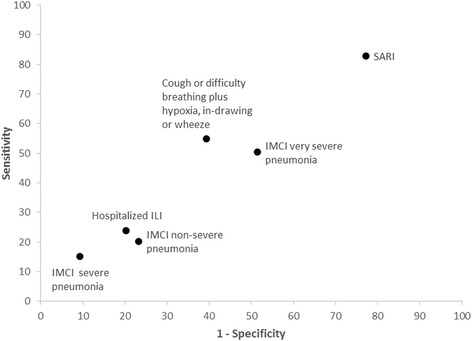
We used data collected between September 2009 - August 2013 from children aged <5 years hospitalized with acute respiratory Illness at Siaya County Referral Hospital. We evaluated the sensitivity, specificity, positive predictive value (PPV) and negative predictive value (NPV) of individual signs, symptoms and standard respiratory disease case definitions (severe acute respiratory illness [SARI]; hospitalized influenza-like illness [hILI]; integrated management of childhood illness [IMCI] pneumonia) to detect laboratory-confirmed RSV infection. We also evaluated an alternative case definition of cough or difficulty breathing plus hypoxia, in-drawing, or wheeze.
Results
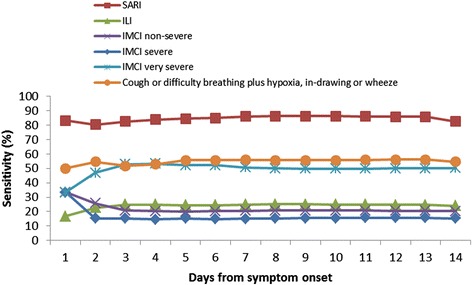
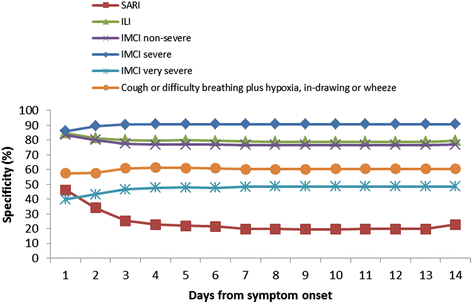
Among 4714 children hospitalized with ARI, 3810 (81 %) were tested for RSV; and 470 (12 %) were positive. Among individual signs and symptoms, cough alone had the highest sensitivity to detect laboratory-confirmed RSV [96 %, 95 % CI (95–98)]. Hypoxia, wheezing, stridor, nasal flaring and chest wall in-drawing had sensitivities ranging from 8 to 31 %, but had specificities >75 %. Of the standard respiratory case definitions, SARI had the highest sensitivity [83 %, 95 % CI (79–86)] whereas IMCI severe pneumonia had the highest specificity [91 %, 95 % CI (90–92)]. The alternative case definition (cough or difficulty breathing plus hypoxia, in-drawing, or wheeze) had a sensitivity of [55 %, 95 % CI (50–59)] and a specificity of [60 %, 95 % CI (59–62)]. The PPV for all case definitions and individual signs/symptoms ranged from 11 to 20 % while the negative predictive values were >87 %. When we stratified by age <1 year and 1- < 5 years, difficulty breathing, severe pneumonia and the alternative case definition were more sensitive in children aged <1 year [70 % vs. 54 %, p < 0.01], [19 % vs. 11 %, p = 0.01] and [66 % vs. 43 %, p < 0.01] respectively, while non-severe pneumonia was more sensitive [14 % vs. 26 %, p < 0.01] among children aged 1- < 5 years.
Conclusion
The sensitivity and specificity of different commonly used case definitions for detecting laboratory-confirmed RSV cases varied widely, while the positive predictive value was consistently low. Optimal choice of case definition will depend upon study context and research objectives.
-
Subjects:
-
Source:BMC Infect Dis. 16.
-
Pubmed ID:27207342
-
Pubmed Central ID:PMC4875667
-
Document Type:
-
Place as Subject:
-
Volume:16
-
Collection(s):
-
Main Document Checksum:urn:sha256:cce1808e888617f4625116646f7e9e1fd9b0d3606445af0d3c61f50d96aa34e2
-
Download URL:
-
File Type:
 [PDF
- 823.99 KB
]
[PDF
- 823.99 KB
]
Supporting Files


File Language:
English
ON THIS PAGE



CDC STACKS serves as an archival repository of CDC-published products including
scientific findings,
journal articles, guidelines, recommendations, or other public health information authored or
co-authored by CDC or funded partners.
As a repository, CDC STACKS retains documents in their original published format to ensure public access to scientific information.
As a repository, CDC STACKS retains documents in their original published format to ensure public access to scientific information.
You May Also Like
COLLECTION
CDC Public Access