



Exposure to Methyl tert-Butyl Ether and Benzene among Service Station Attendants and Operators
Supporting Files
Public Domain
Peer Reviewed

-
1993/12/01
File Language:
English
Details
-
Journal Article:Environmental Health Perspectives
-
Personal Author:
-
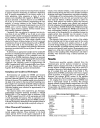
Description:The exposure of service station attendants and operators to methyl- tert-butyl-ether (1634044) (MTBE) and benzene (71432) was investigated. Service attendants with at least one full service island, and three categories of service (stations that did not use MTBE (Cincinnati, Ohio), those that had seasonal requirements to use 12% to 15% MTBE (Phoenix, Arizona), and those equipped with active vapor recovery systems (Los Angeles, California). Sampling consisted of about 60 shifts, two samples/shift. Personal air samples of one per 4 hour (hr) or two per 8hr shift were collected. Results from 27 Cincinnati samples showed MTBE contents of 0.03 to 0.13% liquid volume (LV%), with average benzene ranging from 0.39 to 0.86LV%. Highest MTBE and benzene contents were from regular grade gasoline (0.18 and 1.60 LV%, respectively). Average MTBE in Phoenix was much higher (1.18 to 1.63 LV%), while those in Los Angeles were 2.10 LV%. Benzene levels in Los Angeles were 1.76 to 2.00 LV%. MTBE and benzene exposure variations by location were calculated. Only one of 32 samples for MTBE was above the analytical limit of detection in Cincinnati at 0.16 parts per million (ppm). In Phoenix, where MTBE content averaged 12.5 to 13%, exposures averaged 0.30ppm. In Los Angeles, MTBE exposures averaged 0.14ppm. Higher MTBE exposures were correlated with the service station distributing premium grade fuel containing 11 LV% MTBE. Benzene exposures averaged 0.03ppm in Cincinnati, 0.05ppm in Phoenix, and 0.06ppm in Los Angeles. The author concludes that the average exposure to MTBE among service station attendants is below 1ppm, when at least 12% MTBE is used in fuels, and that this does not seem to affect benzene exposure patterns. Description provided by NIOSH
-
Subjects:
-
Keywords:
-
Source:Environ Health Perspect 1993 Dec; 101(Suppl 6):23-26
-
ISSN:0091-6765
-
Document Type:
-
Genre:
-
Place as Subject:
-
CIO:
-
Division:
-
Topic:
-
Location:
-
Pages in Document:4 pdf pages
-
Volume:101
-
Issue:6
-
NIOSHTIC Number:nn:00220783
-
Contact Point Address:Richard Hartle, Robert A. Taft Laboratories, National Institute for Occupational Safety and Health, 4676 Columbia Parkway, R/11, Cincinnati, OH 45226
-
CAS Registry Number:
-
Federal Fiscal Year:1994
-
Peer Reviewed:True
-
Download URL:
-
File Type:
 [PDF - 657.11 KB]
 -
Collection(s):
-
Main Document Checksum:urn:sha-512:d29ff6596d29b2f264d295e89b0004caa7d45d27ef22e4d1368c22415cbd0ee4e2da94779bd0558a5b22d943ad86de53d7af4a775c3d332f7556c3fccce85895
Supporting Files


File Language:
English
 Was this page helpful?
 Found an issue?



CDC STACKS serves as an archival repository of CDC-published products including
scientific findings, journal articles, guidelines, recommendations, or other public health information authored or
co-authored by CDC or funded partners.
As a repository, CDC STACKS retains documents in their original published format to ensure public access to scientific information.
As a repository, CDC STACKS retains documents in their original published format to ensure public access to scientific information.
You May Also Like