



Effect of Financial Stress and Positive Financial Behaviors on Cost-Related Nonadherence to Health Regimens Among Adults in a Community-Based Setting
Supporting Files

-
Apr 07 2016
File Language:
English
Details
-
Journal Article:Preventing Chronic Disease (PCD)
-
Personal Author:
-
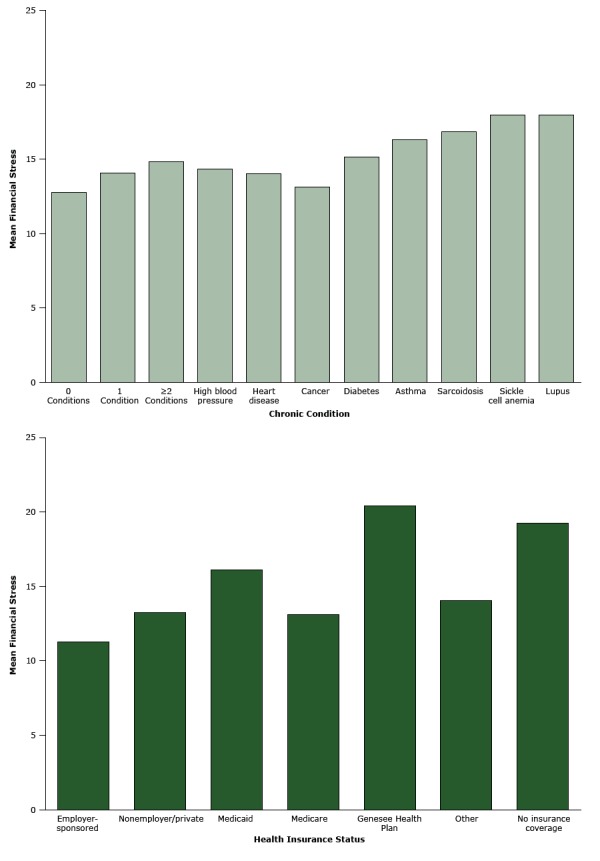
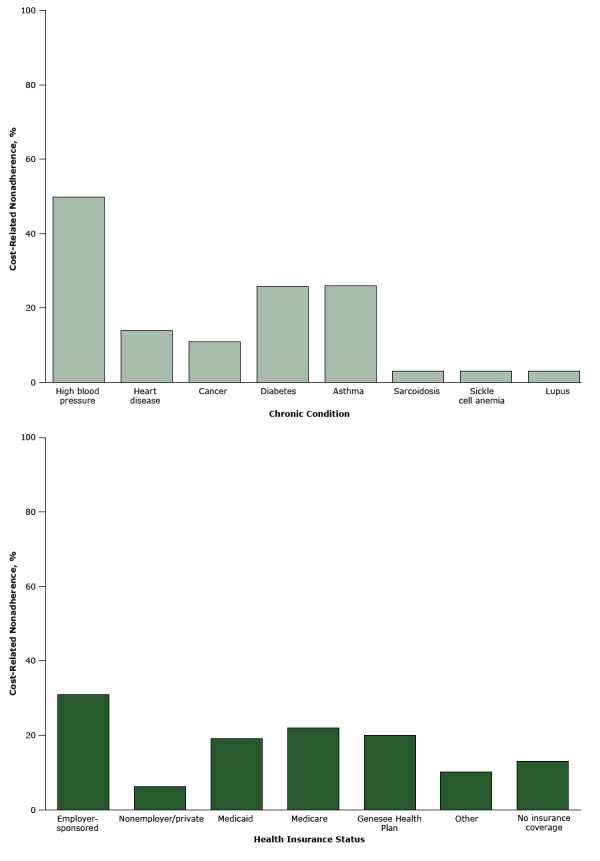
Description:Introduction ; Little is known about the role of positive financial behaviors (behaviors that allow maintenance of financial stability with financial resources) in mitigating cost-related nonadherence (CRN) to health regimens. This study examined the relationships between positive financial behaviors, financial stress, and CRN. ; Methods ; Data came from the 2011 Speak to Your Health! Community Survey (n = 1,234). Descriptive statistics were computed to examine financial stress and CRN, by chronic condition and health insurance status. We used multivariate logistic regression models to examine the relationship between positive financial behaviors and financial stress and their interaction on a composite score of CRN, controlling for health insurance status, educational level, age, marital status, number of chronic conditions, and employment status. ; Results ; Thirty percent of the sample engaged in CRN. Participants reported moderate financial stress (mean, 13.85; standard deviation SD = 6.97), and moderate positive financial behavior (mean, 8.84; SD = 3.24). Participants with employer-sponsored insurance, Medicaid, Medicare, the Genesee Health Plan, high blood pressure, asthma, and diabetes had the highest proportion of CRN. The relationship between financial stress and CRN was not significantly different between those who reported lower versus higher levels of positive financial behavior (P = .32). Greater financial stress was associated with a greater likelihood of CRN (odds ratio OR = 2.49; 95% confidence interval CI, 2.08–2.99). Higher level of positive financial behavior was associated with a lower likelihood of CRN (OR = 0.80; 95% CI, 0.67–0.94). ; Conclusion ; Financial literacy as a means of promoting positive financial behavior may help reduce CRN. An intervention strategy focused on improving financial literacy may be relevant for high-risk groups who report high levels of financial stress.
-
Subjects:
-
Source:Prev Chronic Dis. 13.
-
DOI:
-
ISSN:1545-1151
-
Pubmed ID:27055263
-
Pubmed Central ID:PMC4830259
-
Document Type:
-
Funding:
-
Place as Subject:
-
Location:
-
Volume:13
-
Download URL:
-
File Type:
 [PDF - 326.78 KB]
 -
Collection(s):
-
Main Document Checksum:urn:sha-512:44e73cd107283ab0d93d66d3bacc51303f07df4d349bd2f75bf18c729ec4fee94b28e332e63a2934ad7811ee270f416ff9ec7c453c4916f0c60597a78538eaf8
Supporting Files


File Language:
English
 Was this page helpful?
 Found an issue?


CDC STACKS serves as an archival repository of CDC-published products including
scientific findings, journal articles, guidelines, recommendations, or other public health information authored or
co-authored by CDC or funded partners.
As a repository, CDC STACKS retains documents in their original published format to ensure public access to scientific information.
As a repository, CDC STACKS retains documents in their original published format to ensure public access to scientific information.
You May Also Like
COLLECTION
Preventing Chronic Disease