


Treatment Decisions for Localized Prostate Cancer: A Concept Mapping Approach
Supporting Files

-
Feb 9 2014
-
Details
-
Alternative Title:Health Expect
-
Personal Author:
-
Description:Objective
Few decision aids emphasize active surveillance for localized prostate cancer. Concept mapping was used to produce a conceptual framework incorporating active surveillance and treatment.
Methods
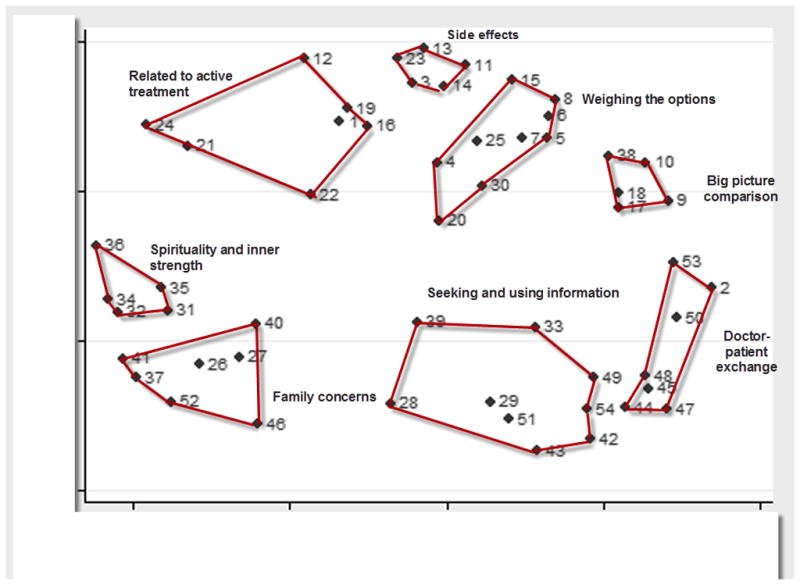
54 statements about what men need to make a decision for localized prostate cancer were derived from focus groups with African American, Latino, and white men previously screened for prostate cancer and partners (n=80). In the second phase, 89 participants sorted and rated the importance of statements.
Results
An 8 cluster map was produced for the overall sample. Clusters were labelled Doctor-patient exchange, Big picture comparisons, Weighing the options, Seeking and using information, Spirituality and inner strength, Related to active treatment, Side effects, and Family concerns. A major division was between medical and home-based clusters. Ethnic groups and genders had similar sorting, but some variation in importance. Latinos rated Big picture comparisons as less important. African Americans saw Spirituality and inner strength most important, followed by Latinos, then whites. Ethnic- and gender-specific concept maps were not analyzed because of high similarity in their sorting patterns.
Conclusions
We identified a conceptual framework for management of early stage prostate cancer that included coverage of active surveillance. Eliciting the conceptual framework is an important step in constructing decision aids which will address gaps related to active surveillance.
-
Subjects:
-
Source:Health Expect. 18(6):2079-2090.
-
Pubmed ID:24506829
-
Pubmed Central ID:PMC4128894
-
Document Type:
-
Funding:
-
Volume:18
-
Issue:6
-
Collection(s):
-
Main Document Checksum:urn:sha256:aa627e2d2f7fc717e497e21cd803439d6d30fa67889dcccac484c44fa10317e3
-
Download URL:
-
File Type:
 [PDF
- 272.09 KB
]
[PDF
- 272.09 KB
]
Supporting Files


ON THIS PAGE


CDC STACKS serves as an archival repository of CDC-published products including
scientific findings,
journal articles, guidelines, recommendations, or other public health information authored or
co-authored by CDC or funded partners.
As a repository, CDC STACKS retains documents in their original published format to ensure public access to scientific information.
As a repository, CDC STACKS retains documents in their original published format to ensure public access to scientific information.
You May Also Like
COLLECTION
CDC Public Access