


Pulmonary Reactions to Organic Dust Exposures: Development of an Animal Model
Supporting Files
Public Domain

-
1996/03/01
File Language:
English
Details
-
Journal Article:Environmental Health Perspectives
-
Personal Author:
-
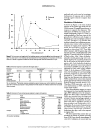
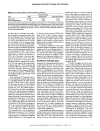
Description:In a review of acute organic dust induced reactions, development of animal models for the study of acute pulmonary responses to organic dust exposures was discussed, and pathological responses resulting from inhaling organic dusts were described. Acute inhalation of organic dusts such as cotton, hay, silage, grain, hemp, or animal confinement or compost dusts can cause an illness characterized by fever, pulmonary inflammation, chest tightness, or airway obstruction frequently referred to as organic dust toxic syndrome. It was noted that to fully characterize the reactions to various organic dusts including their dose dependence and time course, the mechanisms governing these reactions, and the etiologic agents present in the dust, it is necessary to develop animal models that can predict human responses to inhaling the dusts. The process of developing animal models for predicting human responses to acute organic dust inhalation consists of four steps: developing a suitable exposure system, characterizing the responses of an appropriate animal, working out a mechanism that can explain the responses, and identifying the etiologic agent. These steps were illustrated by describing an exposure system developed to investigate the pulmonary responses of guinea-pigs to cotton dust. The system was based on a Pitt 3 cotton dust generator that can generate respirable dusts from field samples. The guinea-pig has been found to be a suitable animal model because its responses to inhaled organic dusts are similar to those reported for humans exposed to cotton or compost dusts. The time course of the pulmonary responses of guinea-pigs more closely mimic those of humans than those of rats or mice. Inhalation of cotton dust has been shown to stimulate alveolar macrophages to produce mediators that act as chemoattractants for polymorphonuclear leukocytes (PMNs). Recruitment of PMNs appears to play a critical role in determining the pulmonary responses. Tumor-necrosis-factor-alpha also appears to be an important mediator of cotton dust induced pulmonary inflammation. Bacterial endotoxin, a common contaminant of cotton dust, is considered to be the major etiologic agent responsible for the pulmonary responses to cotton dust. There is evidence that n-formylmethionyl-leucyl-phenylalanine may also be involved in the pulmonary responses to cotton and other organic dusts. [Description provided by NIOSH]
-
Subjects:
-
Keywords:Author Keywords: Agricultural Dusts; Cotton Dusts; Mechanisms; Etiologic Agents; Byssinosis; Organic Dust Toxic Syndrome; Endotoxin; Exposure System; Animal Model NIOSH-Author; Organic-dusts; Inhalation-studies; Cotton-dust; Laboratory-animals; In-vivo-studies; Endotoxins; Physiological-response; Respiratory-system-disorders; Risk-analysis; Laboratory-equipment;
-
Source:Environ Health Perspect 1996 Mar; 104(Suppl 1):41-53
-
ISSN:0091-6765
-
Document Type:
-
Genre:
-
Place as Subject:
-
CIO:
-
Division:
-
Topic:
-
Location:
-
Pages in Document:13 pdf pages
-
Volume:104
-
NIOSHTIC Number:nn:00234086
-
Federal Fiscal Year:1996
-
NORA Priority Area:
-
Peer Reviewed:True
-
Collection(s):
-
Main Document Checksum:urn:sha-512:7d4b0deef5146dc46e2595348080b5fb8e9c62af88b26e8b16e363c382467e1f421d94a40e2275c5ca694865598dbdb097d20714cc5b0843b1d8a128c1d9a8d5
-
Download URL:
-
File Type:
 [PDF
- 3.35 MB
]
[PDF
- 3.35 MB
]
Supporting Files


File Language:
English
ON THIS PAGE








CDC STACKS serves as an archival repository of CDC-published products including
scientific findings,
journal articles, guidelines, recommendations, or other public health information authored or
co-authored by CDC or funded partners.
As a repository, CDC STACKS retains documents in their original published format to ensure public access to scientific information.
As a repository, CDC STACKS retains documents in their original published format to ensure public access to scientific information.
You May Also Like