


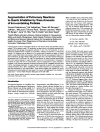
Augmentation of Pulmonary Reactions to Quartz Inhalation by Trace Amounts of Iron-Containing Particles
Supporting Files
Public Domain

-
1997/09/01
-
File Language:
English
Details
-
Journal Article:Environmental Health Perspectives
-
Personal Author:
-
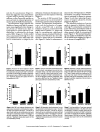
Description:The effects of iron (7439896) contamination on the pulmonary responses to quartz (14808607) dust were examined. Fischer-344-rats were exposed by whole body inhalation to 20mg/m3 of freshly milled quartz dust containing 57 parts per million (ppm) iron (low iron contamination) or 430ppm iron (high iron contamination) 5 hours daily for 10 days. The rats were killed after the 10 day period and the lungs were removed and lavaged. Changes in lavagate cellularity were determined. Alveolar macrophages (AMs) were recovered from the lavagate and their ability to produce reactive oxygen species (ROS) was assessed by measuring chemiluminescence following stimulation with zymosan and formation of oxygen radicals by electron spin resonance (ESR) using N-tert-butyl-phenylnitrone as the spin trap and nitric-oxide. Lung tissue samples were prepared and assayed for lipid peroxidation using the thiobarbituric-acid reactive substance assay. The surface reactivity of the quartz samples was evaluated by measuring surface free radicals by ESR spectroscopy. Milling quartz produced silicon and silicon oxyl radicals, the extent of formation not varying significantly between quartz samples with high and low iron contamination. When placed in aqueous medium, quartz with high iron contamination produced approximately 57% more reactive species than quartz samples with low levels of iron contamination, suggesting that contamination with 430ppm iron was sufficient to allow Fenton type reactions to occur in freshly milled quartz. Inhalation of quartz with high iron contamination induced significantly greater influx of red blood cells and leukocytes into the lavage fluid than inhalation of quartz with low iron contamination, indicating that the higher level of iron contamination promoted more damage to the alveolar air/blood barrier and inflammation. AMs from rats exposed to quartz with high iron contamination produced more ROS and nitric-oxide than AMs from animals exposed to quartz with low iron contamination. Lung tissue lipid peroxidation was also greater in these animals. The authors conclude that trace contamination with iron can catalyze generation of hydroxyl radicals by freshly fractured quartz leading to increased lung damage and inflammation. [Description provided by NIOSH]
-
Subjects:
-
Keywords:
-
Source:Environ Health Perspect 1997 Sep; 105(Suppl 5):1319-1324
-
ISSN:0091-6765
-
Document Type:
-
Genre:
-
Place as Subject:
-
CIO:
-
Division:
-
Topic:
-
Location:
-
Pages in Document:6 pdf pages
-
Volume:105
-
NIOSHTIC Number:nn:00239971
-
Contact Point Address:Dr. V. Castranova, PPRB/HELD/NIOSH, 1095 Willowdale Road (M/S 2015), Morgantown, WV 26505
-
CAS Registry Number:
-
Federal Fiscal Year:1997
-
NORA Priority Area:
-
Peer Reviewed:True
-
Collection(s):
-
Main Document Checksum:urn:sha-512:51dbdab6856c23e97cc705be6f0f309672afc1047a711bdf83256cbcb01bc2325f48957be72bd8b2b548772530dc3449d9dd7b79b30c072dc8492e8b03b57589
-
Download URL:
-
File Type:
 [PDF
- 1.32 MB
]
[PDF
- 1.32 MB
]
Supporting Files


File Language:
English
ON THIS PAGE



CDC STACKS serves as an archival repository of CDC-published products including
scientific findings,
journal articles, guidelines, recommendations, or other public health information authored or
co-authored by CDC or funded partners.
As a repository, CDC STACKS retains documents in their original published format to ensure public access to scientific information.
As a repository, CDC STACKS retains documents in their original published format to ensure public access to scientific information.
You May Also Like