


GENOME EDITING IN HUMAN CELLS USING CRISPR/CAS NUCLEASES
Supporting Files

-
Oct 01 2015
Details
-
Alternative Title:Curr Protoc Mol Biol
-
Personal Author:
-
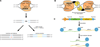
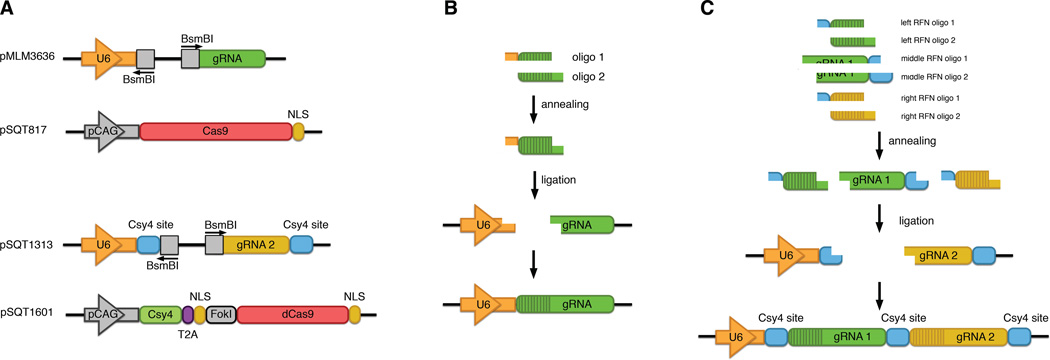
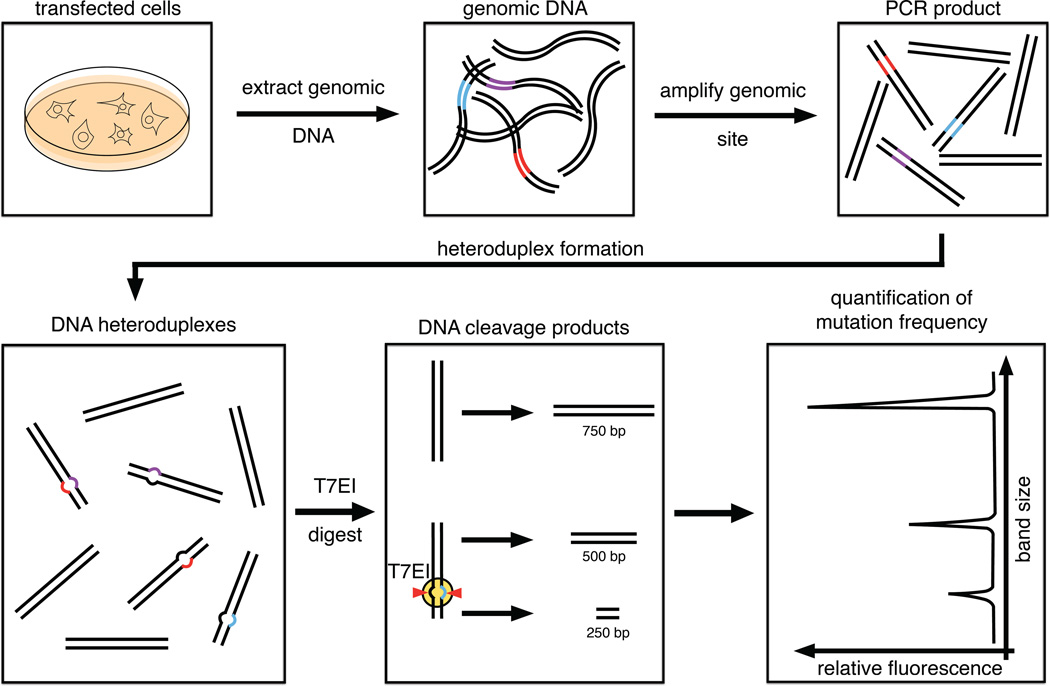
Description:The clustered regularly interspaced short palindromic repeat (CRISPR)/CRISPR-associated (Cas) system has been broadly adopted for highly efficient genome editing in a variety of model organisms and human cell types. Unlike previous genome editing technologies such as zinc finger nucleases (ZFNs) and transcription activator-like effector nucleases (TALENs), CRISPR/Cas technology does not require complex protein engineering and can be utilized by any researcher proficient in basic molecular biology and cell culture techniques. This unit describes protocols for design and cloning of vectors expressing single or multiplex gRNAs, for transient transfection of human cell lines, and for quantitation of mutation frequencies by T7 endonuclease I assay. These protocols also include guidance for using two improvements that increase the specificity of CRISPR/Cas nucleases: truncated gRNAs and dimeric RNA-guided FokI nucleases.
-
Subjects:
-
Source:Curr Protoc Mol Biol. 112:31.3.1-31.318.
-
Pubmed ID:26423589
-
Pubmed Central ID:PMC4852847
-
Document Type:
-
Funding:
-
Volume:112
-
Collection(s):
-
Main Document Checksum:urn:sha256:043681f6ae0ef452bbdfa42939b11028c10de689497beec12e77ebaebda4fe55
-
Download URL:
-
File Type:
 [PDF
- 1.05 MB
]
[PDF
- 1.05 MB
]
Supporting Files


ON THIS PAGE







CDC STACKS serves as an archival repository of CDC-published products including
scientific findings,
journal articles, guidelines, recommendations, or other public health information authored or
co-authored by CDC or funded partners.
As a repository, CDC STACKS retains documents in their original published format to ensure public access to scientific information.
As a repository, CDC STACKS retains documents in their original published format to ensure public access to scientific information.
You May Also Like
COLLECTION
CDC Public Access