


Reduction of Elevated Blood Lead Levels in Children in North Carolina and Vermont, 1996–1999
Supporting Files
Public Domain

-
Jul 2008
-
File Language:
English
Details
-
Alternative Title:Environ Health Perspect
-
Personal Author:
-
Description:Background
Few studies have examined factors related to the time required for children’s blood lead levels (BLLs) ≥ 10 μg/dL to decline to < 10 μg/dL.
Objectives
We used routinely collected surveillance data to determine the length of time and risk factors associated with reducing elevated BLLs in children below the level of concern of 10 μg/dL.
Methods
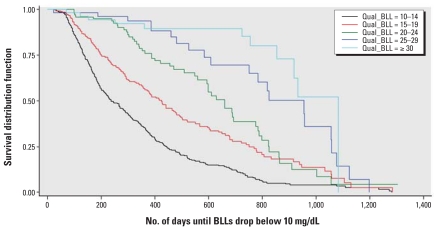
From the North Carolina and Vermont state surveillance databases, we identified a retrospective cohort of 996 children < 6 years of age whose first two blood lead tests produced levels ≥ 10 μg/dL during 1996–1999. Data were stratified into five categories of qualifying BLLs and analyzed using Cox regression. Survival curves were used to describe the time until BLLs declined below the level of concern. We compared three different analytic methods to account for children lost to follow-up.
Results
On average, it required slightly more than 1 year (382 days) for a child’s BLL to decline to < 10 μg/dL, with the highest BLLs taking even longer. The BLLs of black children [hazard ratio (HR) = 0.84; 95% confidence interval (CI), 0.71–0.99], males (HRmale = 0.83; 95% CI, 0.71–0.98), and children from rural areas (HRrural = 0.83; 95% CI, 0.70–0.97) took longer to fall below 10 μg/dL than those of other children, after controlling for qualifying BLL and other covariates. Sensitivity analysis demonstrated that including censored children estimated a longer time for BLL reduction than when using linear interpolation or when excluding censored children.
Conclusion
Children with high confirmatory BLLs, black children, males, and children from rural areas may need additional attention during case management to expedite their BLL reduction time to < 10 μg/dL. Analytic methods that do not account for loss to follow-up may underestimate the time it takes for BLLs to fall below the recommended target level.
-
Subjects:
-
Source:Environ Health Perspect. 2008; 116(7):981-985.
-
Document Type:
-
Place as Subject:
-
Volume:116
-
Issue:7
-
Collection(s):
-
Main Document Checksum:urn:sha-512:166519466df13cfa35814911d7ae230efb9944ea3d1c3531d7820e2198840ca796176daa214e5bc12a42b4912ed33a225490191522d99d4c36c1355938639dc4
-
Download URL:
-
File Type:
 [PDF
- 136.06 KB
]
[PDF
- 136.06 KB
]
Supporting Files


File Language:
English
ON THIS PAGE

CDC STACKS serves as an archival repository of CDC-published products including
scientific findings,
journal articles, guidelines, recommendations, or other public health information authored or
co-authored by CDC or funded partners.
As a repository, CDC STACKS retains documents in their original published format to ensure public access to scientific information.
As a repository, CDC STACKS retains documents in their original published format to ensure public access to scientific information.
You May Also Like
COLLECTION
CDC Public Access