


Comparative effectiveness of high-dose versus standard-dose influenza vaccines in US residents aged 65 years and older from 2012 to 2013 using Medicare data: a retrospective cohort analysis
Supporting Files

-
3 2015
-
File Language:
English
Details
-
Alternative Title:Lancet Infect Dis
-
Personal Author:
-
Description:Background
A high-dose trivalent inactivated influenza vaccine was licensed in 2009 by the US Food and Drug Administration (FDA) on the basis of serological criteria. We sought to establish whether high-dose inactivated influenza vaccine was more effective for prevention of influenza-related visits and hospital admissions in US Medicare beneficiaries than was standard-dose inactivated influenza vaccine.
Methods
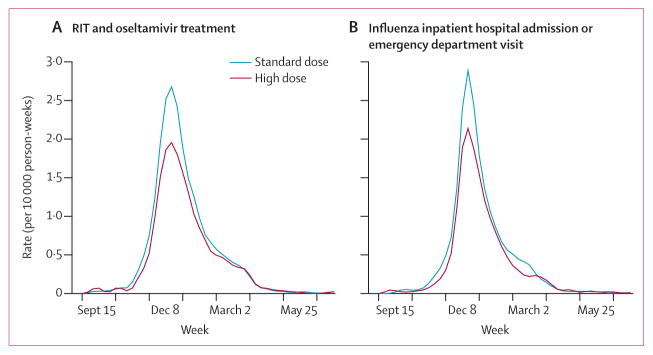
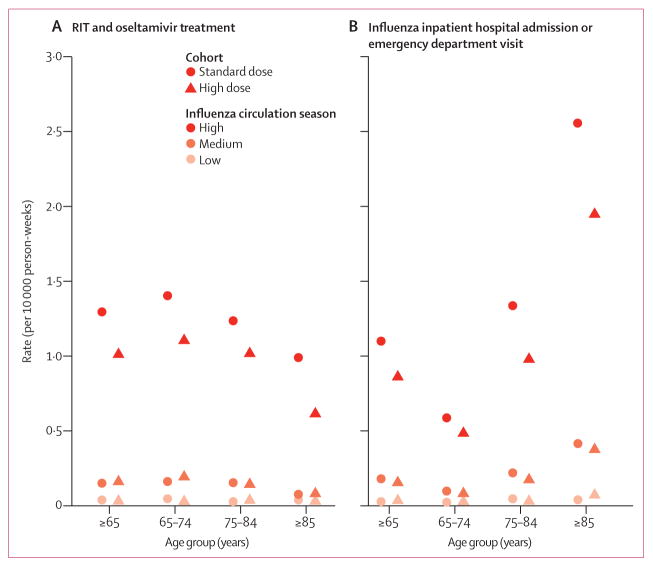
In this retrospective cohort study, we identified Medicare beneficiaries aged 65 years and older who received high-dose or standard-dose inactivated influenza vaccines from community pharmacies that offered both vaccines during the 2012–13 influenza season. Outcomes were defined with billing codes on Medicare claims. The primary outcome was probable influenza infection, defined by receipt of a rapid influenza test followed by dispensing of the neuraminidase inhibitor oseltamivir. The secondary outcome was a hospital or emergency department visit, listing a Medicare billing code for influenza. We estimated relative vaccine effectiveness by comparing outcome rates in Medicare beneficiaries during periods of high influenza circulation. Univariate and multivariate Poisson regression models were used for analyses.
Findings
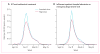
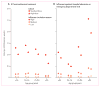
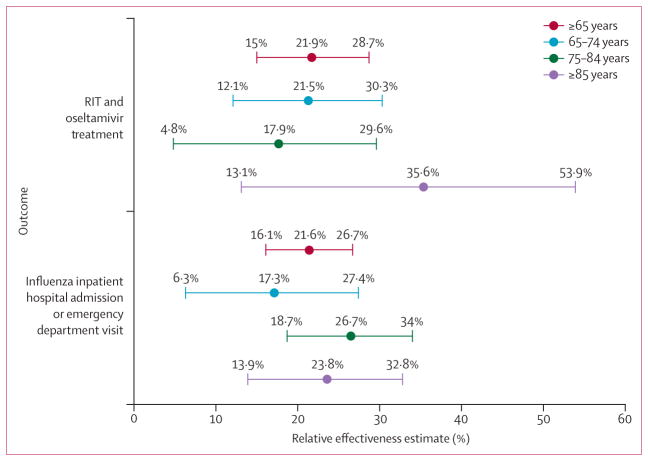
Between Aug 1, 2012 and Jan 31, 2013, we studied 929 730 recipients of high-dose vaccine and 1 615 545 recipients of standard-dose vaccine. Participants enrolled in each cohort were well balanced with respect to age and presence of underlying medical disorders. The high-dose vaccine (1·30 outcomes per 10 000 person-weeks) was 22% (95% CI 15–29) more effective than the standard-dose vaccine (1·01 outcomes per 10 000 person-weeks) for prevention of probable influenza infections (rapid influenza test followed by oseltamivir treatment) and 22% (95% CI 16–27%) more effective for prevention of influenza hospital admissions (0·86 outcomes per 10 000 person-weeks in the high-dose cohort vs 1·10 outcomes per 10 000 person-weeks in the standard-dose cohort).
Interpretation
Our retrospective cohort study in US Medicare beneficiaries shows that, in people 65 years of age and older, high-dose inactivated influenza vaccine was significantly more effective than standard-dose vaccine in prevention of influenza-related medical encounters. Additionally, the large population in our study enabled us to show, for the first time, a significant reduction in influenza-related hospital admissions in high-dose compared to standard-dose vaccine recipients, an outcome not shown in randomised studies. These results provide important new information to be considered by policy makers recommending influenza vaccinations for elderly people.
Funding
FDA and the office of the Assistant Secretary of Planning and Evaluation.
-
Subjects:
-
Source:Lancet Infect Dis. 15(3):293-300
-
Pubmed ID:25672568
-
Pubmed Central ID:PMC4834448
-
Document Type:
-
Funding:
-
Volume:15
-
Issue:3
-
Collection(s):
-
Main Document Checksum:urn:sha256:2782ffeec7ebc47cc6d8c58705e0267ce556d7b3b663e1435ebda350dbaefe91
-
Download URL:
-
File Type:
 [PDF
- 218.35 KB
]
[PDF
- 218.35 KB
]
Supporting Files


File Language:
English
ON THIS PAGE

CDC STACKS serves as an archival repository of CDC-published products including
scientific findings,
journal articles, guidelines, recommendations, or other public health information authored or
co-authored by CDC or funded partners.
As a repository, CDC STACKS retains documents in their original published format to ensure public access to scientific information.
As a repository, CDC STACKS retains documents in their original published format to ensure public access to scientific information.
You May Also Like
COLLECTION
CDC Public Access