


Evaluation of Viremia Frequencies of a Novel Human Pegivirus by Using Bioinformatic Screening and PCR
Supporting Files
Public Domain

-
Apr 2016
-
Details
-
Alternative Title:Emerg Infect Dis
-
Personal Author:Bonsall, David ; Gregory, William F. ; Ip, Camilla L.C. ; Donfield, Sharyne ; Iles, James ; Ansari, M. Azim ; Piazza, Paolo ; Trebes, Amy ; Brown, Anthony ; Frater, John ; Pybus, Oliver G. ; Goulder, Phillip ; Klenerman, Paul ; Bowden, Rory ; Gomperts, Edward D. ; Barnes, Eleanor ; Kapoor, Amit ; Sharp, Colin P. ; Simmonds, Peter
-
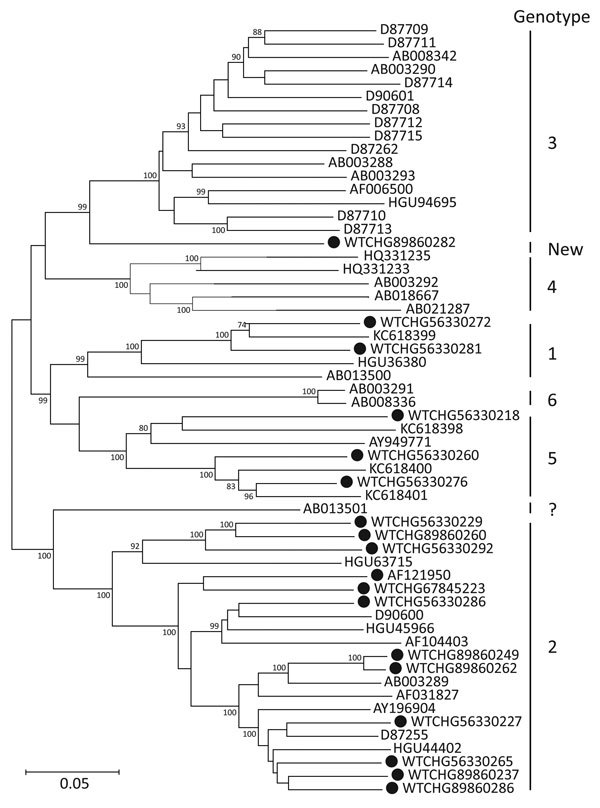
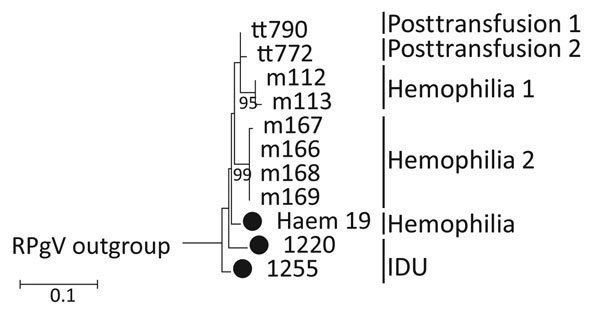
Description:Next-generation sequencing has critical applications in virus discovery, diagnostics, and environmental surveillance. We used metagenomic sequence libraries for retrospective screening of plasma samples for the recently discovered human hepegivirus 1 (HHpgV-1). From a cohort of 150 hepatitis C virus (HCV)-positive case-patients, we identified 2 persons with HHpgV-1 viremia and a high frequency of human pegivirus (HPgV) viremia (14%). Detection of HHpgV-1 and HPgV was concordant with parallel PCR-based screening using conserved primers matching groups 1 (HPgV) and 2 (HHPgV-1) nonstructural 3 region sequences. PCR identified 1 HHPgV-1-positive person with viremia from a group of 195 persons with hemophilia who had been exposed to nonvirally inactivated factor VII/IX; 18 (9%) were HPgV-positive. Relative to HCV and HPgV, active infections with HHpgV-1 were infrequently detected in blood, even in groups that had substantial parenteral exposure. Our findings are consistent with lower transmissibility or higher rates of virus clearance for HHpgV-1 than for other bloodborne human flaviviruses.
-
Subjects:
-
Source:Emerg Infect Dis. 22(4):671-678.
-
Pubmed ID:26982117
-
Pubmed Central ID:PMC4806942
-
Document Type:
-
Volume:22
-
Issue:4
-
Collection(s):
-
Main Document Checksum:urn:sha256:6cf5898756aa547289c3f4755081402040e6d10ab16b673fe051123e3538687c
-
Download URL:
-
File Type:
 [PDF
- 621.97 KB
]
[PDF
- 621.97 KB
]
Supporting Files


ON THIS PAGE


CDC STACKS serves as an archival repository of CDC-published products including
scientific findings,
journal articles, guidelines, recommendations, or other public health information authored or
co-authored by CDC or funded partners.
As a repository, CDC STACKS retains documents in their original published format to ensure public access to scientific information.
As a repository, CDC STACKS retains documents in their original published format to ensure public access to scientific information.
You May Also Like
COLLECTION
Emerging Infectious Diseases