



Nosocomial Co-Transmission of Avian Influenza A(H7N9) and A(H1N1)pdm09 Viruses between 2 Patients with Hematologic Disorders
Supporting Files
Public Domain

-
Apr 2016
File Language:
English
Details
-
Alternative Title:Emerg Infect Dis
-
Personal Author:Chen, Huazhong ; Liu, Shelan ; Liu, Jun ; Chai, Chengliang ; Mao, Haiyan ; Yu, Zhao ; Tang, Yuming ; Zhu, Geqin ; Chen, Haixiao X. ; Zhu, Chengchu ; Shao, Hui ; Tan, Shuguang ; Wang, Qianli ; Bi, Yuhai ; Zou, Zhen ; Liu, Guang ; Jin, Tao ; Jiang, Chengyu ; Gao, George F. ; Peiris, Malik ; Yu, Hongjie ; Chen, Enfu
-
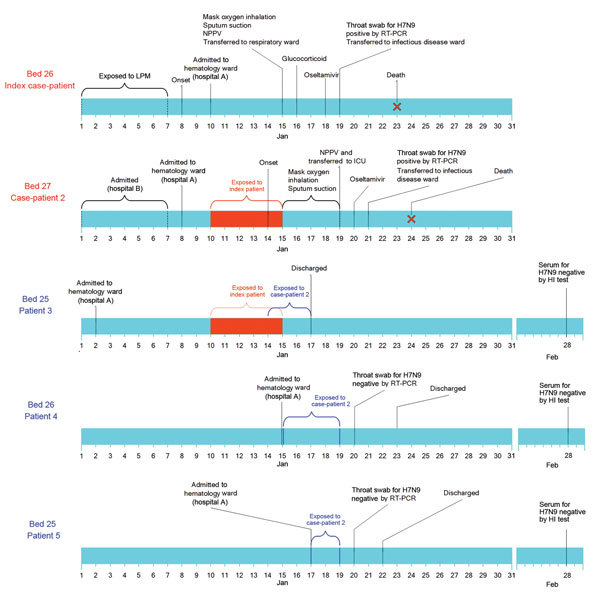
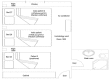
Description:A nosocomial cluster induced by co-infections with avian influenza A(H7N9) and A(H1N1)pdm09 (pH1N1) viruses occurred in 2 patients at a hospital in Zhejiang Province, China, in January 2014. The index case-patient was a 57-year-old man with chronic lymphocytic leukemia who had been occupationally exposed to poultry. He had co-infection with H7N9 and pH1N1 viruses. A 71-year-old man with polycythemia vera who was in the same ward as the index case-patient for 6 days acquired infection with H7N9 and pH1N1 viruses. The incubation period for the second case-patient was estimated to be <4 days. Both case-patients died of multiple organ failure. Virus genetic sequences from the 2 case-patients were identical. Of 103 close contacts, none had acute respiratory symptoms; all were negative for H7N9 virus. Serum samples from both case-patients demonstrated strong proinflammatory cytokine secretion but incompetent protective immune responses. These findings strongly suggest limited nosocomial co-transmission of H7N9 and pH1N1 viruses from 1 immunocompromised patient to another.
-
Subjects:
- Aged
- Animals
- Cross Infection
- Cytokines
- Fatal Outcome
- Humans
- Immunocompromised Host
- Influenza A Virus, H1N1 Subtype
- Influenza A Virus, H7N9 Subtype
- Influenza In Birds
- Influenza, Human
- Leukemia, Lymphocytic, Chronic, B-Cell
- Male
- Middle Aged
- Occupational Exposure
- Polycythemia Vera
- Poultry
- Poultry Diseases
-
Source:Emerg Infect Dis. 22(4):598-607.
-
Pubmed ID:26982379
-
Pubmed Central ID:PMC4806937
-
Document Type:
-
Place as Subject:
-
Volume:22
-
Issue:4
-
Download URL:
-
File Type:
 [PDF - 848.09 KB]
 -
Collection(s):
-
Main Document Checksum:urn:sha256:039116da8212270b9605d4497a786a4d71b1912ddc4d52cfa5c57a64f518e85c
Supporting Files


File Language:
English
 Was this page helpful?
 Found an issue?


CDC STACKS serves as an archival repository of CDC-published products including
scientific findings, journal articles, guidelines, recommendations, or other public health information authored or
co-authored by CDC or funded partners.
As a repository, CDC STACKS retains documents in their original published format to ensure public access to scientific information.
As a repository, CDC STACKS retains documents in their original published format to ensure public access to scientific information.
You May Also Like
COLLECTION
Emerging Infectious Diseases