


Respiratory Morbidity in Office Workers in a Water-Damaged Building
Supporting Files
Public Domain

-
2005/04/01
-
File Language:
English
Details
-
Journal Article:Environmental Health Perspectives
-
Personal Author:
-
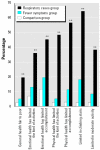
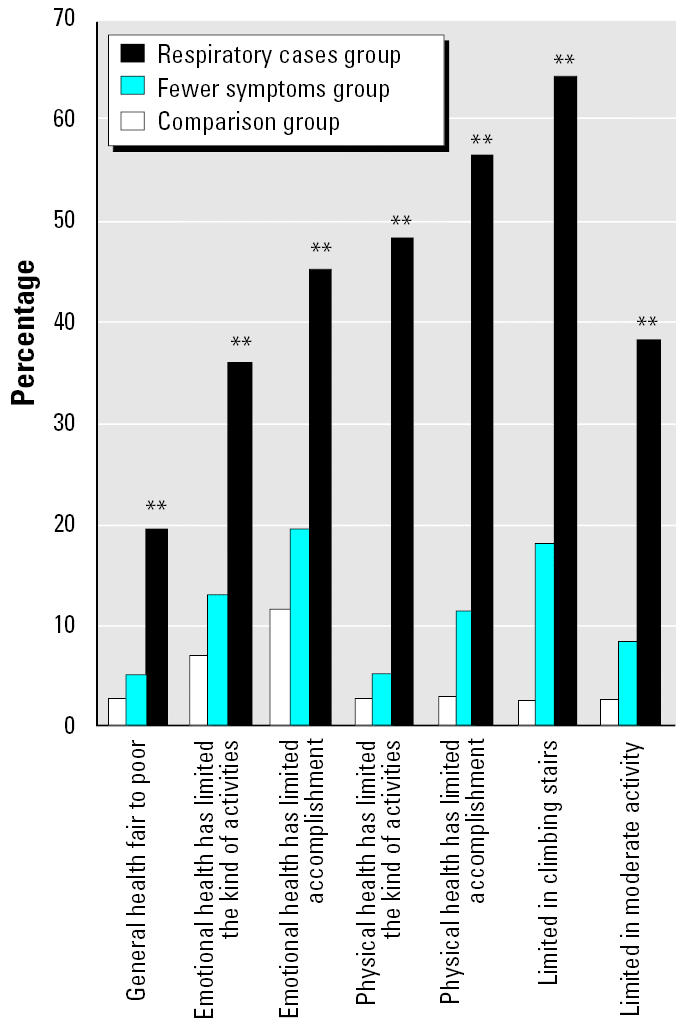
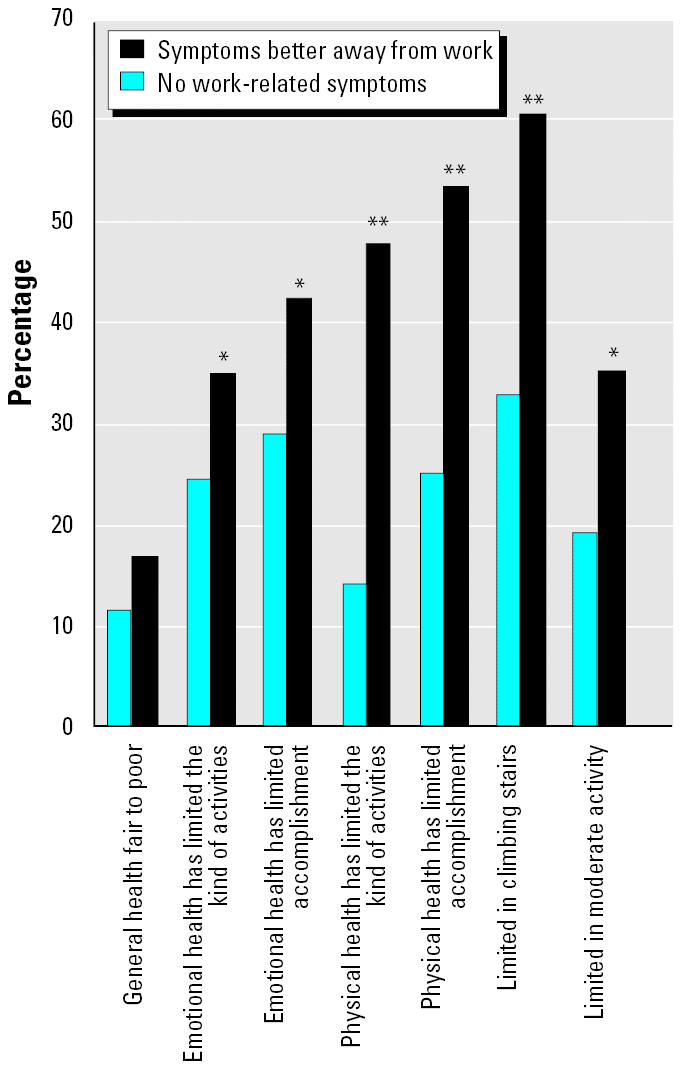
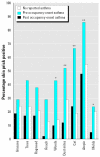
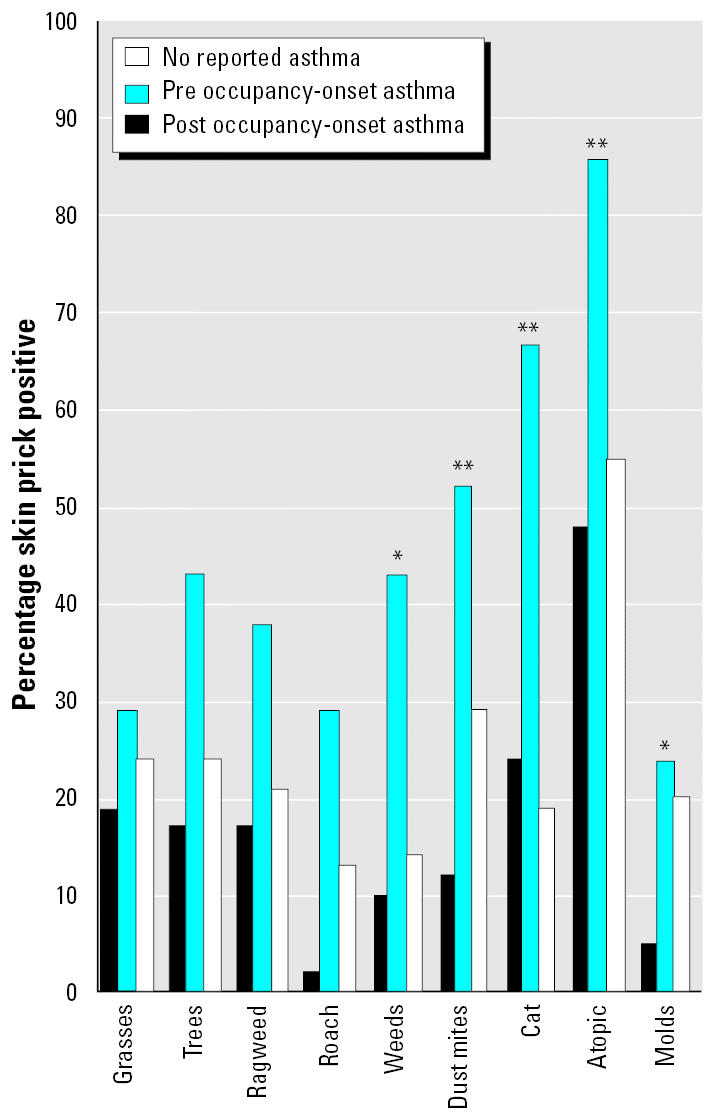
Description:We conducted a study on building-related respiratory disease and associated social impact in an office building with water incursions in the northeastern United States. An initial questionnaire had 67% participation (888/1,327). Compared with the U.S. adult population, prevalence ratios were 2.2-2.5 for wheezing, lifetime asthma, and current asthma, 3.3 for adult-onset asthma, and 3.4 for symptoms improving away from work (p < 0.05). Two-thirds (66/103) of the adult-onset asthma arose after occupancy, with an incidence rate of 1.9/1,000 person-years before building occupancy and 14.5/1,000 person-years after building occupancy. We conducted a second survey on 140 respiratory cases, 63 subjects with fewer symptoms, and 44 comparison subjects. Health-related quality of life decreased with increasing severity of respiratory symptoms and in those with work-related symptoms. Symptom status was not associated with job satisfaction or how often jobs required hard work. Respiratory health problems accounted for one-third of sick leave, and respiratory cases with work-related symptoms had more respiratory sick days than those without work-related symptoms (9.4 vs. 2.4 days/year; p < 0.01). Abnormal lung function and/or breathing medication use was found in 67% of respiratory cases, in 38% of participants with fewer symptoms, and in 11% of the comparison group (p < 0.01), with similar results in never-smokers. Postoccupancy-onset asthma was associated with less atopy than preoccupancy-onset asthma. Occupancy of the water-damaged building was associated with onset and exacerbation of respiratory conditions, confirmed by objective medical tests. The morbidity and lost work time burdened both employees and employers. [Description provided by NIOSH]
-
Subjects:
-
Keywords:Author Keywords: Building-related Symptoms; Hypersensitivity Pneumonitis; Indoor Environment; Occupational Asthma; Office Workers; Quality Of Life; Sarcoidosis; Sick Leave Respiratory-system-disorders; Hypersensitivity; Environmental-exposure; Environmental-hazards; Lung-function; Morbidity-rates; Office-workers; Pulmonary-system-disorders; Microorganisms;
-
Source:Environ Health Perspect 2005 Apr; 113(4):485-490
-
ISSN:0091-6765
-
Document Type:
-
Genre:
-
Place as Subject:
-
CIO:
-
Division:
-
Topic:
-
Location:
-
Pages in Document:6 pdf pages
-
Volume:113
-
Issue:4
-
NIOSHTIC Number:nn:20026466
-
Contact Point Address:J.M. Cox-Ganser, National Institute for Occupational Safety and Health, Suite H-2800, 1095 Willowdale Rd., Morgantown, WV 26505 USA
-
Email:jjc8@cdc.gov
-
Federal Fiscal Year:2005
-
NORA Priority Area:
-
Peer Reviewed:True
-
Collection(s):
-
Main Document Checksum:urn:sha-512:7d8e3e2e379d75d6a19b5c6c63bbcf2e20e9364326e0afd0c697bfadf38cceeb2e72f8bf63ca138fab19973d331c1c5dda48f21d55865533a745a317e7d9d39f
-
Download URL:
-
File Type:
 [PDF
- 128.90 KB
]
[PDF
- 128.90 KB
]
Supporting Files


File Language:
English
ON THIS PAGE


CDC STACKS serves as an archival repository of CDC-published products including
scientific findings,
journal articles, guidelines, recommendations, or other public health information authored or
co-authored by CDC or funded partners.
As a repository, CDC STACKS retains documents in their original published format to ensure public access to scientific information.
As a repository, CDC STACKS retains documents in their original published format to ensure public access to scientific information.
You May Also Like