


Paternal Occupational Exposure to 2,3,7,8-Tetrachlorodibenzo-p-dioxin and Birth Outcomes of Offspring: Birth Weight, Preterm Delivery, and Birth Defects
Supporting Files
Public Domain

-
Oct 2004
-
Details
-
Alternative Title:Environ Health Perspect
-
Personal Author:
-
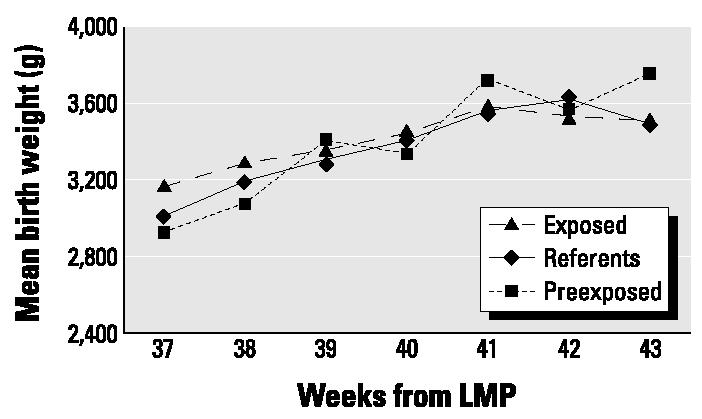
Description:Agent Orange is a phenoxy herbicide that was contaminated with 2,3,7,8-tetrachlorodibenzo-p-dioxin (TCDD). We studied pregnancy outcomes among wives of male chemical workers who were highly exposed to chemicals contaminated with TCDD and among wives of nonexposed neighborhood referents. For exposed pregnancies, we estimated serum TCDD concentration at the time of conception using a pharmacokinetic model. The mean TCDD concentration for workers' births was 254 pg/g lipid (range, 3-16,340 pg/g). The mean referent concentration of 6 pg/g was assigned to pregnancies fathered by workers before exposure. A total of 1,117 live singleton births of 217 referent wives and 176 worker wives were included. Only full-term births were included in the birth weight analysis (greater than or equal to 37 weeks of gestation). Mean birth weight among full-term babies was similar among referents' babies (n = 604), preexposure workers' babies (n = 221), and exposed workers' babies (n = 292) (3,420, 3,347, and 3,442 g, respectively). Neither continuous nor categorical TCDD concentration had an effect on birth weight for term infants after adjustment for infant sex, mother's education, parity, prenatal cigarette smoking, and gestation length. An analysis to estimate potential direct exposure of the wives during periods of workers' exposure yielded a nonstatistically significant increase in infant birth weight of 130 g in the highest exposure group (TCDD concentration > 254 pg/g) compared with referents (p = 0.09). Mothers' reports of preterm delivery showed a somewhat protective association with paternal TCDD (log) concentration (odds ratio = 0.8; 95% confidence interval, 0.6-1.1). We also include descriptive information on reported birth defects. Because the estimated TCDD concentrations in this population were much higher than in other studies, the results indicate that TCDD is unlikely to increase the risk of low birth weight or preterm delivery through a paternal mechanism. Key words: birth defects, birth weight, congenital anomalies, dioxin, occupation, paternal exposure, preterm birth, TCDD.
-
Subjects:
-
Source:Environ Health Perspect. 112(14):1403-1408.
-
Document Type:
-
Volume:112
-
Issue:14
-
Collection(s):
-
Main Document Checksum:urn:sha-512:69f05e12c5ef6baca190565f89ebf77387014e8cc7a52c53f2dbb2a62e0ca17e90a5681a561eab486a03401b6261969fc68f8f5bfb59dea4dafaa5f980e1bf63
-
Download URL:
-
File Type:
 [PDF
- 139.95 KB
]
[PDF
- 139.95 KB
]
Supporting Files


ON THIS PAGE

CDC STACKS serves as an archival repository of CDC-published products including
scientific findings,
journal articles, guidelines, recommendations, or other public health information authored or
co-authored by CDC or funded partners.
As a repository, CDC STACKS retains documents in their original published format to ensure public access to scientific information.
As a repository, CDC STACKS retains documents in their original published format to ensure public access to scientific information.
You May Also Like
COLLECTION
CDC Public Access