


Simulation of air quality and cost to ventilate swine farrowing facilities in winter
Supporting Files

-
10 2013
-
File Language:
English
Details
-
Alternative Title:Comput Electron Agric
-
Personal Author:
-
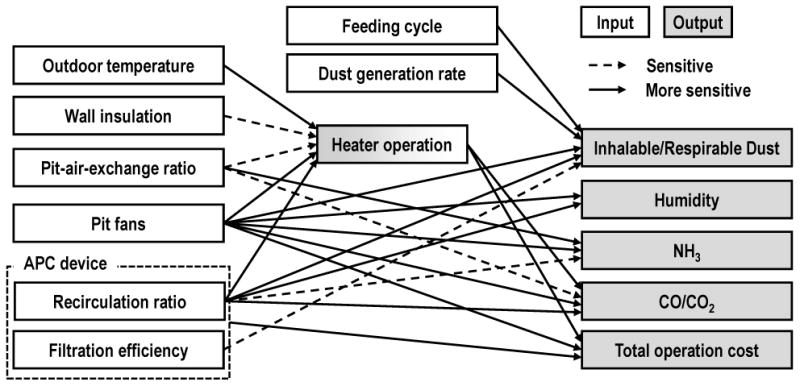
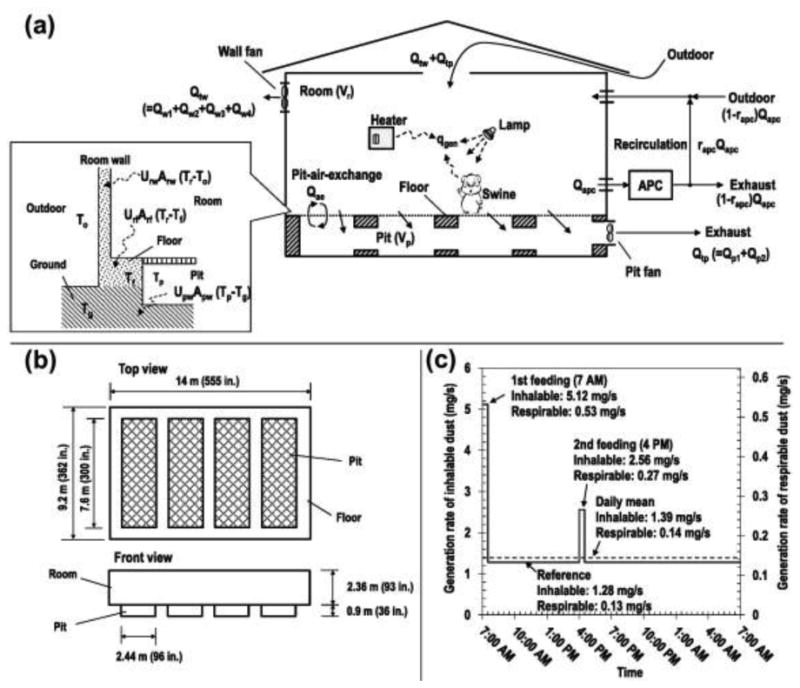
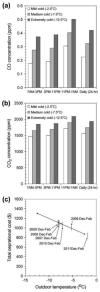
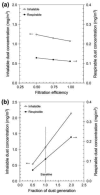
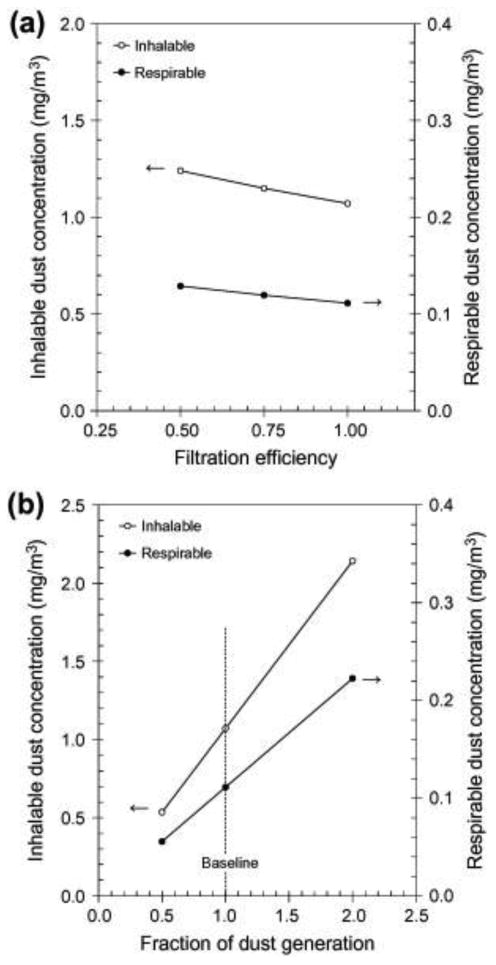
Description:We developed a simulation model to study the effect of ventilation airflow rate with and without filtered recirculation on airborne contaminant concentrations (dust, NH|, CO, and CO|) for swine farrowing facilities. Energy and mass balance equations were used to simulate the indoor air quality and operational cost for a variety of ventilation conditions over a 3-month winter period, using time-varied outdoor temperature. The sensitivity of input and output parameters on indoor air quality and operational cost were evaluated. Significant factors affecting model output included mean winter temperature, generation rate of contaminants, pit-air-exchange ratio, and recirculation ratio. As mean outdoor temperature was decreased from -2.5 °C to -12.5 °C, total operational costs were increased from $872 to $1304. Dust generation rate affected dust concentrations linearly. When dust generation rates changed -50% and +100% from baseline, indoor dust concentrations were changed -50% and +100%, respectively. The selection of a pit-air-exchange ratio was found critical to NH| concentration, but has little impact on other contaminants or cost. As the pit-air-exchange ratio was increased from 0.1 to 0.3, the NH| concentration was increased by a factor of 1.5. The recirculation ratio affected both IAQ factors and total operational cost. As the recirculation ratio decreased to 0, inhalable and respirable dust concentrations, humidity, NH| and CO| concentrations decreased and total operational cost ($2216) was 104% more than with pit-fan-only ventilation ($1088). When the recirculation ratio was 1, the total operational cost was increased by $573 (53%) compared to pit-fan-only. Simulation provides a useful tool for examining the costs and benefits to installing common ventilation technology to CAFO and, ultimately, making sound management decisions.
-
Keywords:
-
Source:Comput Electron Agric. 98:136-145
-
Pubmed ID:26937062
-
Pubmed Central ID:PMC4770838
-
Document Type:
-
Funding:
-
Volume:98
-
Collection(s):
-
Main Document Checksum:urn:sha256:aef59ca7ea3834227391f4f4b855e102d5e6b76f4672c0654fe52feddd0959d9
-
Download URL:
-
File Type:
 [PDF
- 795.74 KB
]
[PDF
- 795.74 KB
]
Supporting Files


File Language:
English
ON THIS PAGE





CDC STACKS serves as an archival repository of CDC-published products including
scientific findings,
journal articles, guidelines, recommendations, or other public health information authored or
co-authored by CDC or funded partners.
As a repository, CDC STACKS retains documents in their original published format to ensure public access to scientific information.
As a repository, CDC STACKS retains documents in their original published format to ensure public access to scientific information.
You May Also Like
COLLECTION
CDC Public Access