


Compliance to two city convenience store ordinance requirements
Supporting Files

-
Sep 02 2015
-
Details
-
Alternative Title:Inj Prev
-
Personal Author:
-
Description:Background
Robbery-related homicides and assaults are the leading cause of death in retail businesses. Robbery reduction approaches focus on compliance to Crime Prevention Through Environmental Design (CPTED) guidelines.
Purpose
We evaluated the level of compliance to CPTED guidelines specified by convenience store safety ordinances effective in 2010 in Dallas and Houston, Texas, USA.
Methods
Convenience stores were defined as businesses less than 10 000 square feet that sell grocery items. Store managers were interviewed for store ordinance requirements from August to November 2011, in a random sample of 594 (289 in Dallas, 305 in Houston) convenience stores that were open before and after the effective dates of their city’s ordinance. Data were collected in 2011 and analysed in 2012–2014.
Results
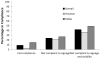
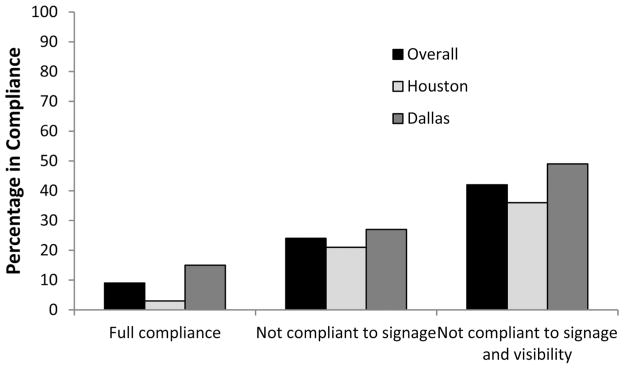
Overall, 9% of stores were in full compliance, although 79% reported being registered with the police departments as compliant. Compliance was consistently significantly higher in Dallas than in Houston for many requirements and by store type. Compliance was lower among single owner-operator stores compared with corporate/franchise stores. Compliance to individual requirements was lowest for signage and visibility.
Conclusions
Full compliance to the required safety measures is consistent with industry ‘best practices’ and evidence-based workplace violence prevention research findings. In Houston and Dallas compliance was higher for some CPTED requirements but not the less costly approaches that are also the more straightforward to adopt.
-
Subjects:
-
Source:Inj Prev. 22(2):117-122.
-
Pubmed ID:26337569
-
Pubmed Central ID:PMC4775448
-
Document Type:
-
Funding:
-
Volume:22
-
Issue:2
-
Collection(s):
-
Main Document Checksum:urn:sha256:93d4c7d55e6c4deffbef7ba9adee1f1383277f299b702c48c01c7f76226dc27d
-
Download URL:
-
File Type:
 [PDF
- 358.67 KB
]
[PDF
- 358.67 KB
]
Supporting Files


ON THIS PAGE



CDC STACKS serves as an archival repository of CDC-published products including
scientific findings,
journal articles, guidelines, recommendations, or other public health information authored or
co-authored by CDC or funded partners.
As a repository, CDC STACKS retains documents in their original published format to ensure public access to scientific information.
As a repository, CDC STACKS retains documents in their original published format to ensure public access to scientific information.
You May Also Like
COLLECTION
CDC Public Access