



Estimating Effects of Arsenic Exposure During Pregnancy on Perinatal Outcomes in a Bangladeshi Cohort
Supporting Files
Peer Reviewed

-
2016/03/01
File Language:
English
Details
-
Journal Article:Epidemiology
-
Personal Author:
-
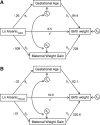
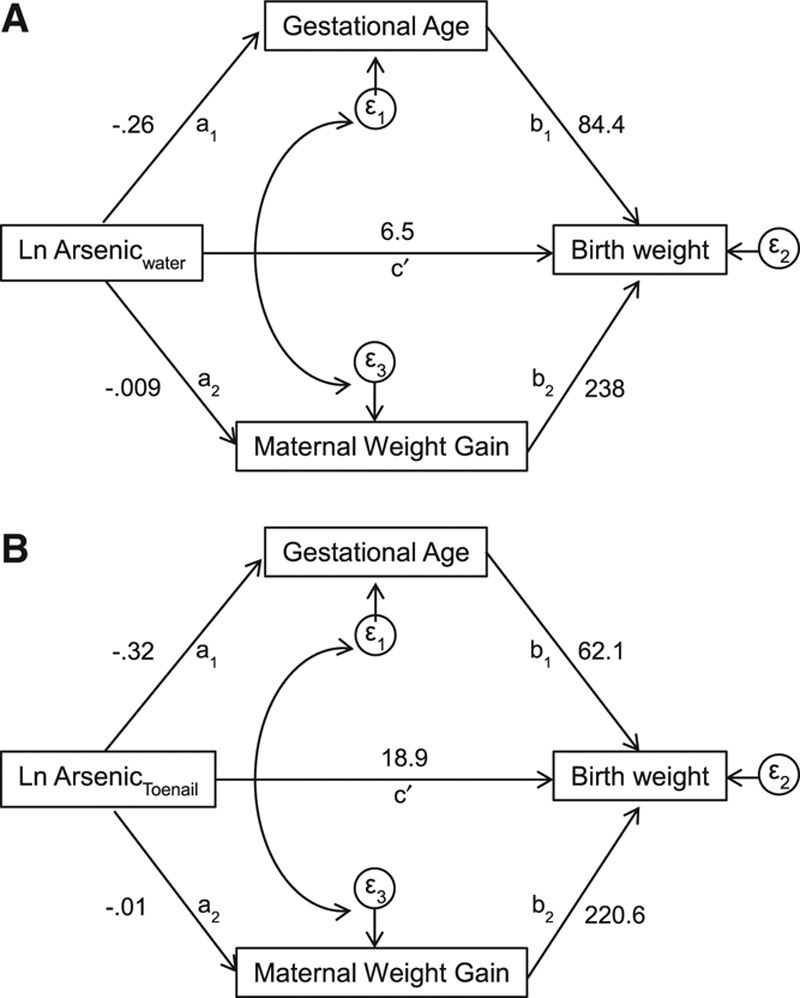
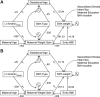
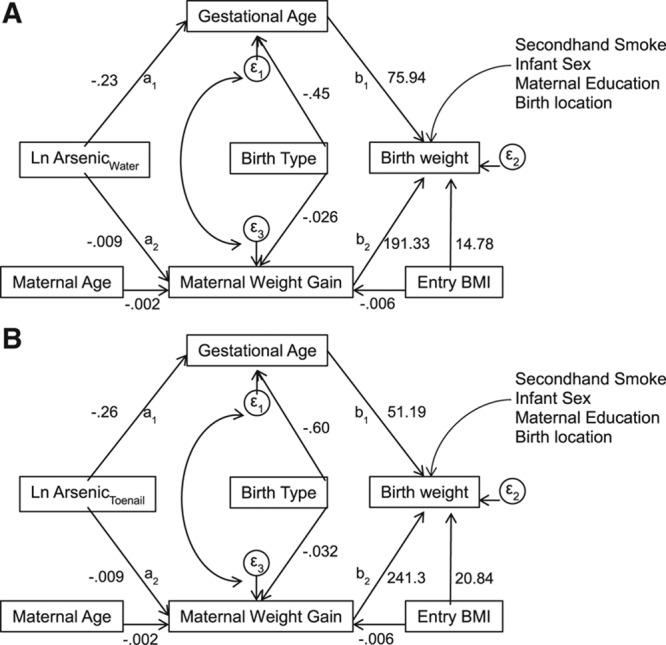
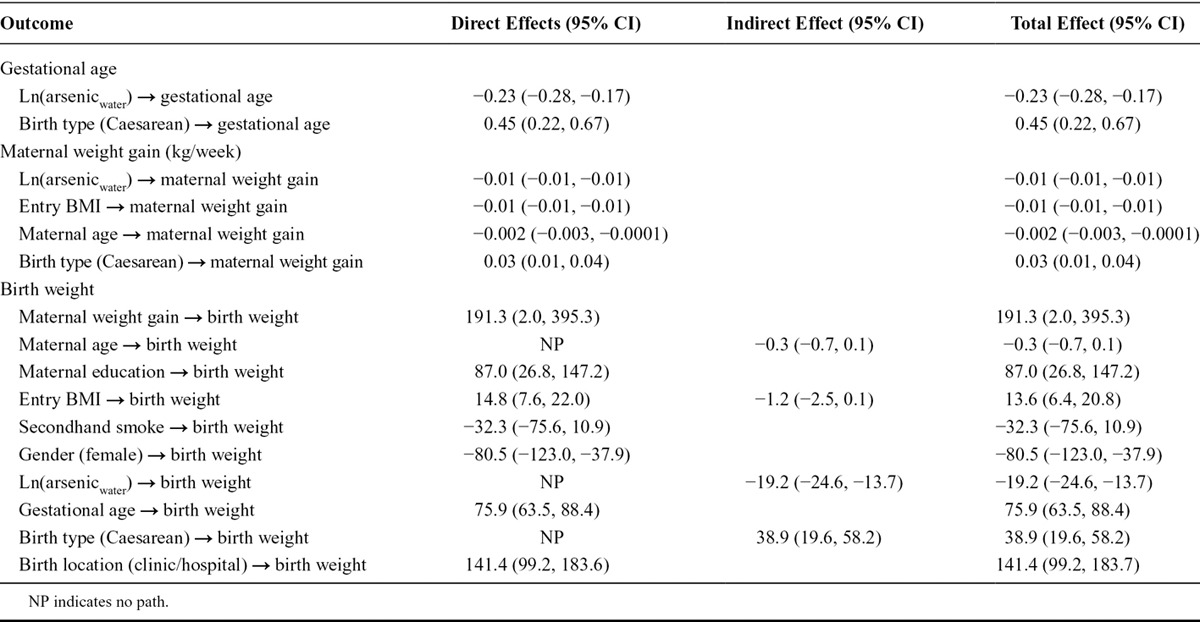
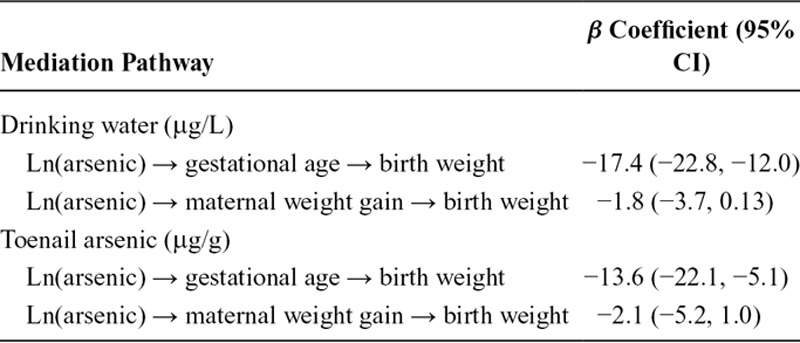
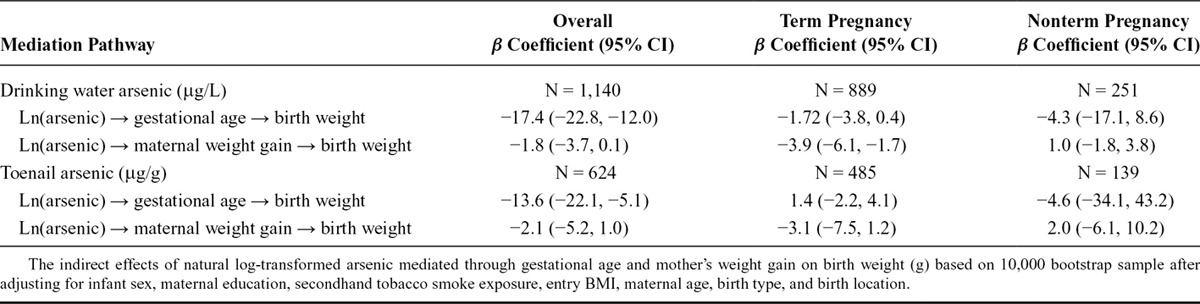
Description:Background: The relationship between arsenic and birth weight is not well understood. The objective was to evaluate the causal relationship between prenatal arsenic exposure and birth weight considering the potential mediation effects of gestational age and maternal weight gain during pregnancy using structural equation models. Methods: A prospectively enrolled cohort of pregnant women was recruited in Bangladesh from 2008 to 2011. Arsenic was measured in personal drinking water at the time of enrollment (gestational age <16 weeks, N = 1,140) and in toenails collected ≤ 1 month postpartum (N = 624) using inductively coupled plasma mass spectrometry. Structural equation models estimated the direct and indirect effects of arsenic on birth weight with gestational age and maternal weight gain considered as mediating variables. Results: Every unit increase in natural log water arsenic was indirectly associated with decreased birth weight (beta = -19.17 g, 95% confidence interval CI: -24.64, -13.69) after adjusting for other risk factors. This association was mediated entirely through gestational age (beta = -17.37 g, 95% CI: -22.77, -11.98) and maternal weight gain during pregnancy (beta = -1.80 g, 95% CI: -3.72, 0.13). When exposure was modeled using toenail arsenic concentrations, similar results were observed. Every increase in natural log toenail arsenic was indirectly associated with decreased birth weight (beta = -15.72 g, 95% CI: -24.52, -6.91) which was mediated through gestational age (beta = -13.59 g, 95% CI: -22.10, -5.07) and maternal weight gain during pregnancy (beta = -2.13 g, 95% CI: -5.24, 0.96). Conclusion: Arsenic exposure during pregnancy was associated with lower birth weight. The effect of arsenic on birth weight appears to be mediated mainly through decreasing gestational age and to a lesser extent by lower maternal weight gain during pregnancy. Description provided by NIOSH
-
Subjects:
-
Keywords:
-
Source:Epidemiology 2016 Mar; 27(2):173-181
-
ISSN:1044-3983
-
Pubmed ID:26583609
-
Pubmed Central ID:PMC4733817
-
Document Type:
-
Funding:T42 OH008416/OH/NIOSH CDC HHS/United States ; P30 ES000002/ES/NIEHS NIH HHS/United States ; K01 ES017800/ES/NIEHS NIH HHS/United States ; R01 ES015533/ES/NIEHS NIH HHS/United States ; T41 OH008416/OH/NIOSH CDC HHS/United States ; L30 ES017757/ES/NIEHS NIH HHS/United States ; P42 ES016454/ES/NIEHS NIH HHS/United States ; P30 ES000210/ES/NIEHS NIH HHS/United States
-
Genre:
-
Place as Subject:
-
CIO:
-
Topic:
-
Location:
-
Pages in Document:9 pdf pages
-
Volume:27
-
Issue:2
-
NIOSHTIC Number:nn:20047853
-
Contact Point Address:Molly L Kile, College of Public Health and Human Sciences, Oregon State University, 15 Milam, Corvallis, OR 97331
-
Email:molly.kile@oregonstate.edu
-
CAS Registry Number:
-
Federal Fiscal Year:2016
-
Performing Organization:Harvard School of Public Health
-
Peer Reviewed:True
-
Download URL:
-
File Type:
 [PDF - 643.62 KB]
 -
Collection(s):
-
Main Document Checksum:urn:sha-512:b0ee85923ee266b5b3bec0b9b7198d04acbe039a545c2b83d4e5f072dd04db788ddb3096695736698fe932bc2ad5c5746fc4145b6e5267a2601a486b6baa0732
Supporting Files


File Language:
English
 Was this page helpful?
 Found an issue?






CDC STACKS serves as an archival repository of CDC-published products including
scientific findings, journal articles, guidelines, recommendations, or other public health information authored or
co-authored by CDC or funded partners.
As a repository, CDC STACKS retains documents in their original published format to ensure public access to scientific information.
As a repository, CDC STACKS retains documents in their original published format to ensure public access to scientific information.
You May Also Like