


A Granular Bed for Use in a Nanoparticle Respiratory Deposition Sampler
Supporting Files

-
2015
-
File Language:
English
Details
-
Alternative Title:Aerosol Sci Technol
-
Personal Author:
-
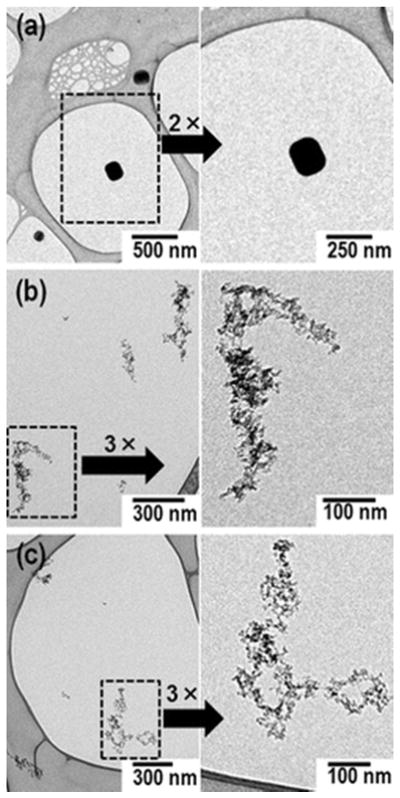
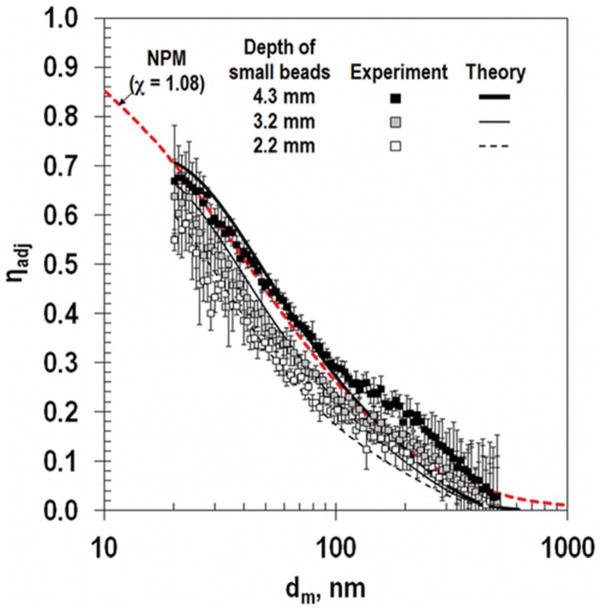
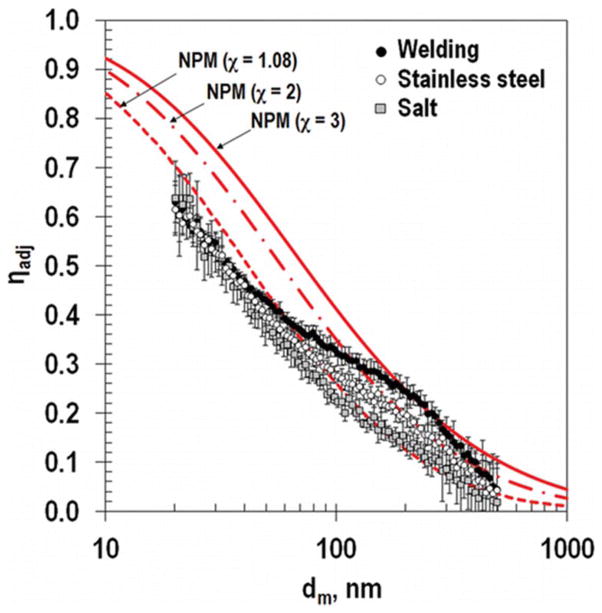
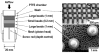
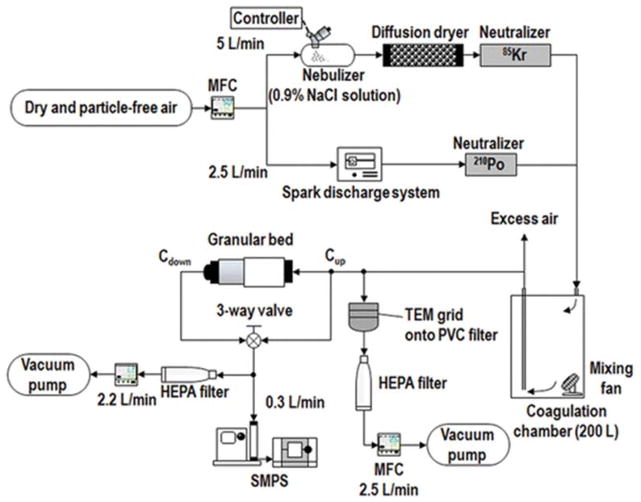
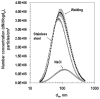
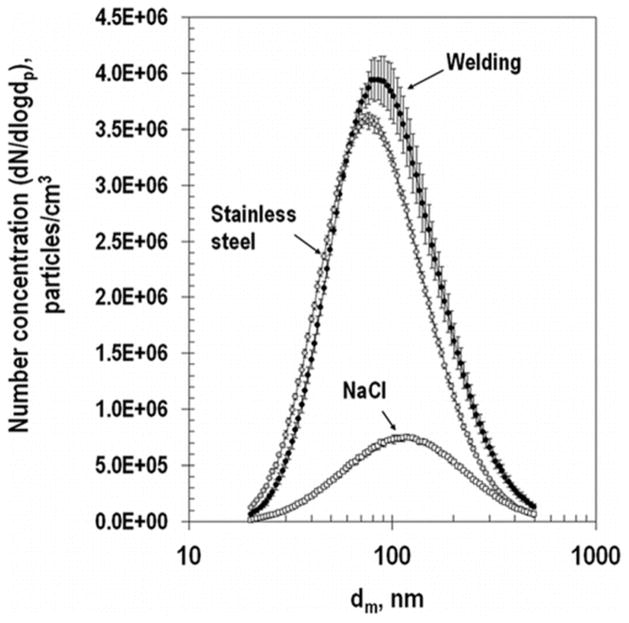
Description:A granular bed was designed to collect nanoparticles as an alternative to nylon mesh screens for use in a nanoparticle respiratory deposition (NRD) sampler. The granular bed consisted of five layers in series: a coarse mesh, a large-bead layer, a small-bead layer, a second large-bead layer, and a second coarse mesh. The bed was designed to primarily collect particles in the small-bead layer, with the coarse mesh and large-bead layers designed to hold the collection layer in position. The collection efficiency of the granular bed was measured for varying depths of the small-bead layer and for test particles with different shape (cuboid, salt particles; and fractal, and stainless steel and welding particles). Experimental measurements of collection efficiency were compared to estimates of efficiency from theory and to the nanoparticulate matter (NPM) criterion, which was established to reflect the total deposition in the human respiratory system for particles smaller than 300 nm. The shape of the collection efficiency curve for the granular bed was similar to the NPM criterion in these experiments. The collection efficiency increased with increasing depth of the small-bead layer: the particle size associated with 50% collection efficiency, |, for salt particles was 25 nm for a depth of 2.2 mm, 35 nm for 3.2 mm, and 45 nm for 4.3 mm. The best-fit to the NPM criterion was found for the bed with a small-bead layer of 3.2 mm. Compared to cubic salt particles, the collection efficiency was higher for fractal-shaped particles larger than 50 nm, presumably due to increased interception.
-
Source:Aerosol Sci Technol. 49(3):179-187
-
Pubmed ID:26900208
-
Pubmed Central ID:PMC4756655
-
Document Type:
-
Funding:
-
Volume:49
-
Issue:3
-
Collection(s):
-
Main Document Checksum:urn:sha256:a60a848ff781ccfaed66e907e00a4f3522af18d9391ce500a964d22626769dc1
-
Download URL:
-
File Type:
 [PDF
- 1.14 MB
]
[PDF
- 1.14 MB
]
Supporting Files


File Language:
English
ON THIS PAGE




CDC STACKS serves as an archival repository of CDC-published products including
scientific findings,
journal articles, guidelines, recommendations, or other public health information authored or
co-authored by CDC or funded partners.
As a repository, CDC STACKS retains documents in their original published format to ensure public access to scientific information.
As a repository, CDC STACKS retains documents in their original published format to ensure public access to scientific information.