


Changing Trends in Asthma Prevalence Among Children
Supporting Files

-
December 28 2015
File Language:
English
Details
-
Alternative Title:Pediatrics
-
Personal Author:
-
Description:BACKGROUND
Childhood asthma prevalence doubled from 1980 to 1995 and then increased more slowly from 2001 to 2010. During this second period, racial disparities increased. More recent trends remain to be described.
METHODS
We analyzed current asthma prevalence using 2001–2013 National Health Interview Survey data for children ages 0 to 17 years. Logistic regression with quadratic terms was used to test for nonlinear patterns in trends. Differences between demographic subgroups were further assessed with multivariate models controlling for gender, age, poverty status, race/ethnicity, urbanicity, and geographic region.
RESULTS
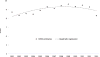
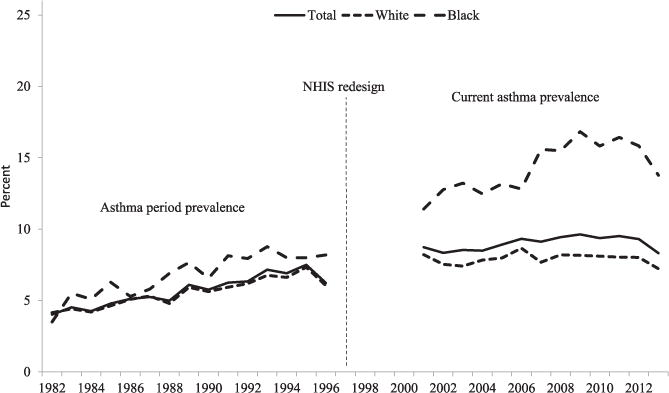
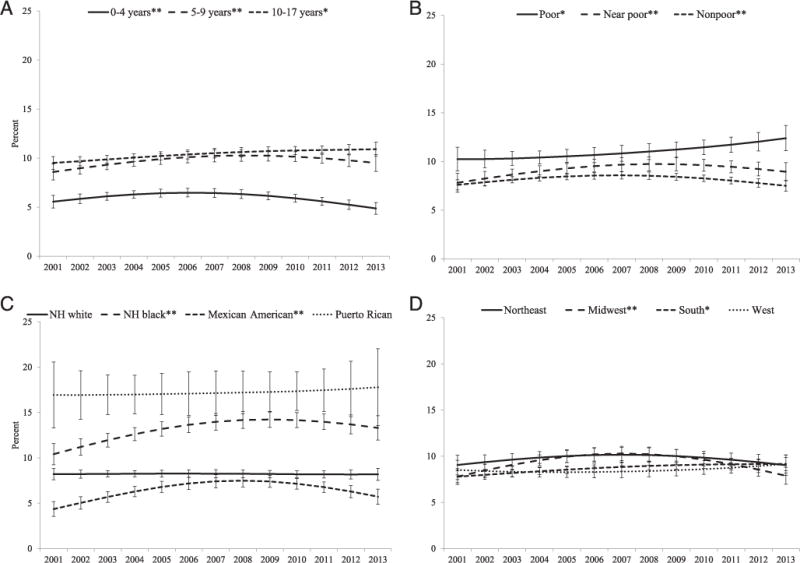
Overall, childhood asthma prevalence increased from 2001 to 2009 followed by a plateau then a decline in 2013. From 2001 to 2013, multivariate logistic regression showed no change in prevalence among non-Hispanic white and Puerto Rican children and those in the Northeast and West; increasing prevalence among 10- to 17-year-olds, poor children, and those living in the South; increasing then plateauing prevalence among 5- to 9-year-olds, near-poor children, and non-Hispanic black children; and increasing then decreasing prevalence among 0- to 4-year-olds, nonpoor, and Mexican children and those in the Midwest. Non-Hispanic black-white disparities stopped increasing, and Puerto Rican children remained with the highest prevalence.
CONCLUSIONS
Current asthma prevalence ceased to increase among children in recent years and the non-Hispanic black-white disparity stopped increasing due mainly to plateauing prevalence among non-Hispanic black children.
-
Subjects:
-
Source:Pediatrics. 137(1):1-7
-
Pubmed ID:26712860
-
Pubmed Central ID:PMC4755484
-
Document Type:
-
Funding:
-
Place as Subject:
-
Volume:137
-
Issue:1
-
Collection(s):
-
Main Document Checksum:urn:sha256:c30fa5a32c3e971f16fd4233189fc0009c928c94c159ea48e781049200bad5c9
-
Download URL:
-
File Type:
 [PDF
- 147.96 KB
]
[PDF
- 147.96 KB
]
Supporting Files


File Language:
English
ON THIS PAGE

CDC STACKS serves as an archival repository of CDC-published products including
scientific findings,
journal articles, guidelines, recommendations, or other public health information authored or
co-authored by CDC or funded partners.
As a repository, CDC STACKS retains documents in their original published format to ensure public access to scientific information.
As a repository, CDC STACKS retains documents in their original published format to ensure public access to scientific information.
You May Also Like
COLLECTION
CDC Public Access