



Racial and ethnic differences in human papillomavirus positivity and risk factors among low-income women in Federally Qualified Health Centers in the United States
Supporting Files

-
Sep 9 2015
-
File Language:
English
Details
-
Alternative Title:Prev Med
-
Personal Author:
-
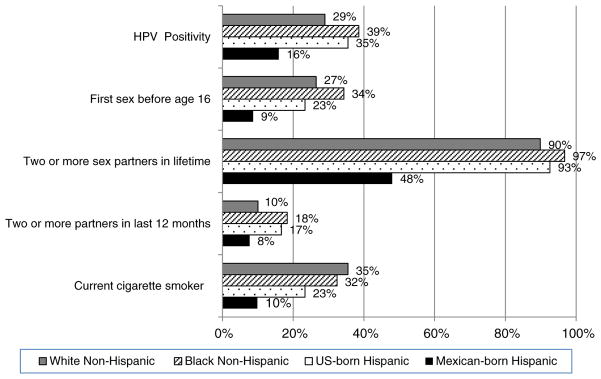
Description:Reasons for racial/ethnic disparities in HPV infection are unclear. This study assessed racial/ethnic differences in and risk factors for HPV positivity among low-income women. Data were collected from 984 low-income women visiting Federally Qualified Health Centers across Illinois (2009-2011). Pearson chi square and Logistic regression analyses were used to examine associations with HPV positivity. Our results showed Mexican-born Hispanics had the lowest HPV positivity (16%), followed by non-Hispanic whites (29%), US-born Hispanics (35%), and non-Hispanic blacks (39%). Mexican-born Hispanics reported fewer risk behaviors for HPV positivity, including first sexual intercourse before age 16 years (9% versus 27%), multiple sexual partners in lifetime (48% versus 90%), and current cigarette smoking status (10% versus 35%) when compared to non-Hispanic whites (p<0.001). In multivariate-adjusted logistic regression, being non-Hispanic black, first sexual intercourse before age 16 years, increasing numbers of recent or lifetime sexual partners and current cigarette smoking status were associated with a higher likelihood of HPV positivity. Our findings highlight racial/ethnic differences in HPV positivity and risk factors in a population of women with similar socioeconomic characteristics. When measuring HPV risk factors within the Hispanic population, foreign-born status and other mediating factors, such as social norms and cultural characteristics, may be relevant to assess the intragroup heterogeneity.
-
Subjects:
-
Source:Prev Med. 81:258-261.
-
Pubmed ID:26361751
-
Pubmed Central ID:PMC4751981
-
Document Type:
-
Funding:
-
Place as Subject:
-
Volume:81
-
Collection(s):
-
Main Document Checksum:urn:sha256:2fce0c64175464ae53aa199298f6e93e8bce23b548eed9f1c937998c2cb7507c
-
Download URL:
-
File Type:
 [PDF
- 205.60 KB
]
[PDF
- 205.60 KB
]
Supporting Files


File Language:
English
 Was this page helpful?
 Found an issue?
CDC STACKS serves as an archival repository of CDC-published products including
scientific findings,
journal articles, guidelines, recommendations, or other public health information authored or
co-authored by CDC or funded partners.
As a repository, CDC STACKS retains documents in their original published format to ensure public access to scientific information.
As a repository, CDC STACKS retains documents in their original published format to ensure public access to scientific information.
You May Also Like
COLLECTION
CDC Public Access