


Strategies and approaches to vector control in nine malaria-eliminating countries: a cross-case study analysis
Supporting Files
Public Domain

-
Jan 04 2016
-
Details
-
Alternative Title:Malar J
-
Personal Author:
-
Description:Background
There has been progress towards malaria elimination in the last decade. In response, WHO launched the Global Technical Strategy (GTS), in which vector surveillance and control play important roles. Country experiences in the Eliminating Malaria Case Study Series were reviewed to identify success factors on the road to elimination using a cross-case study analytic approach.
Methods
Reports were included in the analysis if final English language draft reports or publications were available at the time of analysis (Bhutan, Cape Verde, Malaysia, Mauritius, Namibia, Philippines, Sri Lanka, Turkey, Turkmenistan). A conceptual framework for vector control in malaria elimination was developed, reviewed, formatted as a matrix, and case study data was extracted and entered into the matrix. A workshop was convened during which participants conducted reviews of the case studies and matrices and arrived at a consensus on the evidence and lessons. The framework was revised and a second round of data extraction, synthesis and summary of the case study reports was conducted.
Results
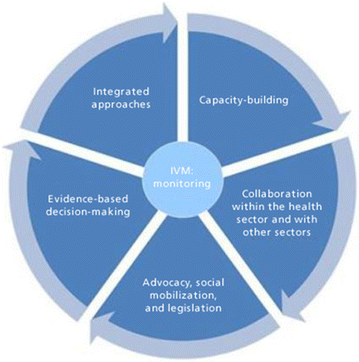
Countries implemented a range of vector control interventions. Most countries aligned with integrated vector management, however its impact was not well articulated. All programmes conducted entomological surveillance, but the response (i.e., stratification and targeting of interventions, outbreak forecasting and strategy) was limited or not described. Indoor residual spraying (IRS) was commonly used by countries. There were several examples of severe reductions or halting of IRS coverage and subsequent resurgence of malaria. Funding and operational constraints and poor implementation had roles. Bed nets were commonly used by most programmes; coverage and effectiveness were either not measured or not articulated. Larval control was an important intervention for several countries, preventing re-introduction, however coverage and impact on incidence were not described. Across all interventions, coverage indicators were incomparable, and the rationale for which tools were used and which were not used appeared to be a function of the availability of funding, operational issues and cost instead of evidence of effectiveness to reduce incidence.
Conclusions
More work is required to fill gaps in programme guidance, clarify the best methods for choosing and targeting vector control interventions, and support to measure cost, cost-effectiveness and cost-benefit of vector surveillance and control interventions.
-
Subjects:
-
Source:Malar J. 15.
-
Pubmed ID:26727923
-
Pubmed Central ID:PMC4700736
-
Document Type:
-
Volume:15
-
Collection(s):
-
Main Document Checksum:urn:sha256:50e936f3eebc722588b69c1768ddad2bdb664b836a50d6ad648edd6968f95a33
-
Download URL:
-
File Type:
 [PDF
- 1.02 MB
]
[PDF
- 1.02 MB
]
Supporting Files


ON THIS PAGE


CDC STACKS serves as an archival repository of CDC-published products including
scientific findings,
journal articles, guidelines, recommendations, or other public health information authored or
co-authored by CDC or funded partners.
As a repository, CDC STACKS retains documents in their original published format to ensure public access to scientific information.
As a repository, CDC STACKS retains documents in their original published format to ensure public access to scientific information.
You May Also Like
COLLECTION
CDC Public Access