



Antitoxin Treatment of Inhalation Anthrax: A Systematic Review
Supporting Files

-
2015 Nov-Dec
-
Available in CDC Stacks on 2016-11-01T00:00:00Z
Details
-
Alternative Title:Health Secur
-
Personal Author:
-
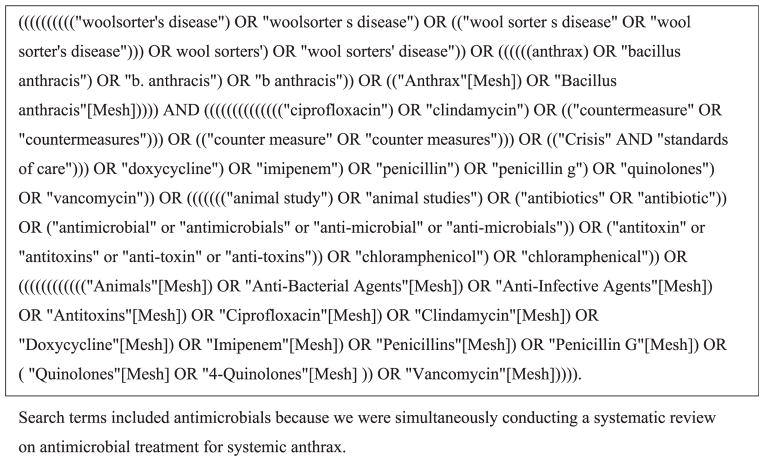
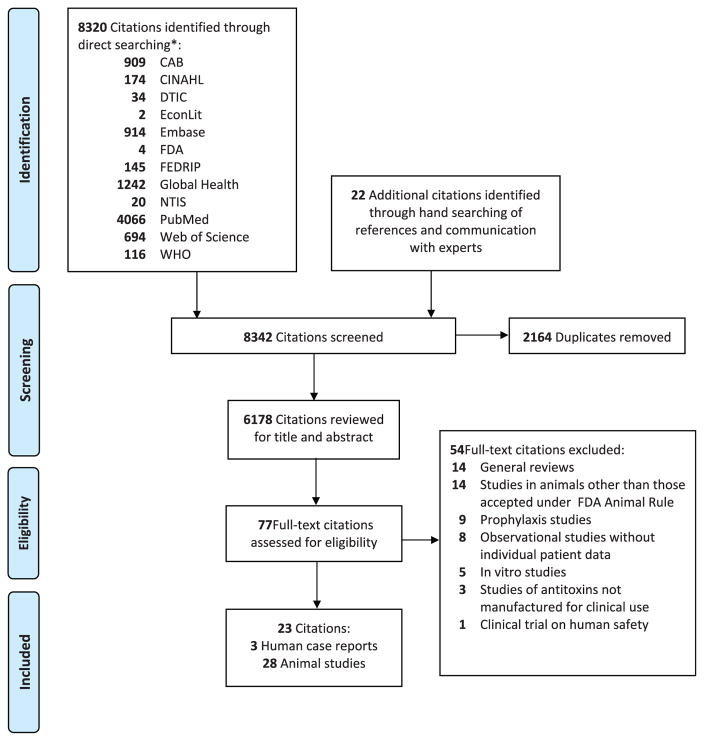
Description:Concern about use of anthrax as a bioweapon prompted development of novel anthrax antitoxins for treatment. Clinical guidelines for the treatment of anthrax recommend antitoxin therapy in combination with intravenous antimicrobials; however, a large-scale or mass anthrax incident may exceed antitoxin availability and create a need for judicious antitoxin use. We conducted a systematic review of antitoxin treatment of inhalation anthrax in humans and experimental animals to inform antitoxin recommendations during a large-scale or mass anthrax incident. A comprehensive search of 11 databases and the FDA website was conducted to identify relevant animal studies and human reports: 28 animal studies and 3 human cases were identified. Antitoxin monotherapy at or shortly after symptom onset demonstrates increased survival compared to no treatment in animals. With early treatment, survival did not differ between antimicrobial monotherapy and antimicrobial-antitoxin therapy in nonhuman primates and rabbits. With delayed treatment, antitoxin-antimicrobial treatment increased rabbit survival. Among human cases, addition of antitoxin to combination antimicrobial treatment was associated with survival in 2 of the 3 cases treated. Despite the paucity of human data, limited animal data suggest that adjunctive antitoxin therapy may improve survival. Delayed treatment studies suggest improved survival with combined antitoxin-antimicrobial therapy, although a survival difference compared with antimicrobial therapy alone was not demonstrated statistically. In a mass anthrax incident with limited antitoxin supplies, antitoxin treatment of individuals who have not demonstrated a clinical benefit from antimicrobials, or those who present with more severe illness, may be warranted. Additional pathophysiology studies are needed, and a point-of-care assay correlating toxin levels with clinical status may provide important information to guide antitoxin use during a large-scale anthrax incident.
-
Subjects:
-
Source:Health Secur. 13(6):365-377.
-
Pubmed ID:26690378
-
Pubmed Central ID:PMC4710135
-
Document Type:
-
Funding:
-
Volume:13
-
Issue:6
-
Download URL:
-
File Type:
 [PDF - 781.44 KB]
 -
Collection(s):
-
Main Document Checksum:urn:sha256:1f3b2744c68f60834936bc8343bf0582c274cd01c8ce2c4d839d91e56508e7ac
Supporting Files


 Was this page helpful?
 Found an issue?

CDC STACKS serves as an archival repository of CDC-published products including
scientific findings, journal articles, guidelines, recommendations, or other public health information authored or
co-authored by CDC or funded partners.
As a repository, CDC STACKS retains documents in their original published format to ensure public access to scientific information.
As a repository, CDC STACKS retains documents in their original published format to ensure public access to scientific information.
You May Also Like
COLLECTION
CDC Public Access