



Evidence-based public health practice among program managers in local public health departments
Supporting Files

-
2014 ; Sep-Oct 2014
-
Available in CDC Stacks on January 06, 2016, 12:00 AM
File Language:
English
Details
-
Alternative Title:J Public Health Manag Pract
-
Personal Author:
-
Description:Objectives
We assessed the use of administrative-evidence based practices (A-EBPs) among managers of programs in chronic diseases (CD), environmental health (EH), and infectious diseases (ID) from a sample of local health departments (LHDs) in the U.S.
Design
Program managers completed a survey consisting of six sections (biographical data, use of A-EBPs, diffusion attributes, use of resources, and barriers to, and competencies in, evidence-based public health (EBPH)) with a total of 66 questions.
Participants
The survey was sent electronically to 168 program managers in CD, 179 in EH, and 175 in ID, representing 228 LHDs. The survey had previously been completed by 517 LHD Directors.
Measures
The use of A-EBPs was scored for 19 individual A-EBPs, across the five A-EBP domains, and for all domains combined. Individual characteristics were derived from the survey responses, with additional data on LHDs drawn from linked NACCHO Profile survey data. Results for program managers were compared across the three types of programs and to responses from the previous survey of LHD directors. The scores were ordered and categorized into tertiles. Unconditional logistic regression models were used to calculate odds ratios (ORs) and 95% confidence intervals (CIs), comparing individual and agency characteristics for those with the highest third of A-EBPs scores to those with the lowest third.
Results
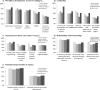
The 332 total responses from program managers represented 196 individual LHDs. Program managers differed (across the three programs, and compared to LHD Directors) in demographic characteristics, education, and experience. The use of A-EBPs varied widely across specific practices and individuals, but the pattern of responses from directors and program managers was very similar for the majority of A-EBPs.
Conclusions
Understanding the differences in educational background, experience, organizational culture, and performance of A-EBPs between program managers and LHD directors is a necessary step to improving competencies in EBPH. -
Keywords:
- evidence-based public health
- organization and administration
- public health practice
- quality improvement
- translational research
- Chronic Disease
- Communicable Diseases
- Educational Status
- Environmental Health
- Evidence-Based Practice
- Humans
- Organizational Culture
- Professional Competence
- Public Health Practice
- Quality Improvement
- Surveys and Questionnaires
- United States
-
Source:J Public Health Manag Pract. 20(5):472-480
-
Pubmed ID:24253406
-
Pubmed Central ID:PMC4703040
-
Document Type:
-
Funding:
-
Volume:20
-
Issue:5
-
Download URL:
-
File Type:
 [PDF - 1.36 MB]
 -
Collection(s):
-
Main Document Checksum:urn:sha256:83f52ffe05d19665dce058a7fef5bb6583bc97bcdaae4c5b48b6b947ae71f72f
Supporting Files


File Language:
English
 Was this page helpful?
 Found an issue?


CDC STACKS serves as an archival repository of CDC-published products including
scientific findings, journal articles, guidelines, recommendations, or other public health information authored or
co-authored by CDC or funded partners.
As a repository, CDC STACKS retains documents in their original published format to ensure public access to scientific information.
As a repository, CDC STACKS retains documents in their original published format to ensure public access to scientific information.
You May Also Like
COLLECTION
CDC Public Access