



Effects of Mental Health Benefits Legislation
Supporting Files

-
6-2015
-
Available in CDC Stacks on 2016-06-01T00:00:00Z
File Language:
English
Details
-
Alternative Title:Am J Prev Med
-
Personal Author:Sipe, Theresa Ann ; Finnie, Ramona K.C. ; Knopf, John A. ; Qu, Shuli ; Reynolds, Jeffrey A. ; Thota, Anilkrishna B. ; Hahn, Robert A. ; Goetzel, Ron Z. ; Hennessy, Kevin D. ; McKnight-Eily, Lela R. ; Chapman, Daniel P. ; Anderson, Clinton W. ; Azrin, Susan ; Abraido-Lanza, Ana F. ; Gelenberg, Alan J. ; Vernon-Smiley, Mary E. ; Nease, Donald E.
-
Corporate Authors:
-
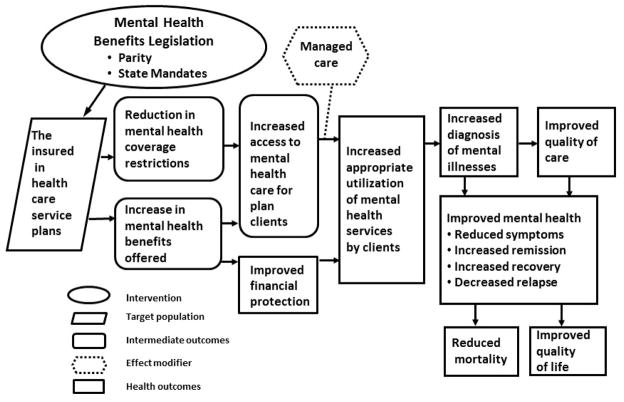
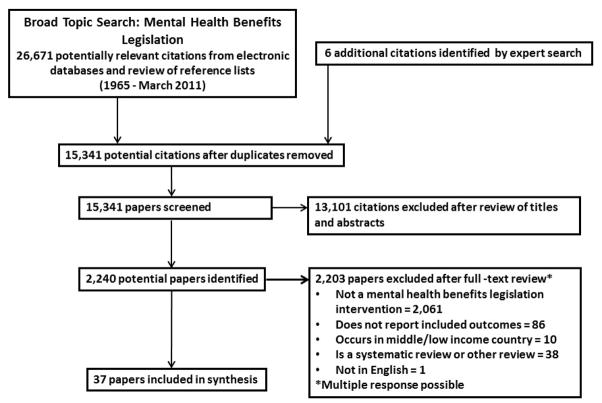
Description:Context ; Health insurance benefits for mental health services typically have paid less than benefits for physical health services, resulting in potential underutilization or financial burden for people with mental health conditions. Mental health benefits legislation was introduced to improve financial protection (i.e., decrease financial burden) and to increase access to, and use of, mental health services. This systematic review was conducted to determine the effectiveness of mental health benefits legislation, including executive orders, in improving mental health. ; Evidence acquisition ; Methods developed for the Guide to Community Preventive Services were used to identify, evaluate, and analyze available evidence. The evidence included studies published or reported from 1965 to March 2011 with at least one of the following outcomes: access to care, financial protection, appropriate utilization, quality of care, diagnosis of mental illness, morbidity and mortality, and quality of life. Analyses were conducted in 2012. ; Evidence synthesis ; Thirty eligible studies were identified in 37 papers. Implementation of mental health benefits legislation was associated with financial protection (decreased out-of-pocket costs) and appropriate utilization of services. Among studies examining the impact of legislation strength, most found larger positive effects for comprehensive parity legislation or policies than for less-comprehensive ones. Few studies assessed other mental health outcomes. ; Conclusions ; Evidence indicates that mental health benefits legislation, particularly comprehensive parity legislation, is effective in improving financial protection and increasing appropriate utilization of mental health services for people with mental health conditions. Evidence is limited for other mental health outcomes.
-
Keywords:
-
Source:Am J Prev Med. 48(6):755-766
-
Pubmed ID:25998926
-
Pubmed Central ID:PMC4700502
-
Document Type:
-
Funding:
-
Volume:48
-
Issue:6
-
Download URL:
-
File Type:
 [PDF - 743.49 KB]
 -
Collection(s):
-
Main Document Checksum:urn:sha256:616c26f294dc65d1fa52c1eb2f98470b87a8775b9eec6ac44c41e3dec9d88164
Supporting Files


File Language:
English
 Was this page helpful?
 Found an issue?


CDC STACKS serves as an archival repository of CDC-published products including
scientific findings, journal articles, guidelines, recommendations, or other public health information authored or
co-authored by CDC or funded partners.
As a repository, CDC STACKS retains documents in their original published format to ensure public access to scientific information.
As a repository, CDC STACKS retains documents in their original published format to ensure public access to scientific information.
You May Also Like
COLLECTION
CDC Public Access