


Substrate-competitive activity-based profiling of ester prodrug activating enzymes
Supporting Files

-
Aug 17 2015
-
Details
-
Alternative Title:Mol Pharm
-
Personal Author:
-
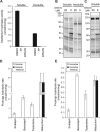
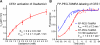
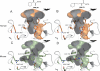
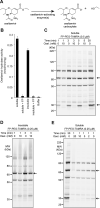
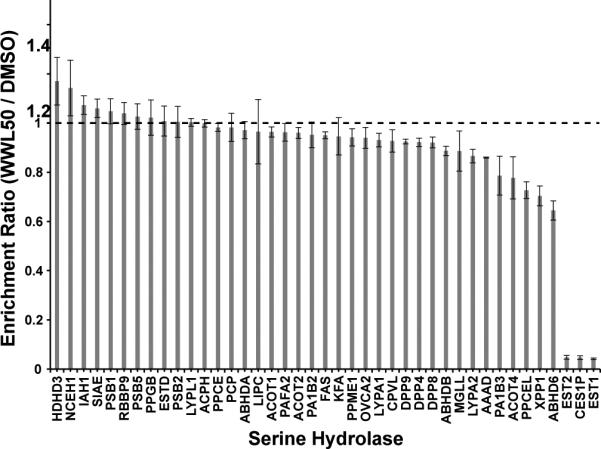
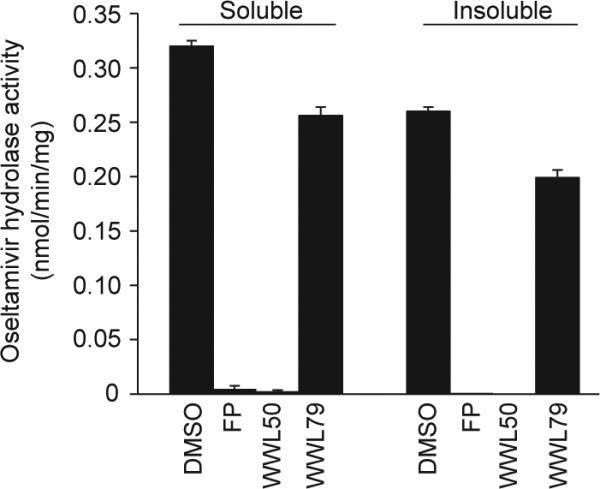
Description:Understanding the mechanistic basis of prodrug delivery and activation is critical for establishing species-specific prodrug sensitivities necessary for evaluating preclinical animal models and potential drug-drug interactions. Despite significant adoption of prodrug methodologies for enhanced pharmacokinetics, functional annotation of prodrug activating enzymes is laborious and often unaddressed. Activity-based protein profiling (ABPP) describes an emerging chemoproteomic approach to assay active site occupancy within a mechanistically similar enzyme class in native proteomes. The serine hydrolase enzyme family is broadly reactive with reporter-linked fluorophosphonates, which have shown to provide a mechanism-based covalent labeling strategy to assay the activation state and active site occupancy of cellular serine amidases, esterases, and thioesterases. Here we describe a modified ABPP approach using direct substrate competition to identify activating enzymes for an ethyl ester prodrug, the influenza neuraminidase inhibitor oseltamivir. Substrate-competitive ABPP analysis identified carboxylesterase 1 (CES1) as an oseltamivir-activating enzyme in intestinal cell homogenates. Saturating concentrations of oseltamivir lead to a four-fold reduction in the observed rate constant for CES1 inactivation by fluorophosphonates. WWL50, a reported carbamate inhibitor of mouse CES1, blocked oseltamivir hydrolysis activity in human cell homogenates, confirming CES1 is the primary prodrug activating enzyme for oseltamivir in human liver and intestinal cell lines. The related carbamate inhibitor WWL79 inhibited mouse but not human CES1, providing a series of probes for analyzing prodrug activation mechanisms in different preclinical models. Overall, we present a substrate-competitive activity-based profiling approach for broadly surveying candidate prodrug hydrolyzing enzymes and outline the kinetic parameters for activating enzyme discovery, ester prodrug design, and preclinical development of ester prodrugs.
-
Subjects:
-
Source:Mol Pharm. 12(9):3399-3407.
-
Pubmed ID:26262434
-
Pubmed Central ID:PMC4694564
-
Document Type:
-
Funding:
-
Volume:12
-
Issue:9
-
Collection(s):
-
Main Document Checksum:urn:sha256:1b0020a4f4d686b0c0f6ea709bfcbf3064a31ad13633ebd97b96fbf04a4165e4
-
Download URL:
-
File Type:
 [PDF
- 746.61 KB
]
[PDF
- 746.61 KB
]
Supporting Files


ON THIS PAGE






CDC STACKS serves as an archival repository of CDC-published products including
scientific findings,
journal articles, guidelines, recommendations, or other public health information authored or
co-authored by CDC or funded partners.
As a repository, CDC STACKS retains documents in their original published format to ensure public access to scientific information.
As a repository, CDC STACKS retains documents in their original published format to ensure public access to scientific information.
You May Also Like
COLLECTION
CDC Public Access