


Are couple-based interventions more effective than interventions delivered to individuals in promoting HIV protective behaviors? A meta-analysis
Supporting Files

-
Nov 25 2015
-
Details
-
Alternative Title:AIDS Care
-
Personal Author:
-
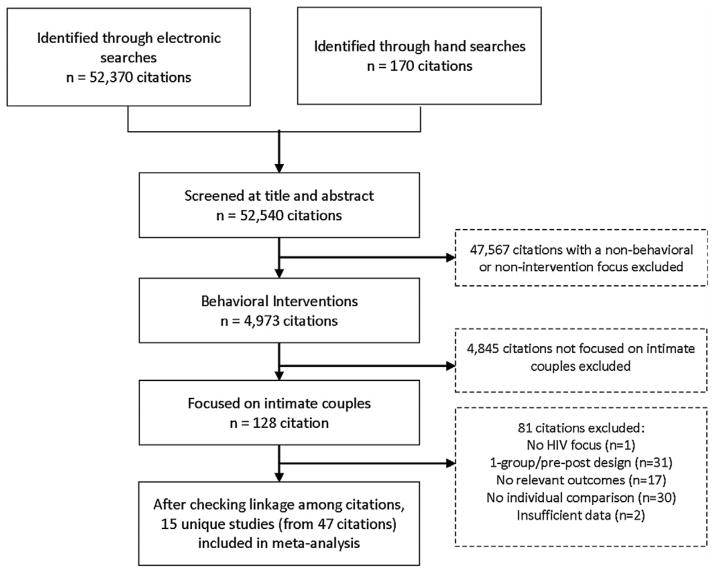
Description:Despite several advantages to bringing couples together to learn how to protect themselves and new-born children from the risk of HIV infection, most interventions are designed for individuals or groups, not for dyads. This meta-analysis provides a direct test of whether couple-based interventions are more effective in promoting HIV protective behaviors than interventions delivered to individuals. We conducted systematic searches of five electronic databases and 60 journals. Eligible studies were controlled trials or prospective cohort designs; evaluated a couple-based intervention compared to an individual-level intervention; assessed at least one HIV prevention outcome (e.g., protective sex, drug use, HIV testing, medication adherence, and sexually transmitted infections [STI]); and were published between 1988 and 2014. Fifteen interventions, including 21,882 participants from China, Kenya, Rwanda, Tanzania, Trinidad, Zambia, and the USA, were evaluated. The results of random-effects models showed statistically significant intervention effects for protective sex (OR = 1.60, 95% CI = 1.21, 2.11), HIV testing (OR = 1.79, 95% CI = 1.31, 2.45), and Nevirapine uptake (OR = 1.51, 95% CI = 1.02, 2.24). The evidence demonstrates the usefulness of couple-based interventions in protecting individuals, partners, and new-born children from the risk of HIV transmission and infection.
-
Subjects:
-
Source:AIDS Care. 27(11):1361-1366.
-
Pubmed ID:26608175
-
Pubmed Central ID:PMC4693597
-
Document Type:
-
Funding:
-
Volume:27
-
Issue:11
-
Collection(s):
-
Main Document Checksum:urn:sha256:54f2f5c9cbb95d3220b9073a7cf5c14a54e7b22b80a71a951fa7b8f1eabbb583
-
Download URL:
-
File Type:
 [PDF
- 321.97 KB
]
[PDF
- 321.97 KB
]
Supporting Files


ON THIS PAGE


CDC STACKS serves as an archival repository of CDC-published products including
scientific findings,
journal articles, guidelines, recommendations, or other public health information authored or
co-authored by CDC or funded partners.
As a repository, CDC STACKS retains documents in their original published format to ensure public access to scientific information.
As a repository, CDC STACKS retains documents in their original published format to ensure public access to scientific information.
You May Also Like
COLLECTION
CDC Public Access