


Cognition and Brain Development in Children with Benign Epilepsy with Centrotemporal Spikes (BECTS)
Supporting Files

-
Sep 04 2015
-
Details
-
Alternative Title:Epilepsia
-
Personal Author:
-
Description:Objective
Benign epilepsy with centrotemporal spikes (BECTS), the most common focal childhood epilepsy, is associated with subtle abnormalities in cognition and possible developmental alterations in brain structure when compared to healthy participants as indicated by previous cross-sectional studies. To examine the natural history of BECTS, we investigated cognition, cortical thickness, and subcortical volumes in children with new/recent onset BECTS and healthy controls (HC).
Methods
Participants were 8–15 years of age, including 24 children with new onset BECTS and 41 age- and gender-matched HC. At baseline and two years later, all participants completed a cognitive assessment and a subset (13 BECTS, 24 HC) underwent T1 volumetric MRI scans focusing on cortical thickness and subcortical volumes.
Results
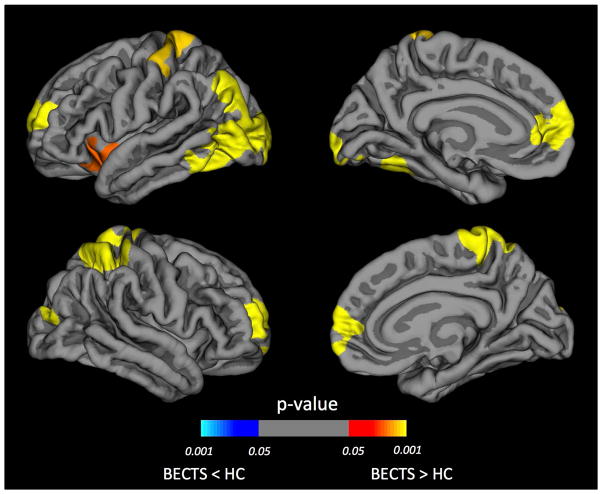
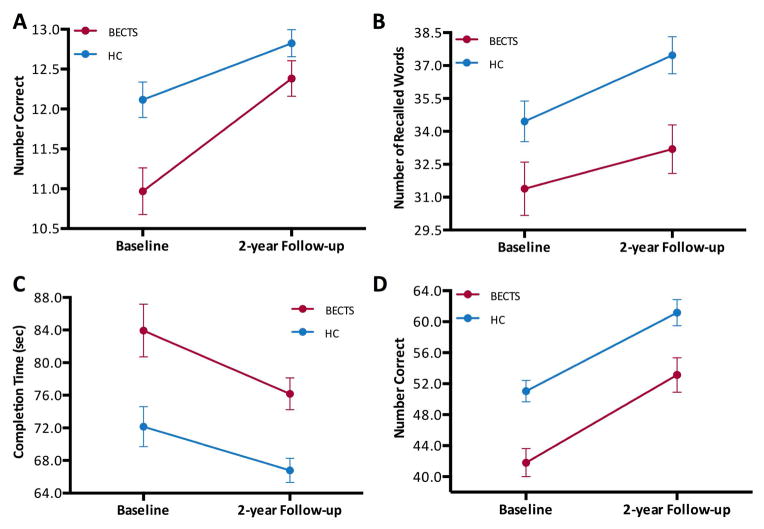
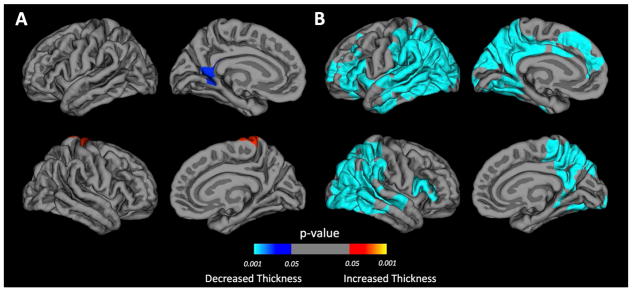
Baseline cognitive abnormalities associated with BECTS (object naming, verbal learning, arithmetic computation, psychomotor speed/dexterity) persisted over two years, with the rate of cognitive development paralleling that of HC. Baseline neuroimaging revealed thinner cortex in BECTS compared to controls in frontal, temporal, and occipital regions. Longitudinally, HC showed widespread cortical thinning in both hemispheres, while BECTS participants showed sparse regions of both cortical thinning and thickening. Analyses of subcortical volumes showed larger left and right putamens persisting over two years in BECTS compared to HC.
Significance
Cognitive and structural brain abnormalities associated with BECTS are present at onset and persist (cognition) and/or evolve (brain structure) over time. Atypical maturation of cortical thickness antecedent to BECTS onset results in early-identified abnormalities that further continue to abnormally develop over time. However, cognition appears more resistant to further change over time compared to anatomical development.
-
Subjects:
-
Source:Epilepsia. 56(10):1615-1622.
-
Pubmed ID:26337046
-
Pubmed Central ID:PMC4593750
-
Document Type:
-
Funding:
-
Volume:56
-
Issue:10
-
Collection(s):
-
Main Document Checksum:urn:sha256:e010ab077d92432ab13e89bd8dd122f478805537d0e5bd5afe239e957de6422d
-
Download URL:
-
File Type:
 [PDF
- 739.99 KB
]
[PDF
- 739.99 KB
]
Supporting Files


ON THIS PAGE


CDC STACKS serves as an archival repository of CDC-published products including
scientific findings,
journal articles, guidelines, recommendations, or other public health information authored or
co-authored by CDC or funded partners.
As a repository, CDC STACKS retains documents in their original published format to ensure public access to scientific information.
As a repository, CDC STACKS retains documents in their original published format to ensure public access to scientific information.
You May Also Like
COLLECTION
CDC Public Access