


State disparities in colorectal cancer rates - contribution of risk factors, screening and survival differences
Supporting Files

-
Jul 6 2015
-
Details
-
Alternative Title:Cancer
-
Personal Author:
-
Description:Background
Northeastern states of the US show more progress in reducing colorectal cancer (CRC) incidence and mortality rates than Southern states, resulting in considerable disparities. We quantified how the disparities in CRC rates between Louisiana (Southern state) and New Jersey (Northeastern state) would be affected if differences in risk factors, screening and stage-specific CRC relative survival between states were eliminated.
Methods
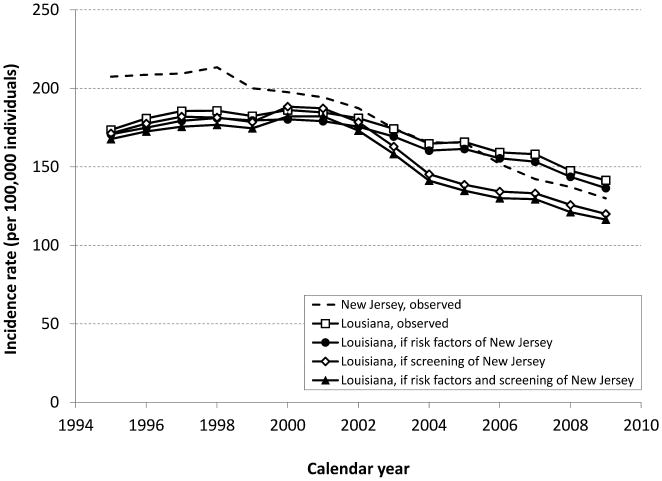
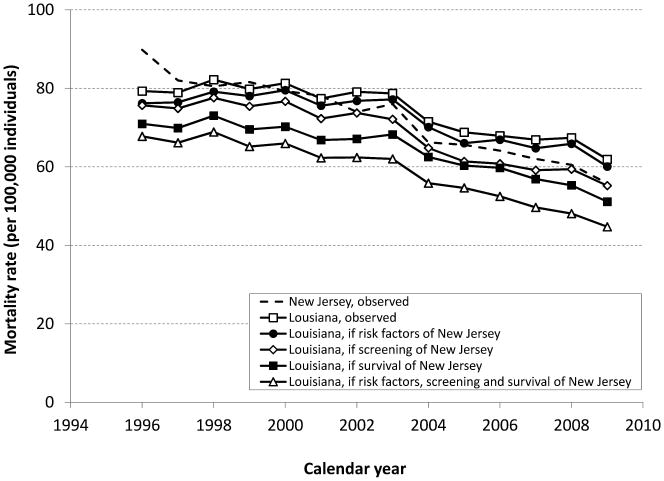
We used the MISCAN-Colon microsimulation model to estimate age-adjusted CRC incidence and mortality rates in Louisiana from 1995-2009 assuming Louisiana had the same 1) smoking and obesity prevalence; 2) CRC screening uptake; 3) stage-specific CRC relative survival; and 4) a combination of all three, as observed in New Jersey.
Results
In 2009 the observed CRC incidence and mortality rates in Louisiana were 141.4 cases and 61.9 deaths per 100,000 individuals, respectively. With the same risk factors and screening as New Jersey, the CRC incidence rate in Louisiana was reduced by 3.5% and 15.2%. New Jersey's risk factors, screening and survival reduced the CRC mortality rate in Louisiana by 3.0%, 10.8%, and 17.4%, respectively. With all trends combined, the modeled rates per 100,000 individuals in Louisiana became lower than the observed rates in New Jersey for both incidence (116.4 versus 130.0) and mortality (44.7 versus 55.8).
Conclusions
The disparities in CRC incidence and mortality rates between Louisiana and New Jersey could be eliminated if Louisiana could attain New Jersey levels of risk factors, screening and survival. Priority should be given to enabling Southern states to improve screening and survival rates.
-
Subjects:
-
Source:Cancer. 121(20):3676-3683.
-
Pubmed ID:26150014
-
Pubmed Central ID:PMC4592401
-
Document Type:
-
Funding:U58 DP003931/DP/NCCDPHP CDC HHS/United States ; HHSN261201300016I/PHS HHS/United States ; U01 CA152959/CA/NCI NIH HHS/United States ; U01-CA-152959/CA/NCI NIH HHS/United States ; 5U58DP003931-02/DP/NCCDPHP CDC HHS/United States ; HHSN26100003/PHS HHS/United States ; U58 DP005390/DP/NCCDPHP CDC HHS/United States ; N01-PC-2013-00021/PC/NCI NIH HHS/United States ; 1U58DP005390/DP/NCCDPHP CDC HHS/United States ; HHSN261201300016C/CP/NCI NIH HHS/United States ; HHSN261201300016I/CA/NCI NIH HHS/United States
-
Volume:121
-
Issue:20
-
Collection(s):
-
Main Document Checksum:urn:sha-512:64b9b8aa88cb416cff2bbe05641b852ad688da196bbd4d7ef60582366054471009fe909d2b98a4a8c8de6d48c6e15af879a61a2bc64756988b5b162b0b958528
-
Download URL:
-
File Type:
 [PDF
- 208.57 KB
]
[PDF
- 208.57 KB
]
Supporting Files


ON THIS PAGE


CDC STACKS serves as an archival repository of CDC-published products including
scientific findings,
journal articles, guidelines, recommendations, or other public health information authored or
co-authored by CDC or funded partners.
As a repository, CDC STACKS retains documents in their original published format to ensure public access to scientific information.
As a repository, CDC STACKS retains documents in their original published format to ensure public access to scientific information.
You May Also Like
COLLECTION
CDC Public Access