



Epidemiology and Risk Factors for Echinocandin Nonsusceptible Candida glabrata Bloodstream Infections: Data From a Large Multisite Population-Based Candidemia Surveillance Program, 2008–2014
Supporting Files
Public Domain

-
Dec 14 2015
File Language:
English
Details
-
Alternative Title:Open Forum Infect Dis
-
Personal Author:
-
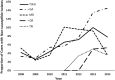
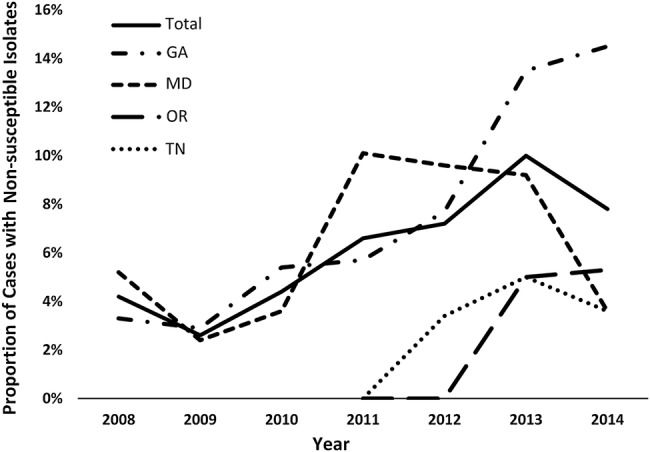
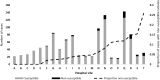
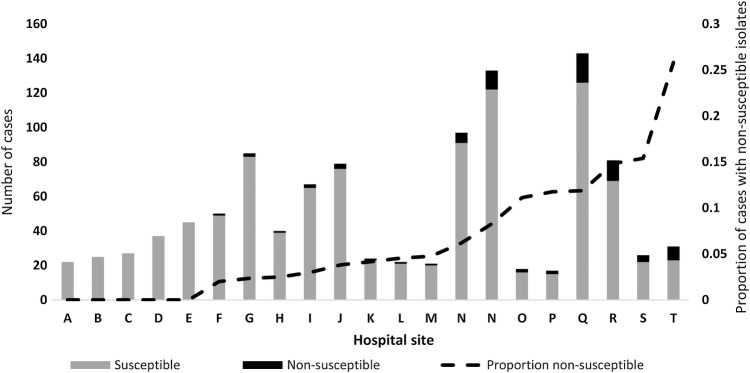
Description:Background. Echinocandins are first-line treatment for Candida glabrata candidemia. Echinocandin resistance is concerning due to limited remaining treatment options. We used data from a multisite, population-based surveillance program to describe the epidemiology and risk factors for echinocandin nonsusceptible (NS) C glabrata candidemia. Methods. The Centers for Disease Control and Prevention's Emerging Infections Program conducts population-based laboratory surveillance for candidemia in 4 metropolitan areas (7.9 million persons; 80 hospitals). We identified C glabrata cases occurring during 2008-2014; medical records of cases were reviewed, and C glabrata isolates underwent broth microdilution antifungal susceptibility testing. We defined echinocandin-NS C glabrata (intermediate or resistant) based on 2012 Clinical and Laboratory Standards Institute minimum inhibitory concentration breakpoints. Independent risk factors for NS C glabrata were determined by stepwise logistic regression. Results. Of 1385 C glabrata cases, 83 (6.0%) had NS isolates (19 intermediate and 64 resistant); the proportion of NS isolates rose from 4.2% in 2008 to 7.8% in 2014 (P < .001). The proportion of NS isolates at each hospital ranged from 0% to 25.8%; 3 large, academic hospitals accounted for almost half of all NS isolates. In multivariate analysis, prior echinocandin exposure (adjusted odds ratio aOR, 5.3; 95% CI, 2.6-1.2), previous candidemia episode (aOR, 2.5; 95% CI, 1.2-5.1), hospitalization in the last 90 days (aOR, 1.9; 95% CI, 1.0-3.5, and fluconazole resistance aOR, 3.6; 95% CI, 2.0-6.4) were significantly associated with NS C glabrata. Fifty-nine percent of NS C glabrata cases had no known prior echinocandin exposure. Conclusion. The proportion of NS C glabrata isolates rose significantly during 2008-2014, and NS C glabrata frequency differed across hospitals. In addition to acquired resistance resulting from prior drug exposure, occurrence of NS C glabrata without prior echinocandin exposure suggests possible transmission of resistant organisms.
-
Subjects:
-
Source:Open Forum Infect Dis. 2015; 2(4).
-
Pubmed ID:26677456
-
Pubmed Central ID:PMC4677623
-
Document Type:
-
Volume:2
-
Issue:4
-
Download URL:
-
File Type:
 [PDF - 194.89 KB]
 -
Collection(s):
-
Main Document Checksum:urn:sha256:6526721bfc4065a121f4614f0ceb2e32a11ef2741470b53196f6e1f65737d79a
Supporting Files


File Language:
English
 Was this page helpful?
 Found an issue?

CDC STACKS serves as an archival repository of CDC-published products including
scientific findings, journal articles, guidelines, recommendations, or other public health information authored or
co-authored by CDC or funded partners.
As a repository, CDC STACKS retains documents in their original published format to ensure public access to scientific information.
As a repository, CDC STACKS retains documents in their original published format to ensure public access to scientific information.
You May Also Like
COLLECTION
CDC Public Access