


Host immunity to repeated rabies virus infection in big brown bats
Supporting Files
Public Domain

-
Jun 02 2010
-
File Language:
English
Details
-
Alternative Title:J Gen Virol
-
Personal Author:
-
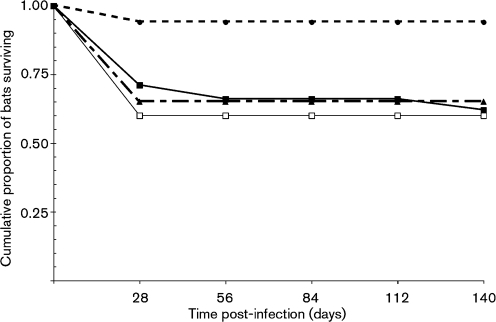
Description:Bats are natural reservoirs for the majority of lyssaviruses globally, and are unique among mammals in having exceptional sociality and longevity. Given these facets, and the recognized status of bats as reservoirs for rabies viruses (RABVs) in the Americas, individual bats may experience repeated exposure to RABV during their lifetime. Nevertheless, little information exists with regard to within-host infection dynamics and the role of immunological memory that may result from abortive RABV infection in bats. In this study, a cohort of big brown bats (Eptesicus fuscus) was infected intramuscularly in the left and right masseter muscles with varying doses [10(-0.1)-10(4.9) median mouse intracerebral lethal doses (MICLD(50))] of an E. fuscus RABV variant isolated from a naturally infected big brown bat. Surviving bats were infected a second time at 175 days post-(primary) infection with a dose (10(3.9)-10(4.9) MICLD(50)) of the same RABV variant. Surviving bats were infected a third time at either 175 or 305 days post-(secondary) infection with a dose (10(4.9) MICLD(50)) of the same RABV variant. When correcting for dose, similar mortality was observed following primary and secondary infection, but reduced mortality was observed following the third and last RABV challenge, despite infection with a high viral dose. Inducible RABV-neutralizing antibody titres post-infection were ephemeral among infected individuals, and dropped below levels of detection in several bats between subsequent infections. These results suggest that long-term repeated infection of bats may confer significant immunological memory and reduced susceptibility to RABV infection.
-
Subjects:
-
Source:J Gen Virol. 2010; 91(Pt 9):2360-2366.
-
Document Type:
-
Volume:91
-
Collection(s):
-
Main Document Checksum:urn:sha-512:7b5d96a8198a5fa787eca6bee018e6d4a9fbdae96e7f7ad790ddd47aab9f5f023302a18179617f3cc7665f9684feb4007c3c552fcc517723bde659b7101c2c8f
-
Download URL:
-
File Type:
 [PDF
- 113.41 KB
]
[PDF
- 113.41 KB
]
Supporting Files


File Language:
English
ON THIS PAGE


CDC STACKS serves as an archival repository of CDC-published products including
scientific findings,
journal articles, guidelines, recommendations, or other public health information authored or
co-authored by CDC or funded partners.
As a repository, CDC STACKS retains documents in their original published format to ensure public access to scientific information.
As a repository, CDC STACKS retains documents in their original published format to ensure public access to scientific information.
You May Also Like
COLLECTION
CDC Public Access