


Effect of the Ebola-virus-disease epidemic on malaria case management in Guinea, 2014: a cross-sectional survey of health facilities
Supporting Files

-
Jun 23 2015
-
Details
-
Alternative Title:Lancet Infect Dis
-
Personal Author:
-
Description:Background
The ongoing west Africa Ebola-virus-disease epidemic has disrupted the entire health-care system in affected countries. Because of the overlap of symptoms of Ebola virus disease and malaria, the care delivery of malaria is particularly sensitive to the indirect effects of the current Ebola-virus-disease epidemic. We therefore characterise malaria case management in the context of the Ebola-virus-disease epidemic and document the effect of the Ebola-virus-disease epidemic on malaria case management.
Methods
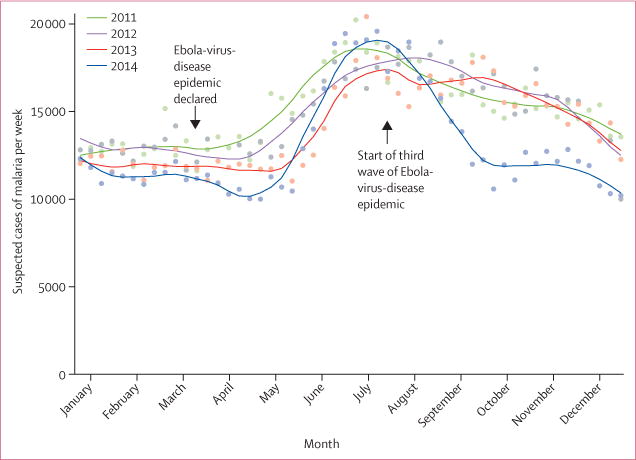
We did a cross-sectional survey of public health facilities in Guinea in December, 2014. We selected the four prefectures most affected by Ebola virus disease and selected four randomly from prefectures without any reported cases of the disease. 60 health facilities were sampled in Ebola-affected and 60 in Ebola-unaffected prefectures. Study teams abstracted malaria case management indicators from registers for January to November for 2013 and 2014 and interviewed health-care workers. Nationwide weekly surveillance data for suspect malaria cases reported between 2011 and 2014 were analysed independently. Data for malaria indicators in 2014 were compared with previous years.
Findings
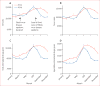
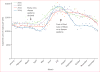
We noted substantial reductions in all-cause outpatient visits (by 23 103 [11%] of 214 899), cases of fever (by 20249 [15%] of 131 330), and patients treated with oral (by 22 655 [24%] of 94 785) and injectable (by 5219 [30%] of 17 684) antimalarial drugs in surveyed health facilities. In Ebola-affected prefectures, 73 of 98 interviewed community health workers were operational (74%, 95% CI 65–83) and 35 of 73 were actively treating malaria cases (48%, 36–60) compared with 106 of 112 (95%, 89–98) and 102 of 106 (96%, 91–99), respectively, in Ebola-unaffected prefectures. Nationwide, the Ebola-virus-disease epidemic was estimated to have resulted in 74 000 (71 000–77 000) fewer malaria cases seen at health facilities in 2014.
Interpretation
The reduction in the delivery of malaria care because of the Ebola-virus-disease epidemic threatens malaria control in Guinea. Untreated and inappropriately treated malaria cases lead to excess malaria mortality and more fever cases in the community, impeding the Ebola-virus-disease response.
Funding
Global Fund to Fight AIDS, Tuberculosis and Malaria, and President’s Malaria Initiative.
-
Subjects:
-
Source:Lancet Infect Dis. 15(9):1017-1023.
-
Pubmed ID:26116183
-
Pubmed Central ID:PMC4669675
-
Document Type:
-
Funding:
-
Volume:15
-
Issue:9
-
Collection(s):
-
Main Document Checksum:urn:sha256:91d5251910e3c9209604ae52438e5a52d9f2f3a49915a11479a0f6eba1d5a296
-
Download URL:
-
File Type:
 [PDF
- 246.89 KB
]
[PDF
- 246.89 KB
]
Supporting Files


ON THIS PAGE


CDC STACKS serves as an archival repository of CDC-published products including
scientific findings,
journal articles, guidelines, recommendations, or other public health information authored or
co-authored by CDC or funded partners.
As a repository, CDC STACKS retains documents in their original published format to ensure public access to scientific information.
As a repository, CDC STACKS retains documents in their original published format to ensure public access to scientific information.
You May Also Like
COLLECTION
CDC Public Access