


Prevalence of Asymptomatic Poliovirus Infection in Older Children and Adults in Northern India: Analysis of Contact and Enhanced Community Surveillance, 2009
Supporting Files

-
Nov 01 2014
-
Details
-
Alternative Title:J Infect Dis
-
Personal Author:
-
Description:Background
In 2009, enhanced poliovirus surveillance was established in polio-endemic areas of Uttar Pradesh and Bihar, India, to assess poliovirus infection in older individuals.
Methods
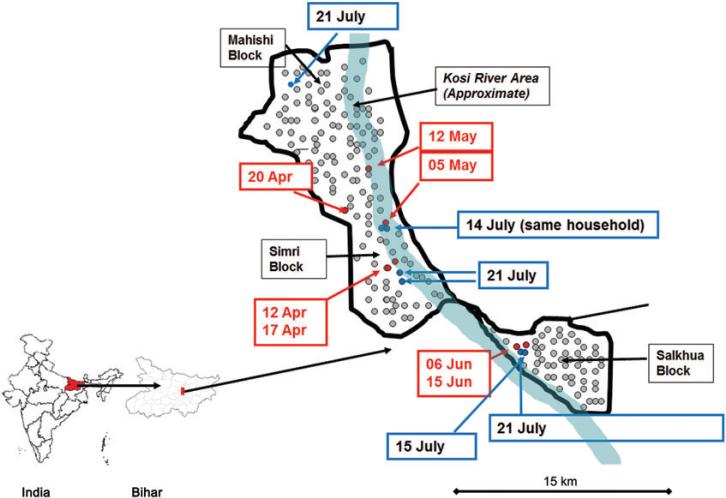
In Uttar Pradesh, stool specimens from asymptomatic household and neighborhood contacts of patients with laboratory-confirmed polio were tested for polioviruses. In Bihar, in community-based surveillance, children and adults from 250 randomly selected households in the Kosi River area provided stool and pharyngeal swab samples that were tested for polioviruses. A descriptive analysis of surveillance data was performed.
Results
In Uttar Pradesh, 89 of 1842 healthy contacts of case patients with polio (4.8%) were shedding wild poliovirus (WPV); 54 of 85 (63.5%) were ≥5 years of age. Shedding was significantly higher in index households than in neighborhood households (P < .05). In Bihar, 11 of 451 healthy persons (2.4%) were shedding WPV in their stool; 6 of 11 (54.5%) were ≥5 years of age. Mean viral titer was similar in older and younger children.
Conclusions
A high proportion of persons ≥5 years of age were asymptomatically shedding polioviruses. These findings provide indirect evidence that older individuals could have contributed to community transmission of WPV in India. Polio vaccination campaigns generally target children <5 years of age. Expanding this target age group in polio-endemic areas could accelerate polio eradication.
-
Subjects:
-
Source:J Infect Dis. 210(0 1):S252-S258.
-
Pubmed ID:25316843
-
Pubmed Central ID:PMC4663665
-
Document Type:
-
Funding:
-
Volume:210
-
Collection(s):
-
Main Document Checksum:urn:sha256:2154e607d4be99caab24ca4b77deece0c1c78bc65746922658745b8c5044290c
-
Download URL:
-
File Type:
 [PDF
- 288.53 KB
]
[PDF
- 288.53 KB
]
Supporting Files


ON THIS PAGE

CDC STACKS serves as an archival repository of CDC-published products including
scientific findings,
journal articles, guidelines, recommendations, or other public health information authored or
co-authored by CDC or funded partners.
As a repository, CDC STACKS retains documents in their original published format to ensure public access to scientific information.
As a repository, CDC STACKS retains documents in their original published format to ensure public access to scientific information.
You May Also Like
COLLECTION
CDC Public Access