


Clinically Unsuspected Prion Disease among Patients with Dementia Diagnoses in an Alzheimer’s Disease Database
Supporting Files

-
Aug 27 2015
-
Details
-
Alternative Title:Am J Alzheimers Dis Other Demen
-
Personal Author:
-
Description:Background
Brain tissue analysis is necessary to confirm prion diseases. Clinically unsuspected cases may be identified through neuropathologic testing.
Methods
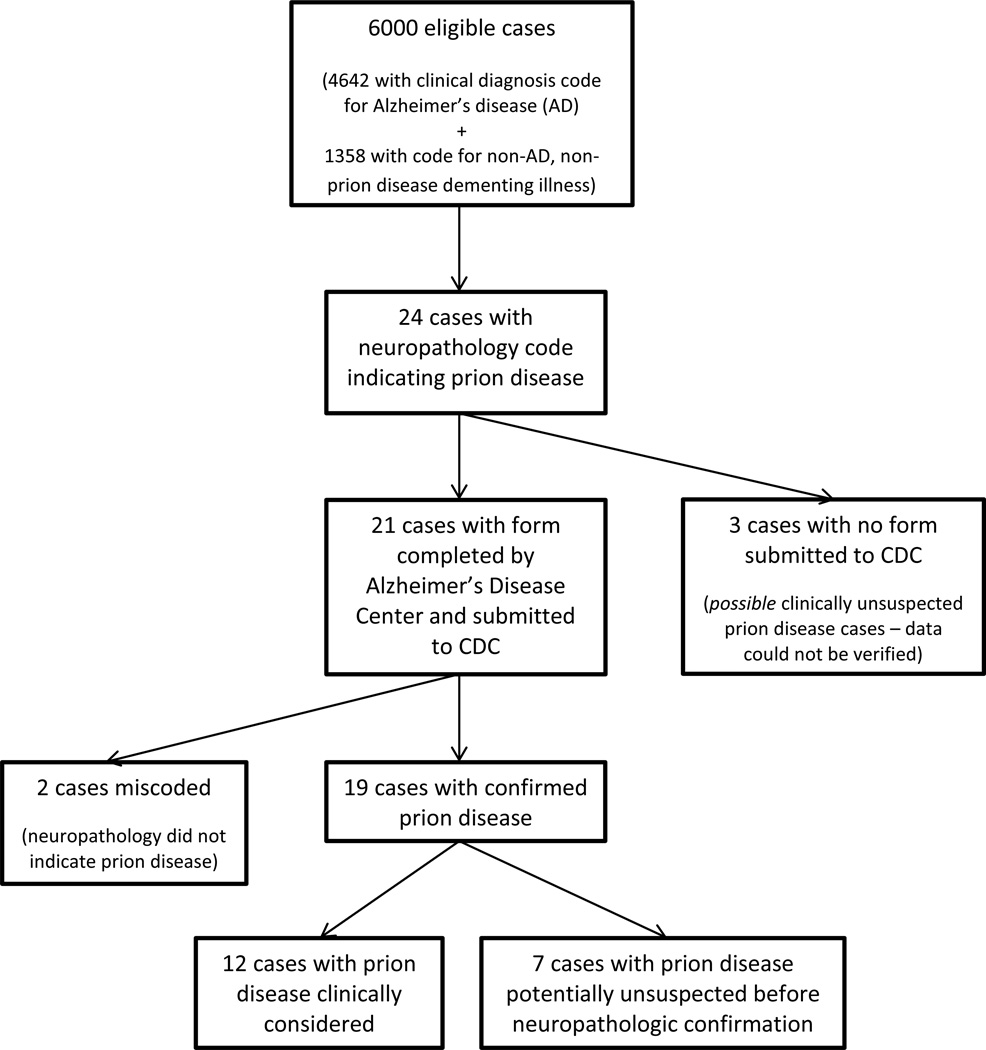
National Alzheimer’s Coordinating Center (NACC) Minimum and Neuropathologic Data Sets for 1984–2005 were reviewed. Eligible patients had dementia, underwent autopsy, had available neuropathologic data, belonged to a currently funded Alzheimer’s Disease Center (ADC), and were coded as having an Alzheimer’s disease clinical diagnosis or a non-prion disease etiology. For the eligible patients with neuropathology indicating prion disease, further clinical information, collected from the reporting ADC, determined whether prion disease was considered before autopsy.
Results
Of 6000 eligible patients in the NACC database, 7 (0.12%) were clinically unsuspected but autopsy confirmed prion disease cases.
Conclusion
The proportion of dementia patients with clinically unrecognized but autopsy confirmed prion disease was small. Besides confirming clinically suspected cases, neuropathology is useful to identify unsuspected, clinically atypical cases of prion disease.
-
Subjects:
-
Source:Am J Alzheimers Dis Other Demen. 30(8):752-755.
-
Pubmed ID:26320231
-
Pubmed Central ID:PMC4651736
-
Document Type:
-
Funding:
-
Volume:30
-
Issue:8
-
Collection(s):
-
Main Document Checksum:urn:sha256:68ac2c6a23d9c7952d9cfd88cd7e59ecf18208b8ed4b20a4dad757ffa696ace5
-
Download URL:
-
File Type:
 [PDF
- 435.78 KB
]
[PDF
- 435.78 KB
]
Supporting Files


ON THIS PAGE

CDC STACKS serves as an archival repository of CDC-published products including
scientific findings,
journal articles, guidelines, recommendations, or other public health information authored or
co-authored by CDC or funded partners.
As a repository, CDC STACKS retains documents in their original published format to ensure public access to scientific information.
As a repository, CDC STACKS retains documents in their original published format to ensure public access to scientific information.
You May Also Like
COLLECTION
CDC Public Access