


Epidemiology of pneumococcal serotype 6A and 6C among invasive and carriage isolates from Alaska, 1986–2009☆
Supporting Files

-
Dec 28 2012
-
File Language:
English
Details
-
Alternative Title:Diagn Microbiol Infect Dis
-
Personal Author:
-
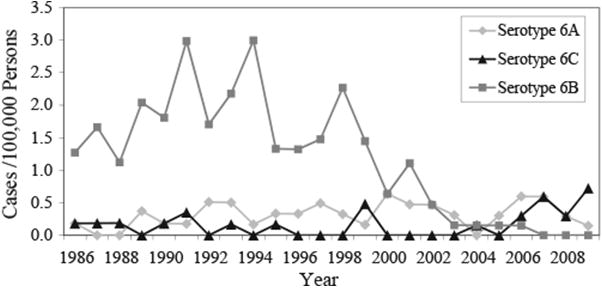
Description:We investigated serotype 6A/6C invasive pneumococcal disease (IPD) incidence, genetic diversity, and carriage before and after 7-valent pneumococcal conjugate vaccine (PCV7) introduction in Alaska. IPD cases (1986-2009) were identified through population-based laboratory surveillance. Isolates were initially serotyped by conventional methods, and 6C isolates were differentiated from 6A by polymerase chain reaction. Among invasive and carriage isolates initially typed as 6A, 35% and 50% were identified as 6C, respectively. IPD rates caused by serotype 6A or 6C among children <5 years did not change from the pre- to post-PCV7 period (P = 0.71 and P = 0.09, respectively). Multilocus sequence typing of IPD isolates revealed 28 sequence types. The proportion of serotype 6A carriage isolates decreased from 7.4% pre-PCV7 to 1.8% (P < 0.001) during 2008-2009; the proportion of serotype 6C carriage isolates increased from 3.0% to 8.4% (P = 0.004) among children <5 years. Continued surveillance is warranted to monitor changes in serotype distribution and prevalence.
-
Subjects:
-
Source:Diagn Microbiol Infect Dis. 75(3):271-276.
-
Pubmed ID:23276772
-
Pubmed Central ID:PMC4629818
-
Document Type:
-
Funding:
-
Place as Subject:
-
Volume:75
-
Issue:3
-
Collection(s):
-
Main Document Checksum:urn:sha256:476a15958f5e7280ad50ea15b7926a02f4026a231dc6357041b32fb84940467b
-
Download URL:
-
File Type:
 [PDF
- 467.87 KB
]
[PDF
- 467.87 KB
]
Supporting Files


File Language:
English
ON THIS PAGE



CDC STACKS serves as an archival repository of CDC-published products including
scientific findings,
journal articles, guidelines, recommendations, or other public health information authored or
co-authored by CDC or funded partners.
As a repository, CDC STACKS retains documents in their original published format to ensure public access to scientific information.
As a repository, CDC STACKS retains documents in their original published format to ensure public access to scientific information.
You May Also Like
COLLECTION
CDC Public Access